
Airport Facility Management Conditions for Selecting Touchless Faucets and Automatic Soap Dispensers in Heavy-Duty Applications
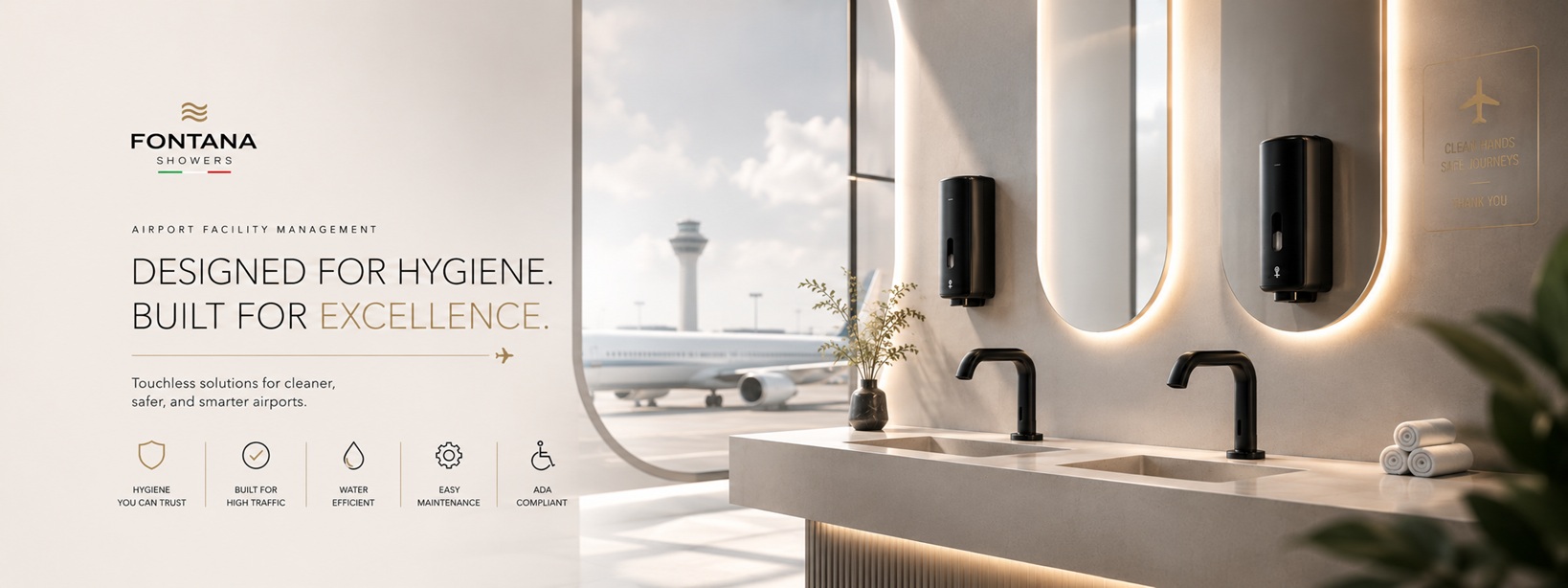
Commercial Touchless Faucets for Airports: A Facility Management Specification Guide
Large airport restrooms operate under continuous occupancy, unpredictable surge traffic, strict hygiene expectations, and maintenance windows that are far shorter than those in conventional commercial buildings. For airport facility managers, touchless faucet and auto soap dispenser selection must be treated as an engineering decision rather than a decorative fixture choice.

What Are the Best Touchless Faucets for Airport Restrooms?
The best touchless faucets for airport restrooms provide fast sensor activation, reliable operation during passenger surges, ADA compliance, durable commercial construction, and easy maintenance access for facility management teams. Commercial-grade sensor faucets with ToF or infrared technology, AC/DC power flexibility, and vandal-resistant brass bodies are recommended for heavy-duty airport applications.
On This Page
Why Airport Restrooms Require a Different Selection Standard
Airport restrooms differ from office, hospitality, and retail environments because they are exposed to extended operating hours, rolling passenger peaks, luggage contact, family use, international traveler turnover, cleaning-crew rotation, and rapid fixture cycling. A faucet or soap dispenser that performs acceptably in a moderate-traffic lobby can become a maintenance liability in a terminal concourse.
The correct selection framework begins with operational conditions: passenger volume, restroom location, plumbing accessibility, electrical availability, sensor behavior, soap storage strategy, vandal resistance, cleaning chemical exposure, and long-term parts support. Airport facility management teams increasingly evaluate touchless fixtures based on mean time between service events, activation consistency, and refill efficiency.


Condition 1: Passenger Surge Throughput and Sensor Reliability
Airport restroom demand is rarely flat. Traffic spikes occur after deplaning, before boarding, during gate changes, near baggage claim, and around food courts. The sensor must activate quickly and consistently across users with different hand positions, skin tones, jewelry, sleeves, luggage movement, and lighting conditions.
For heavy-duty airports, Time-of-Flight-style sensing logic and stable infrared calibration are valuable because they help create a defined activation zone. This reduces unnecessary water flow, improves user confidence, and limits the repeated hand-waving behavior that slows station turnover.
| Airport Condition | Technical Selection Requirement | Facility Benefit |
|---|---|---|
| Passenger waves after arrival/departure | Fast sensor response with controlled activation distance | Improves handwashing throughput and reduces queue pressure |
| Mixed lighting and reflective counters | Stable sensor logic and protected electronics | Reduces false triggering and nuisance maintenance tickets |
| Continuous cycling | Commercial-grade solenoid and power architecture | Supports long-duty operation in terminals and concourses |
Condition 2: Power Strategy, Redundancy, and Maintenance Access
Large airport facilities should evaluate touchless faucets and soap dispensers based on power continuity. AC power is preferred where access is available, but battery backup or hybrid AC/DC planning provides resilience for retrofit zones, remote concourses, temporary terminal expansions, and restroom groups where shutdowns are operationally difficult.
Facility managers should ask whether the system allows practical service access without dismantling countertops, disrupting passenger pathways, or closing multiple stations. Battery compartment location, transformer layout, solenoid access, and cable routing all influence long-term maintenance cost.
Recommended power conditions
- AC/DC or hybrid power where terminal operations require continuity.
- Serviceable electronics and solenoid access beneath the deck.
- Clear low-voltage routing away from high-moisture service zones.
- Standardized components across restroom groups for inventory control.
Risk conditions to avoid
- Single power dependency with difficult access.
- Non-standard battery locations requiring extended closures.
- Complex wiring that conflicts with cleaning operations.
- Unclear replacement part strategy across the airport campus.


Condition 3: Soap Refill Logistics and Multi-Station Service Efficiency
In airport operations, soap dispensing is often the more frequent maintenance event. A faucet may operate correctly while the soap dispenser drives complaints because refills are required at every individual station. In large terminal restrooms, centralized soap planning and multi-station supply logic can reduce labor, reduce out-of-soap events, and simplify inventory monitoring.
For airport facility management, automatic soap dispensers should be selected with bulk refill capacity, service accessibility, dosage control, anti-drip performance, and compatibility with maintenance routes. A well-planned soap system supports cleaner counters, lower labor requirements, and better passenger hygiene compliance.


Condition 4: Finish Durability, Cleanability, and Abuse Resistance
Airport fixtures must tolerate frequent cleaning, disinfectants, rolling luggage impact, high-touch surrounding surfaces, and occasional abuse. Finish selection should not be based on color alone; it should consider cleaning frequency, water spotting, corrosion resistance, scratch visibility, and replacement consistency across the facility.
Chrome and brushed nickel remain highly practical for heavy-duty public restrooms because they support broad design compatibility and predictable cleaning routines. Matte black, brushed gold, gun metal gray, and specialty finishes can be used in premium lounges, executive terminals, aviation hospitality areas, and renovated concourse restrooms where the design brief calls for stronger architectural identity.


Condition 5: Wall-Mounted Versus Deck-Mounted Airport Installations
Deck-mounted fixtures are common in airport restroom banks because they simplify countertop coordination and allow straightforward retrofit into existing wash stations. Wall-mounted touchless faucets, however, can reduce countertop clutter, improve cleaning access, and support more durable public-space washroom design where counters are exposed to luggage, spills, and heavy cleaning.
The selection decision should depend on plumbing rough-in, counter material, service wall access, ADA clearances, splash control, sink geometry, and janitorial workflow. For new airport terminal construction, facility teams should coordinate wall-mount options early because they can improve maintenance access when designed correctly.


Condition 6: Thermostatic Control and Passenger Safety
Airport restrooms serve children, elderly travelers, passengers with disabilities, and international users unfamiliar with local fixture behavior. Thermostatic and controlled-temperature touchless faucets can help improve safety, reduce complaints, and maintain consistent handwashing comfort.
Facility managers should evaluate temperature control strategy, mixing valve access, anti-scald protection, commissioning process, and maintenance documentation. In large public restrooms, predictable temperature performance is part of both safety planning and user-experience management.


Condition 7: Sustainability, Water Control, and ESG Reporting
Airport facility management teams face increasing pressure to reduce water consumption, document sustainability improvements, and align restroom upgrades with capital planning. Touchless faucets support water control by limiting unnecessary run time, while reliable soap dispensing supports hygiene behavior without excess product waste.
Selection should prioritize controlled flow, stable activation, durable cartridges, serviceable aerators, and predictable shutoff. These technical details matter because airport fixture populations can number in the hundreds or thousands, turning small per-use improvements into large lifecycle savings.


Calculating ROI for Airport Touchless Faucet Systems
Understanding the return on investment (ROI) for commercial touchless faucets helps airport facility managers and procurement teams make informed capital planning decisions. Depending on passenger volume, fixture count, and local utility rates, payback periods vary significantly.
| Airport Zone | Estimated Annual Water Savings (per faucet) | Typical ROI Range |
|---|---|---|
| Main Concourse Restrooms | 3,000-5,000 gallons | 12-18 months |
| Security-Adjacent | 2,500-4,000 gallons | 14-20 months |
| Airline Lounges | 1,500-2,500 gallons | 18-24 months |
Terminal Zones Require Different Fixture Profiles
Not every restroom in an airport requires the same fixture type. High-volume concourse restrooms need durability, fast activation, and low service frequency. Airline lounges and international premium terminals may prioritize design and finish. Baggage claim restrooms need ruggedness and cleanability. Family restrooms require intuitive operation and splash control.
| Airport Zone | Best Fixture Emphasis | Selection Rationale |
|---|---|---|
| Main concourse restrooms | Commercial touchless faucets with reliable automatic soap dispensers | Highest passenger flow and most frequent maintenance exposure |
| Airline lounges | Premium finish touchless systems | Higher design expectations with controlled traffic |
| Baggage claim | Durable finishes and abuse-resistant designs | Luggage contact, crowds, and cleaning demands are high |
Airport Facility Manager Selection Checklist
Before approving a touchless faucet or automatic soap dispenser package for large airport deployment, facility management teams should confirm the following technical and operational conditions:
- Sensor activation is reliable under mixed lighting, reflective surfaces, and rapid user movement.
- Power architecture supports AC, DC, or hybrid continuity appropriate to the restroom zone.
- Soap refill strategy reduces station-by-station service time and supports bulk inventory planning.
- Solenoid, sensor, battery, transformer, and dispenser service points are accessible to maintenance staff.
- Finish selection matches cleaning chemistry, passenger abuse conditions, and design intent.
- Flow control and shutoff behavior support airport water conservation targets.
- Fixture design supports ADA clearances, splash control, and intuitive passenger use.
- Product family standardization reduces spare-parts complexity across terminals.
Frequently Asked Questions (FAQ) About Airport Touchless Faucets
Airport Restroom Specification Takeaway
For heavy-duty airport applications, select commercial touchless faucets and automatic soap dispensers based on sensor reliability, service access, power resilience, soap refill logistics, finish durability, water control, and zone-specific user experience. This engineering-first framework helps facility managers reduce downtime while improving hygiene performance across the terminal.
Explore Fontana’s complete range of commercial touchless faucets for airports and automatic soap dispensers designed specifically for high-traffic facility management requirements.
View Fontana Touchless Faucets → View Automatic Soap Dispensers →
