



Commercial Specification
Specifying a commercial automatic soap dispenser requires more than selecting a touchless fixture from a catalog. Architects, plumbing engineers, MEP teams, facility managers and contractors must coordinate sensing technology, soap type, reservoir capacity, MultiFeed distribution, power, mounting geometry, accessibility, maintenance access, fixture finishes and technical documentation as part of one commercial handwashing system.
Commercial Automatic Soap Dispenser Installation & Commissioning Checklist: Sensor, Dose, Power, Reservoir, MultiFeed & ADA
A commercial automatic soap dispenser can be correctly mounted and still be poorly commissioned. The sensor may detect the basin instead of the user’s hand, the tank may be installed at the wrong elevation, the pump may contain air, the soap may be incompatible, the dose may be excessive, or under-counter equipment may interfere with accessible clearances. This guide provides a systematic installation, startup, testing and turnover checklist for architects, MEP engineers, contractors, commissioning teams and facility managers.

Installation Is Not the Same as Commissioning
A fixture can look completely finished from above the countertop while still having serious operational problems beneath it.
Phase 1 — Pre-Installation & Rough-In Checklist
Do not rough-in from a generic automatic soap-dispenser detail when model-specific requirements are available.
Deck mount, wall mount, integrated faucet/soap system or centralized MultiFeed.
Use the selected model’s current installation sheet rather than an assumed hole size.
Reserve space for reservoir, pump, transformer, tubing, drains and future service.
Battery, AC, DC, transformer or hybrid system as applicable.
Liquid, foam or other manufacturer-approved formulation and viscosity.
Coordinate dispenser reach, counter depth and under-counter equipment before construction.
Fontana’s current Touchless Soap Dispenser Technical Sheet hub is specifically organized for architects, engineers and contractors and includes rough-in, power, sensing, soap-viscosity, mounting, downloads and commissioning topics.
Verified Touchless Technical Sheet Hub
Phase 2 — Coordinate Accessibility Before Drilling the Counter
The U.S. Access Board states that when soap dispensers are provided at accessible lavatories, they must be located within the applicable reach ranges and conveniently usable by a person using the accessible lavatory.
Accessible lavatories also require the applicable clear floor space and knee and toe clearance.
The Access Board’s detailed lavatory guidance explains that knee and toe space must extend deep enough to support the required forward reach to soap dispensers and other operable parts.
Mount the Visible Dispenser Correctly
Confirm orientation, finish protection, deck or wall attachment, and the relationship between the soap outlet and basin.
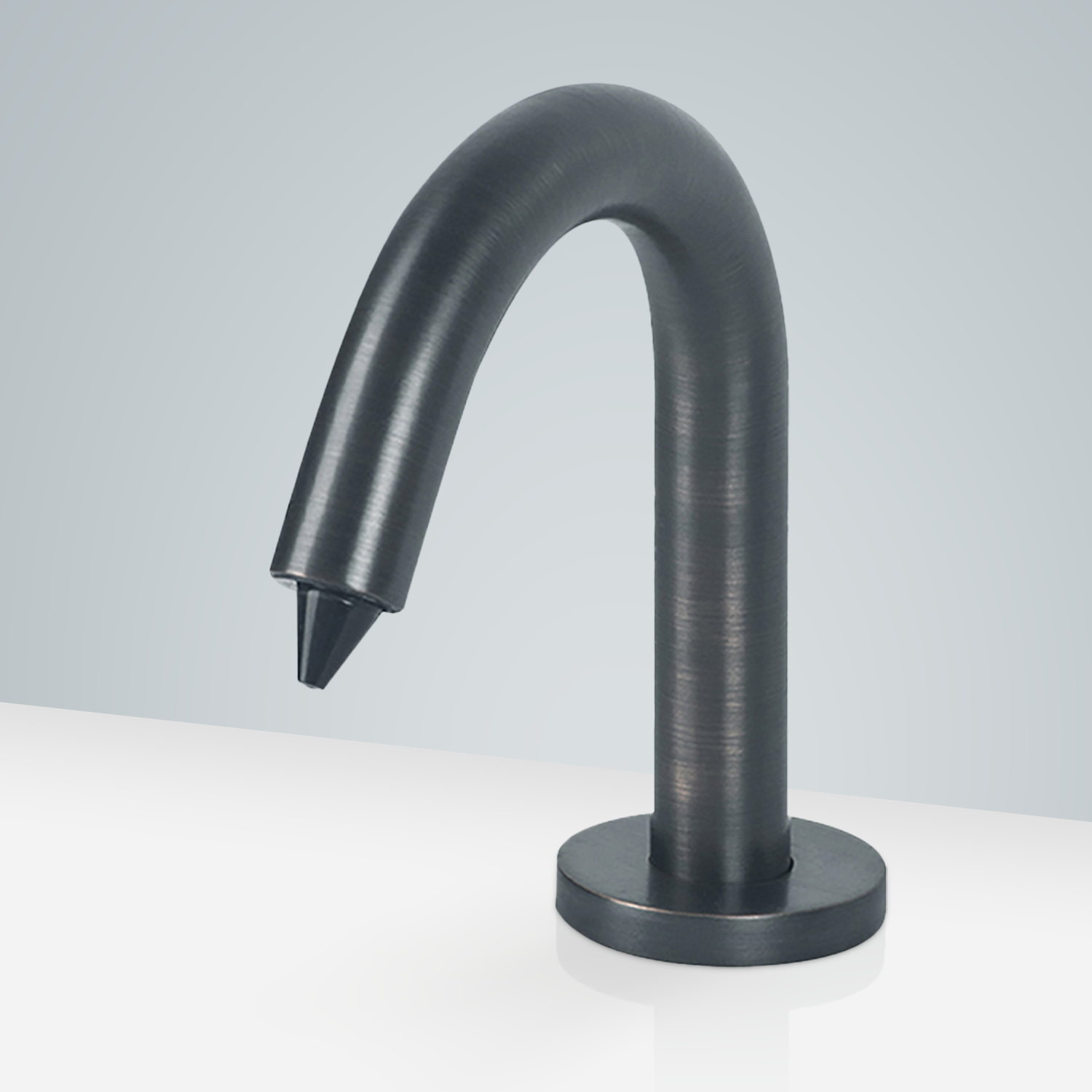
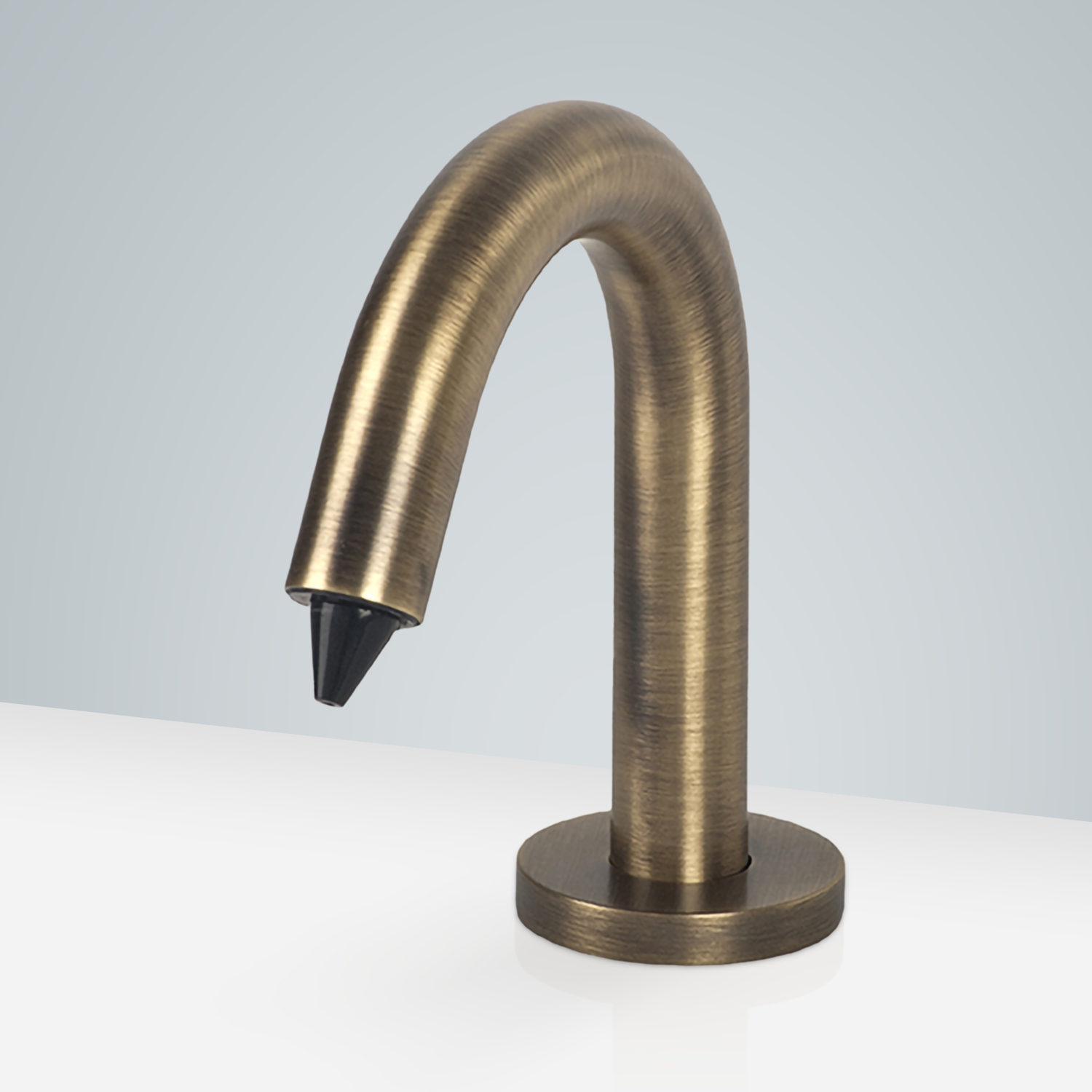
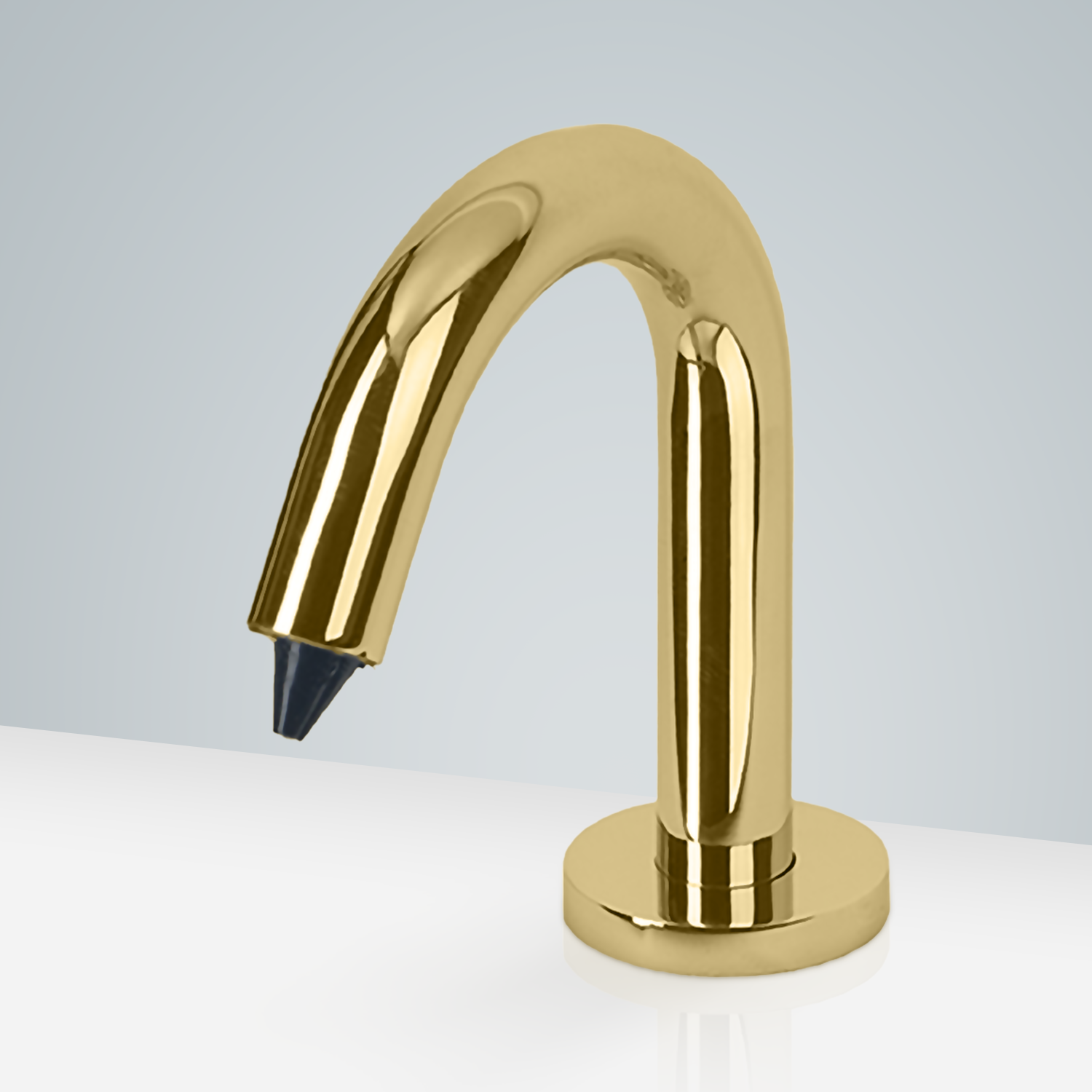
Fontana’s current Atlanta commercial deck-mount installation guide instructs installers to inspect the product before installation and follow the model-specific installation sequence and hole-size requirements.
Verified Atlanta Installation Guide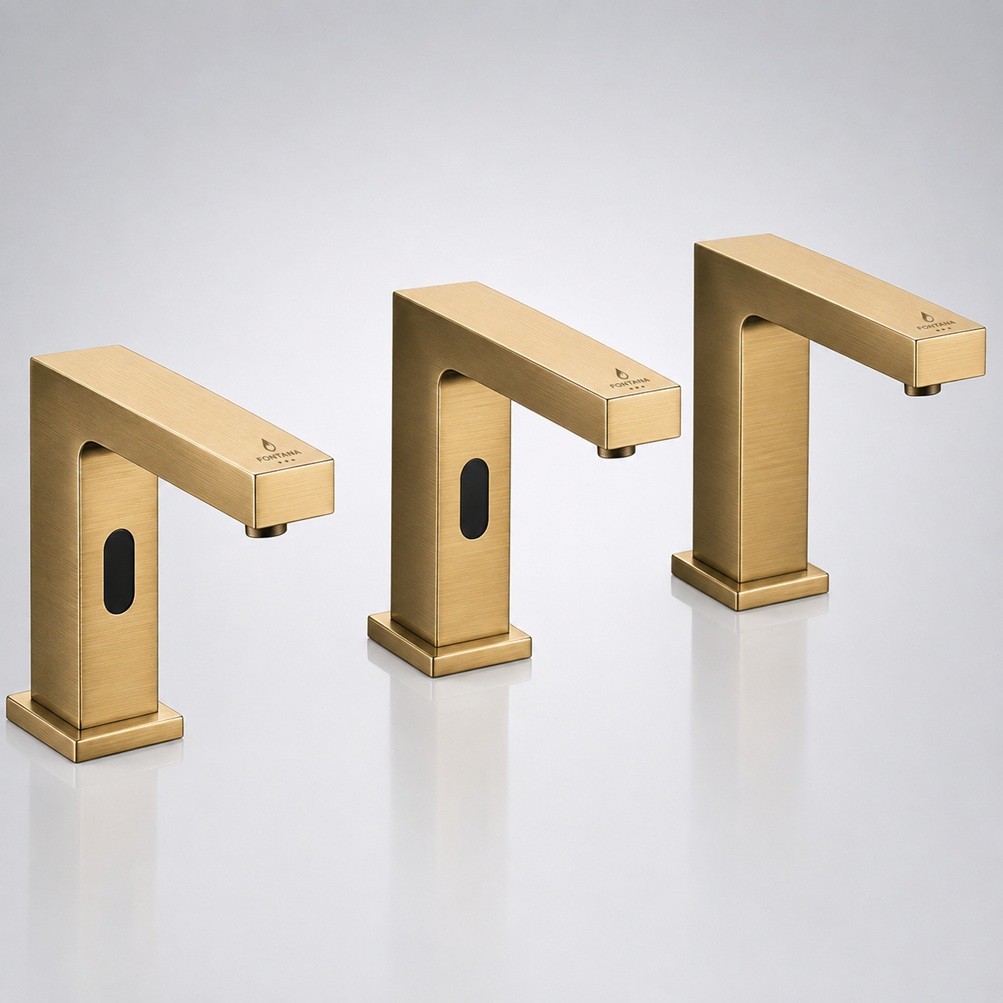
Install the Soap Reservoir in the Correct Location
Reservoir placement influences priming, serviceability and future maintenance.
Fontana’s current FS1018 automatic soap-dispenser installation guidance gives a particularly important installation instruction: the soap tank feeding the dispenser should be mounted below the level of the dispenser rather than above it.
Route Soap Tubing for Serviceability
Tubing should move soap reliably without becoming an inaccessible future maintenance problem.

Phase 3 — MultiFeed Installation & Branch Commissioning
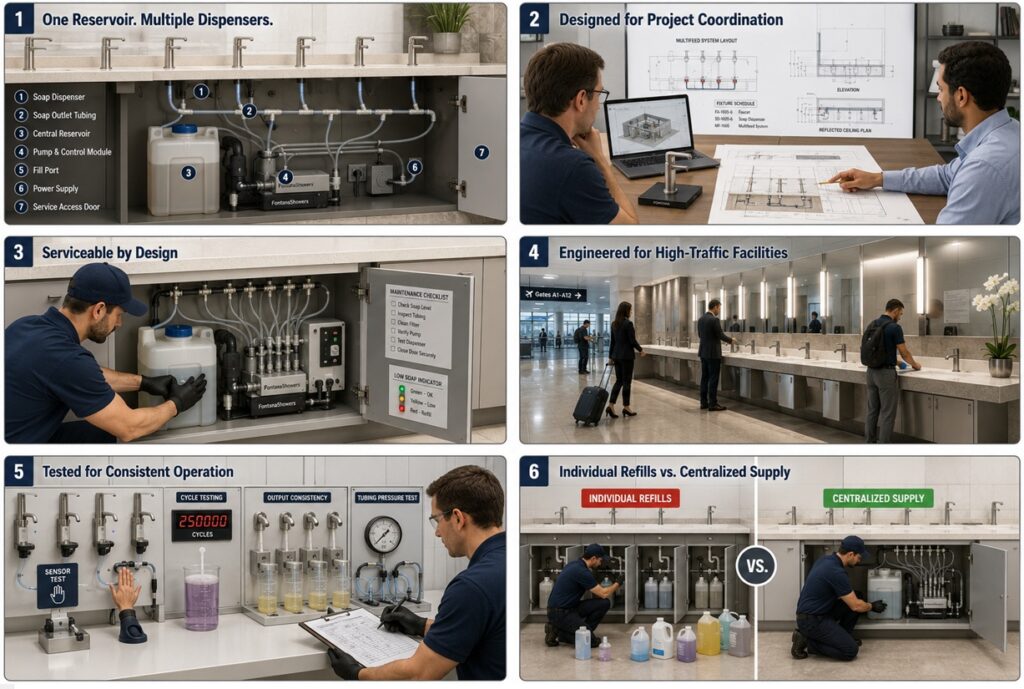
A centralized system must be commissioned as a network rather than as one large soap bottle.
Fontana’s live MultiFeed guidance describes multiple automatic dispensers connected to one central reservoir and emphasizes reservoir, pump, manifold, tubing, maintenance access and connected-dispenser operation as part of the system architecture.
Verify the installed tank matches the approved project configuration.
Do not exceed the manufacturer-approved architecture.
Future troubleshooting becomes much faster when each line is identifiable.
Look for loose fittings, kinks and leak points.
Do not assume one successful head proves all branches are primed.
Record any branch with slower prime, lower output or inconsistent response.
Fill and Prime the Soap System
A newly installed automatic dispenser may be mechanically perfect but appear broken until the soap path is properly primed.
Fontana’s current installation guidance instructs users to fill the soap bottle and operate the priming/control button until liquid soap reaches the nozzle. Its current reset guide similarly tells service teams to inspect the pickup tube and nozzle and re-prime the pump where required.
Verify the Actual Soap Formulation
The system should be commissioned using the same soap formulation intended for normal facility operation.
Fontana’s installation guidance warns against changing or mixing soap types without thoroughly flushing and cleaning the previous formulation from the system, because mixing formulations can change their chemical characteristics.
Phase 4 — Sensor Commissioning Must Occur in the Finished Restroom
Sensor commissioning before the basin, countertop, mirror and permanent lighting are installed can miss real field problems.
| Sensor Test | Pass Condition | Failure Concern |
|---|---|---|
| Normal hand approach | Immediate predictable activation | Range too short or delayed detection |
| Empty basin | No activation | Background/basin false trigger |
| Wet basin | Stable behavior | Reflection or water-related false sensing |
| Adjacent faucet activation | Soap sensor remains independent | Confusing overlapping detection zones |
| Repeated users | System resets normally | Slow recovery or missed second user |
| Hand left in zone | Model behaves as designed | Repeated uncontrolled dispensing |
Fontana’s current technical specification hub includes sensing range among the coordination topics architects and contractors should verify.
Sensor & Rough-In Technical ResourcesSet and Verify the Soap Dose
A dispenser should not be turned over with an unknown or arbitrary output setting.
Record the initial manufacturer setting before adjustment.
Viscosity can influence real output on some systems.
Do not assess dose from only one activation.
Avoid such a small dose that users instinctively trigger the dispenser twice.
The facility team should know what the commissioned dose is intended to be.

Verify Power, Batteries and Service Access
A powered dispenser needs more than an electrical connection—it needs a maintainable electrical connection.
Current Fontana commercial products document multiple power architectures, including battery and AC/DC configurations depending on model, reinforcing the need for model-specific electrical coordination.
Phase 5 — Final Functional Test Before Handover
| Commissioning Test | Minimum Verification | Status |
|---|---|---|
| Mounting | Fixture secure and correctly oriented | □ PASS □ FAIL |
| Sensor | Predictable hand detection with no obvious false activation | □ PASS □ FAIL |
| Pump | Normal sound and consistent operation | □ PASS □ FAIL |
| Prime | No recurring air gaps preventing output | □ PASS □ FAIL |
| Dose | Consistent acceptable quantity | □ PASS □ FAIL |
| Nozzle | Clean discharge with no abnormal drip | □ PASS □ FAIL |
| Reservoir | Secure, accessible and correctly positioned | □ PASS □ FAIL |
| Tubing | No leaks, kinks or loose connections | □ PASS □ FAIL |
| Power | Stable operation and accessible service components | □ PASS □ FAIL |
| Accessibility | Dispenser reach and under-counter equipment coordinated | □ PASS □ FAIL |
MultiFeed Final Test: Do Not Test Only the Nearest Dispenser
Centralized systems should be tested at every connected position.
Healthcare Commissioning: Include the Refill Procedure in Handover
CDC states that liquid soap should not be added to partially empty soap dispensers because topping-off practices have been associated with outbreaks of pathogenic bacteria.
For healthcare projects, commissioning should therefore verify not only that soap dispenses, but also that facility staff understand the approved refill and cleaning procedure.
Phase 6 — Facility Handover Checklist
A successfully commissioned system can become a maintenance problem within months if its settings and service information never reach the building operations team.
Specify Products With Complete Technical Documentation
A commercial dispenser is much easier to coordinate and maintain when the manufacturer provides more than a sales image.
Current Fontana commercial product pages provide examples of a full project documentation set including:
10 Installation & Commissioning Errors to Avoid
| Error | Likely Result |
|---|---|
| 1. Tank installed at incorrect elevation | Flow/priming problems |
| 2. Soap changed after commissioning | Different viscosity, dose or pump behavior |
| 3. System never properly primed | Pump appears to operate without soap delivery |
| 4. Sensor tested before final basin installation | False activation discovered after completion |
| 5. Dose never recorded | Facility cannot maintain intended consumption |
| 6. Transformer hidden permanently | Difficult future electrical service |
| 7. MultiFeed branches not labeled | Slow troubleshooting later |
| 8. Accessible knee space occupied | Potential accessibility conflict and retrofit cost |
| 9. Only one MultiFeed head tested | Branch problems discovered after opening |
| 10. O&M documentation not transferred | Facility staff guess at soap, settings and maintenance |
Verified Fontana Installation & Commissioning Resources
Every internal URL below was verified before inclusion.
Rough-in, mounting, power, sensing range, soap viscosity and commissioning reference for AEC teams.
Technical Sheet HubCentral reservoir, manifold, tubing, multi-head operation and service planning.
MultiFeed EngineeringModel-specific deck-mount automatic soap-dispenser installation instructions.
Installation GuideFontana installation, priming, care and reservoir-location guidance.
Install & Care GuidePower reset, nozzle inspection, pump priming and pickup-line diagnostics.
Reset & PrimePower, sensor, clog, soap-viscosity and pump troubleshooting.
TroubleshootingCommercial Automatic Soap Dispenser Research Series
These verified Fontana and Blogs.FontanaShowers resources extend the installation and commissioning workflow into operation and maintenance.
Current Fontana commercial automatic soap-dispenser products and project resources.
Browse Automatic SoapCalculate refill intervals from traffic, capacity, dose and reserve.
Refill Frequency GuideSizing guidance for individual and centralized commercial soap reservoirs.
Reservoir Capacity GuideInternal navigation to product, install, architect and MultiFeed resources.
Touchless Soap HubCurrent product example with BIM, specification, installation, maintenance, rendering and warranty documentation.
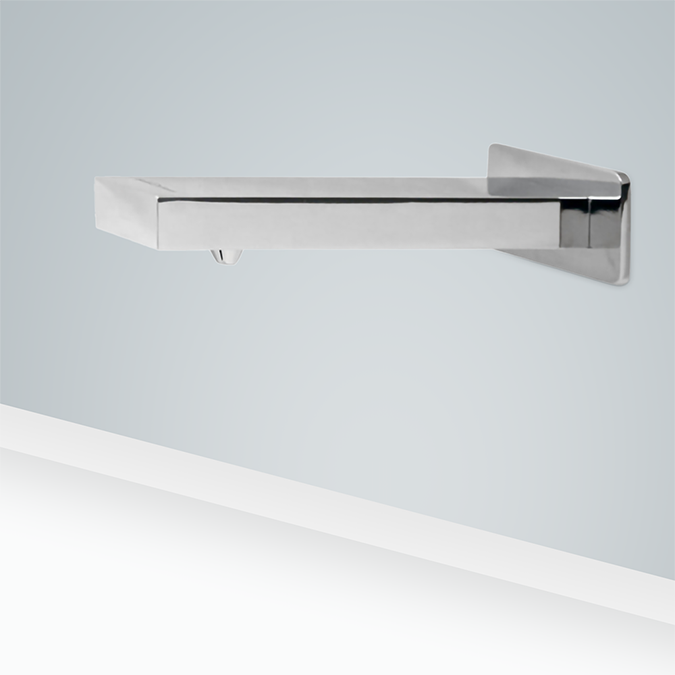
Commercial SystemHeavy-duty wall-mounted automatic soap dispenser with technical project resources.
Wall-Mount SystemAutomatic Soap Dispenser Installation & Commissioning FAQ
Should a commercial soap dispenser be commissioned after installation?
Yes. Installation confirms that the hardware is physically mounted. Commissioning verifies actual sensor response, soap flow, prime, dose, power, reservoir operation and serviceability in the finished restroom.
Where should the soap reservoir be mounted?
Follow the specific manufacturer instructions. Current Fontana installation guidance for applicable systems instructs installers to mount the soap tank below the level of the dispenser rather than above it.
Why does a new automatic soap dispenser make noise but not dispense?
The system may not yet be primed, the pickup line may contain air, the reservoir may be incorrectly positioned, or a connection may be loose.
When should sensor range be tested?
Final sensor testing should occur after the actual basin, countertop, nearby fixtures and permanent lighting are installed.
Should dose be adjusted during commissioning?
Where the selected model permits adjustment, verify output with the approved soap and document the final accepted setting for facility operations.
Should every MultiFeed head be tested?
Yes. Every connected dispensing position should be tested individually because a local branch-line, prime, connection, sensor or nozzle problem may affect only one head.
Can the soap formulation be changed later?
Only within manufacturer requirements. If a formulation changes, the system may require flushing, cleaning, repriming and recommissioning of dose and pump performance.
Can the soap reservoir occupy accessible knee space?
Accessible lavatory knee/toe clearance and reach requirements must be preserved. Under-counter soap equipment should be coordinated around those required spaces.
What should be handed over to the facility manager?
Provide model numbers, technical sheets, installation instructions, approved soap information, reservoir capacity, dose and sensor settings, power information, MultiFeed diagrams where applicable, reset procedures, maintenance requirements, spare parts and warranty documents.
What is the biggest commissioning mistake?
One of the biggest mistakes is confirming only that soap dispenses once. Commercial commissioning should verify repeatable sensing, stable dose, service access, power, prime, tubing and operation across all connected dispensing positions.
Final Recommendation: Do Not Handover an Untested Soap System
Commercial automatic soap dispensers should be treated like other powered building systems: install them correctly, commission them under actual operating conditions, document the final settings and hand the system over with complete O&M information.
For an individual automatic dispenser, commissioning should verify: mounting, reservoir, power, sensor, soap, prime, dose, nozzle and service access.
For a centralized MultiFeed installation, add: tank capacity, manifold labeling, tubing integrity, branch priming, every connected dispensing head and shared-system failure response.
For accessible lavatories, verify that the dispenser remains within applicable reach requirements and that under-counter equipment does not compromise the required accessible space.
And for healthcare environments, ensure the refill and cleaning process is part of the O&M handover rather than leaving staff to invent a procedure later.

Commercial Automatic Soap Dispenser Installation Planning
Successful automatic soap dispenser installation begins with coordinated rough-in planning. Contractors should verify mounting position, sensor clearance, power source, soap reservoir access, countertop or wall penetrations, and service space before final installation. Multi-feed configurations also require properly planned tubing routes between the centralized soap reservoir and each dispensing point to support reliable operation and future maintenance.

Commissioning Automatic Soap Dispensers Before Handover
Commissioning should confirm consistent sensor activation, correct soap delivery, secure connections, suitable power operation, and accessible maintenance components. Each dispensing station should be tested repeatedly under normal operating conditions. For centralized multi-feed installations, contractors should also verify tubing integrity and soap delivery across every connected dispenser before the commercial restroom is released for regular facility operation.
Related Commercial Automatic Soap Dispenser Installation Guides