


Commercial Specification
Specifying a commercial automatic soap dispenser requires more than selecting a touchless fixture from a catalog. Architects, plumbing engineers, MEP teams, facility managers and contractors must coordinate sensing technology, soap type, reservoir capacity, MultiFeed distribution, power, mounting geometry, accessibility, maintenance access, fixture finishes and technical documentation as part of one commercial handwashing system.
Commercial Automatic Soap Dispenser BIM & Specification Guide: What Architects, MEP Engineers & Contractors Must Put in the Submittal
A commercial automatic soap dispenser should not enter a project specification as a vague line item such as “touchless soap dispenser by approved manufacturer.” The submittal needs enough technical information to coordinate the fixture with the countertop, basin, power source, soap formulation, sensor zone, accessible reach, reservoir, pump, MultiFeed infrastructure and future maintenance. This guide defines the BIM, specification, submittal and closeout information project teams should request before approving a commercial touchless soap system.

The Specification Should Define Performance Before a Product Is Approved
The purpose of a commercial soap-dispenser specification is not merely to name a manufacturer. It should define the technical and operational conditions the system must satisfy.
Minimum Commercial Automatic Soap Dispenser Submittal Package
For a substantial commercial project, the submittal should contain more than one product-data sheet.
Exact model, finish, mounting type, capacity and primary operating characteristics.
Overall fixture dimensions, deck/wall interface and under-counter components.
Coordinate geometry, mounting position, service zone and project information requirements.
Include deck opening, mounting, tank, tubing, power and priming requirements.
Battery type, transformer, voltage, input requirements and service-access needs.
Liquid or foam formulation, viscosity range and chemical restrictions.
Sensor architecture, detection range and adjustment or commissioning requirements.
Factory dose and adjustment range where applicable.
Nominal capacity, usable configuration and refill method.
Cleaning, reset, priming, troubleshooting and service instructions.
Coverage period and applicable conditions.
Identify field-serviceable pumps, sensors, tubing and power components where available.
What a Complete Manufacturer Documentation Set Can Look Like
Current Fontana commercial product pages provide a useful example of the level of documentation that can support a project submittal.
Current automatic soap-dispenser product pages may include:
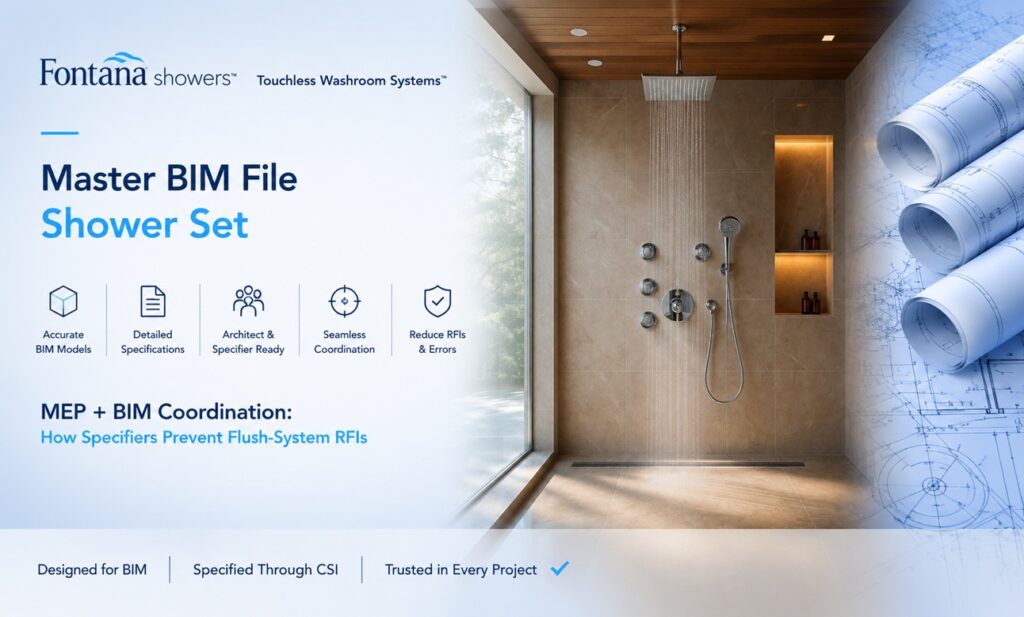
What Should Be in the BIM / Revit Object?
A useful BIM object should provide more value than a visually accurate spout. For a commercial automatic soap system, project teams may need information about both the visible fixture and the hidden infrastructure.
| BIM Information | Why It Matters | Recommended Project Use |
|---|---|---|
| Accurate visible geometry | Coordinates with sink, counter and backsplash | Architectural model |
| Mounting point | Locates required deck/wall interface | Millwork / countertop coordination |
| Spout reach | Influences soap landing zone and basin relationship | Architectural coordination |
| Hidden reservoir envelope | Protects service and cabinet space | MEP / interiors coordination |
| Pump / transformer envelope | Prevents conflicts with drains and supplies | MEP coordination |
| Service-clearance zone | Protects future maintenance access | Facility-oriented design review |
| Model / manufacturer data | Links modeled object to approved equipment | Schedules and asset data |
| Power requirement | Coordinates electrical infrastructure | Electrical / plumbing coordination |
| Reservoir capacity | Supports maintenance and sizing | Specification / asset information |
| Maintenance data | Can support facility handover requirements | Closeout / operations |
The National Institute of Building Sciences’ current NBIMS-US™ Project BIM Requirements framework emphasizes defining required BIM deliverables, model requirements and data deliverables at the project level. Apply that same discipline to restroom equipment: specify what information the automatic soap-dispenser model must deliver instead of requesting “a BIM file” with no defined purpose.
NIBS Project BIM Requirements NIBS BIM Execution PlanningDo Not Over-Model What the Project Does Not Need
A soap-dispenser BIM object should contain sufficient geometry and information to support the intended BIM use, but unnecessary modeled detail can increase file complexity without improving coordination.
NIBS’ current BIM framework distinguishes project BIM requirements, BIM uses, model deliverables and data deliverables. That provides a useful basis for defining restroom-equipment BIM content according to its actual project purpose.
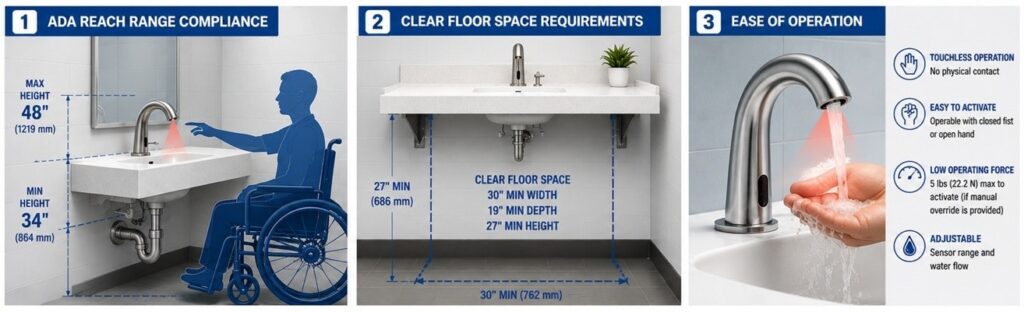
Performance Requirements That Belong in the Specification
| Requirement | Specify | Why |
|---|---|---|
| Activation | Touch-free sensor operation | Defines basic control architecture |
| Sensor Range | Manufacturer range / adjustment information | Supports basin coordination and commissioning |
| Response | Prompt normal user activation | User experience and high-traffic operation |
| Soap Type | Liquid or foam | Pump and formulation compatibility |
| Viscosity | Manufacturer-supported range | Influences pumping and dose |
| Dose | Published or adjustable output | Lifecycle cost and refill frequency |
| Power | Battery / AC / DC / transformer | MEP coordination |
| Capacity | Individual reservoir or central tank | Maintenance and demand planning |
| Pump Type | Manufacturer pump architecture | Service and soap compatibility |
| Finish | Approved project finish | Architectural consistency |
| Maintenance Access | Required service access | Lifecycle serviceability |
| Commissioning | Final installed sensor/dose test | Confirms actual field performance |
Example of the Detail a Commercial Specification Can Contain
A current Fontana commercial specification for product FS10045G demonstrates the level of model-specific information that can be useful in a submittal.
This kind of information allows the specifier to evaluate whether a substitute actually matches the performance of the basis-of-design system rather than comparing finish and appearance alone.
Division 10 or Division 22? Coordinate the Specification Instead of Assuming
Commercial soap dispensers can appear in different specification locations depending on the system architecture and project practice.
Fontana’s current bid-document specification guide specifically addresses coordination of touchless faucets and soap dispensers within architectural and plumbing bid documents.
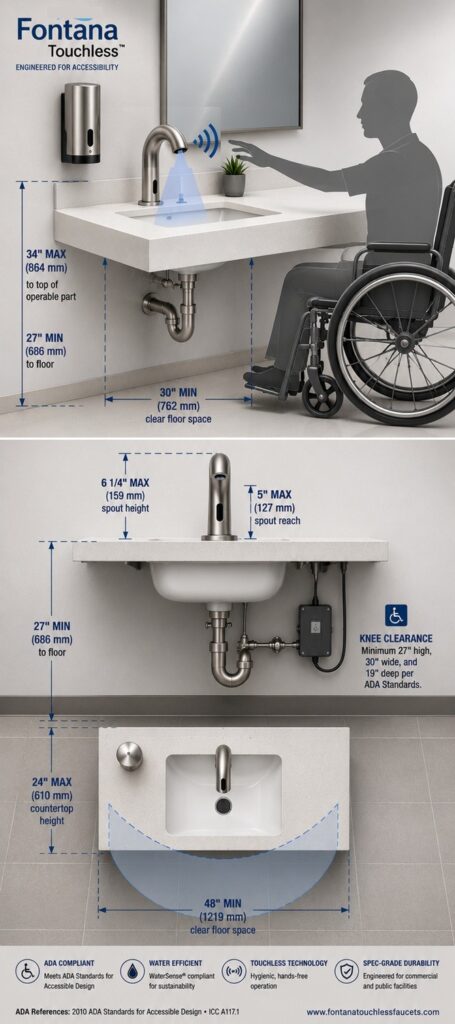
ADA Coordination Belongs in Design — Not in the Punch List
The U.S. Access Board states that when soap dispensers are provided at an accessible lavatory, they must be located within applicable reach ranges and conveniently usable from the accessible lavatory.
The accessible lavatory also requires compliant clear floor space and knee/toe clearance.
Its detailed lavatory guidance explains that knee and toe space must be deep enough to support the required reach to soap dispensers and other operable parts.
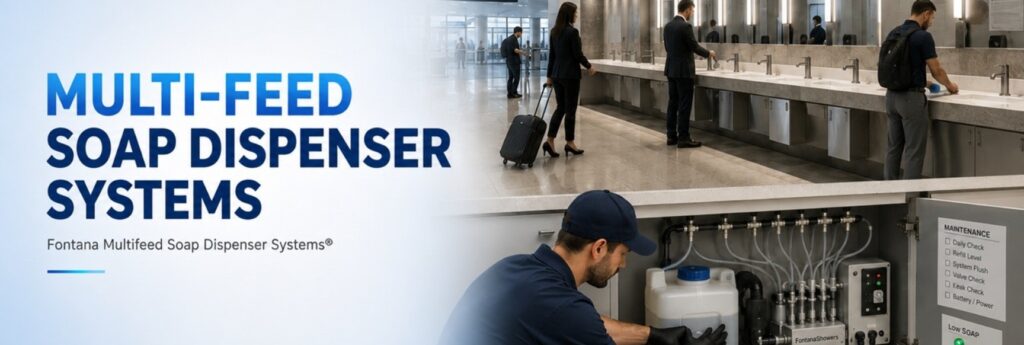
MultiFeed Requires a System Specification, Not Just a Dispenser Specification
When several automatic dispensers share a central soap source, the specification should define the complete dispensing architecture.
| MultiFeed Requirement | Submittal Information Needed |
|---|---|
| Maximum Connected Heads | Manufacturer-approved number of dispensing positions. |
| Reservoir Capacity | Nominal and project-selected central capacity. |
| Pump Architecture | Central or distributed pumping configuration. |
| Manifold | Distribution arrangement and branch count. |
| Tubing | Approved tubing, connections, routing and service requirements. |
| Power | Power requirements for pump, controls and dispenser heads. |
| Priming | Startup procedure for system and individual branches. |
| Low Soap | Indicator or monitoring provisions where provided. |
| Maintenance Access | Tank, pump, manifold and branch components must remain serviceable. |
| Commissioning | Test every connected dispensing point. |
Reservoir Capacity Should Be a Calculated Requirement
Do not approve a reservoir simply because its nominal capacity sounds large.
The design team should consider:
Fontana’s verified current high-traffic reservoir guide addresses reservoir sizing using traffic, dose, refill interval, peak demand and maintenance access.
Verified Reservoir Capacity GuideSpecify the Facility Refill Strategy
A dispenser submittal should make it possible for the owner to understand how frequently the fixture may require attention.
Fontana’s live commercial refill-frequency guide distinguishes refill frequency from inspection frequency and recommends planning service from actual traffic, capacity, dose and reserve rather than using one generic calendar interval.
Verified Refill Frequency Guide
High-Traffic Projects Need Stronger Submittal Requirements
A dispenser serving a small office restroom does not create the same project risk as a dispenser bank serving an airport, stadium, convention center, hospital or major university.
| Project Type | Specification Priority |
|---|---|
| Airport | High capacity, service access, redundancy, parts availability and power reliability. |
| Stadium / Arena | Peak demand, rapid refill, rugged construction and centralized maintenance. |
| Hospital | Soap availability, controlled refill procedure, documentation and maintainability. |
| University | Fleet standardization, replaceable parts and procurement flexibility. |
| Office Tower | Lifecycle cost, predictable maintenance and consistent architectural finish. |
| Luxury Hotel | Finish coordination, discreet service infrastructure and reliable guest operation. |
| Convention Center | Demand variability, capacity and easy pre-event servicing. |
How to Review “Approved Equal” Substitutions
An automatic soap dispenser substitution should be evaluated against the performance basis, not merely against appearance.
| Compare | Basis of Design | Proposed Substitute |
|---|---|---|
| Mounting | _____ | _____ |
| Spout / Geometry | _____ | _____ |
| Sensor Architecture | _____ | _____ |
| Sensing Range | _____ | _____ |
| Power | _____ | _____ |
| Soap Type / Viscosity | _____ | _____ |
| Dose | _____ | _____ |
| Reservoir Capacity | _____ | _____ |
| MultiFeed Capability | _____ | _____ |
| BIM / Technical Documentation | _____ | _____ |
| Maintenance Access | _____ | _____ |
| Warranty / Parts | _____ | _____ |
BIM Quality Control Before Approval
The BIM object should be checked against the technical submittal rather than trusted automatically.
NIBS’ current Project BIM Requirements Standard states that owners should identify required BIM, model and data deliverables and define expectations for those deliverables. That is a useful quality-control principle for fixture families as well as major building systems.
Closeout: The Submittal Should Become Facility Information
A technically excellent submittal has little long-term value if the operations team never receives it.
Recommended Automatic Soap Dispenser Closeout Package
NIBS’ current national BIM framework also recognizes structured data deliverables such as COBie where required by the owner’s BIM requirements, providing a broader framework for moving project information into operations.
Commercial Automatic Soap Dispenser Specification Checklist
| Specification Item | Project Requirement |
|---|---|
| Manufacturer / Basis of Design | ____________________________ |
| Model | ____________________________ |
| Mounting | □ Deck □ Wall □ Integrated |
| Soap Format | □ Liquid □ Foam |
| Viscosity Range | ____________________________ |
| Sensor Type | ____________________________ |
| Activation Range | ____________________________ |
| Dose | ____________________________ mL |
| Power | □ Battery □ AC □ DC □ Hybrid |
| Reservoir Capacity | ____________________________ L |
| MultiFeed | □ No □ Yes — Heads: ______ |
| Finish | ____________________________ |
| BIM Required | □ Yes □ No |
| Installation Instructions | □ Required |
| Maintenance Guide | □ Required |
| Commissioning | □ Sensor □ Dose □ Prime □ All Heads |
| Warranty | ____________________________ |
Verified Fontana AEC Specification Resources
Every Fontana internal URL below was verified live before inclusion.
Fontana’s dedicated specification resource for sensor faucets and commercial touchless restroom fixtures.
Touchless SpecificationsArchitecture, rough-in, BIM, mounting, sensing, power and project-coordination information.
Technical SheetGuidance for specifying touchless faucets and soap dispensers in architectural and plumbing bid documents.
Bid Specification GuideCentral reservoir, pump, manifold, tubing, maintenance and multi-head project planning.
MultiFeed EngineeringProduct example with BIM, specification, installation, maintenance, rendering and warranty documentation.
Commercial SystemCurrent product documentation including BIM and project-support materials.
Commercial DispenserCommercial Automatic Soap Dispenser Research Series
The following supporting resources are verified FontanaShowers or Blogs.FontanaShowers destinations rather than assumed article URLs.
Central reservoir and multi-head engineering guidance for commercial projects.
Explore MultiFeedTraffic, capacity, dose, reserve and refill-interval planning.
Refill FrequencySizing individual and central reservoirs for demanding restroom applications.
Reservoir CapacityReset, nozzle, power, pickup-line and pump-priming support.
Reset & PrimingPower, sensor, clog, soap viscosity and pump diagnostics.
TroubleshootingAEC-oriented technical information for commercial sensor-fixture projects.
Specification HubIndependent BIM & Accessibility References
Current U.S. framework for defining BIM project requirements, model deliverables, data deliverables and information-management expectations.
Project BIM RequirementsDefines BIM execution-plan activities and project information responsibilities across participating teams.
BIM Execution PlanningOfficial accessibility requirements and advisory information for accessible lavatories and soap-dispenser reach.
ADA Chapter 6Detailed guidance on reach depth, knee/toe space and accessible operable parts.
Lavatory GuideCommercial Automatic Soap Dispenser BIM & Specification FAQ
Should an automatic soap dispenser have a BIM file?
For BIM-enabled commercial projects, a manufacturer BIM object can support coordination when it contains useful geometry and product information. The owner’s BIM requirements should define whether the object is required and what information it must contain.
What should be included in an automatic soap-dispenser submittal?
Include product data, dimensions, installation requirements, power, sensor information, soap compatibility, dose, reservoir capacity, maintenance information, warranty and BIM/model information where required.
Should under-counter reservoirs be modeled?
They should be represented when their envelope is needed for clash detection, accessibility coordination, millwork coordination or maintenance-access planning.
Should soap viscosity be included in the specification?
Yes when the manufacturer defines a supported viscosity range. Pump behavior and dispensed quantity can be affected by soap formulation.
Should soap dose be included?
Yes. Dose influences annual soap consumption, refill intervals and reservoir sizing.
Should MultiFeed be specified by tank size only?
No. Also define connected head count, pump architecture, manifold, tubing, power, service access, priming and commissioning requirements.
What should be checked when reviewing a substitution?
Compare mounting, dimensions, sensor, power, soap requirements, dose, capacity, MultiFeed capability, BIM/documentation, serviceability, warranty and parts.
Does ADA affect automatic soap dispenser specification?
Yes. At accessible lavatories, dispenser placement must be coordinated with applicable reach ranges and the required accessible lavatory space.
Should service access be shown in BIM?
Where maintenance access is important to coordination, showing or otherwise documenting a service envelope can prevent tanks, pumps or transformers from being trapped behind other building systems.
What should the facility receive at closeout?
The owner should receive the approved product information, installation and maintenance instructions, final settings, soap requirements, reservoir and power information, system diagrams where applicable, warranty and replacement-parts data.
Final Recommendation: Specify the Complete Soap-Dispensing System
A commercial automatic soap dispenser is more than the fixture visible above the countertop.
The complete system may include: sensor, control electronics, power, pump, soap formulation, reservoir, tubing, manifold, mounting, BIM information, service access and commissioning requirements.
For a basic individual dispenser, the submittal still needs enough information to coordinate mounting, power, soap, sensor operation and future maintenance.
For a large MultiFeed installation, the specification needs to go considerably further by defining the central reservoir, connected heads, pump architecture, distribution network, branch identification, maintenance access and full-system commissioning.
And on BIM-enabled projects, the design team should define what the digital object is expected to accomplish rather than requiring a BIM file with no defined information purpose.
Commercial Automatic Soap Dispenser BIM & Specification Guide
BIM and specification documentation should identify dispenser dimensions, mounting configuration, sensor activation method, soap reservoir arrangement, power requirements, finish, material construction, installation clearances, and compatible soap type. For multi-feed systems, drawings should also document centralized reservoir location, tubing routes, service access, and connections serving each dispensing station.