
Commercial Touchless Faucets and Automatic Soap Dispensers: A Facility Management Specification Guide
Facility Management Technical Specification Guide
Commercial Touchless Faucets and Automatic Soap Dispensers: A Facility Management Specification Guide
For stadiums, airports, healthcare campuses, universities, transportation hubs, convention centers, civic buildings, and other high-use facilities, restroom fixture selection is now an operational engineering decision. Facility managers are evaluating sensor reliability, service access, soap delivery capacity, vandal resistance, power redundancy, lifecycle cost, water control, hygiene performance, and maintenance labor before approving any touchless faucet or automatic soap dispenser platform.

What Are the Best Commercial Touchless Faucets for High-Traffic Restrooms?
The best commercial touchless faucets for high-traffic restrooms provide reliable sensor activation, easy maintenance access, ADA compliance, durable construction, water-saving performance (30-50% reduction), and compatibility with automatic soap dispensing systems. Commercial-grade sensor faucets with ToF or infrared technology, vandal-resistant brass bodies, and AC/DC power flexibility are recommended for airports, stadiums, hospitals, and public facilities.
On This Page
1. Start With the Operating Environment, Not the Product Photo
Heavy-duty commercial restrooms behave differently from residential, hospitality-suite, or low-traffic office restrooms. A facility manager should first classify the restroom by traffic profile, peak-use intensity, abuse exposure, cleaning frequency, soap refill logistics, water-pressure consistency, power availability, ADA layout, counter material, vandal risk, and service-access limitations.
In a large facility, a faucet is not simply a finish selection. It is an electromechanical node that must survive repetitive activation, repeated cleaning cycles, inconsistent user behavior, mineral exposure, janitorial chemicals, and highly compressed use windows. The right touchless faucet and automatic soap dispenser should reduce labor, reduce fixture downtime, and maintain predictable user experience under peak loads.

- Peak load: Estimate activations during halftime, class change, flight bank, shift change, or event intermission.
- Service access: Confirm whether maintenance can reach batteries, solenoids, filters, soap reservoirs, and sensor wiring without removing counters.
- Cleaning chemistry: Match finishes and sensor windows to the actual disinfectants used by janitorial teams.
- Soap logistics: Choose individual bottles or MultiFeed/centralized soap based on refill labor and dispenser count.
2. Sensor Technology: Why Detection Stability Is a Selection Condition

Facility teams should evaluate sensor performance by activation repeatability, false-trigger resistance, response speed, hand-detection distance, reflective-surface tolerance, and failure behavior. In high-traffic restrooms, inconsistent activation produces complaints, wasted water, longer queues, and unnecessary maintenance calls.
Modern commercial specifications increasingly favor advanced sensing logic, including ToF-style distance control where appropriate, because it improves activation precision compared with basic reflective sensing. For facility management, the value is not only user convenience; it is reduced nuisance activations, tighter water control, and fewer service tickets from fixtures perceived as unreliable.
3. Faucet + Soap System Pairing: Avoid Creating Two Separate Maintenance Problems
Many facilities upgrade faucets first and treat soap dispensers as accessories. In heavy-duty environments, that is a mistake. Soap availability is often the highest-frequency maintenance issue in public restrooms. If the faucet performs well but soap dispensers run empty, drip, clog, or require excessive manual refill rounds, the restroom still fails operationally.


Facility managers should specify touchless faucets and automatic soap dispensers as a coordinated platform whenever possible. The strongest configurations pair sensor-activated water delivery with sensor-activated soap dispensing, matched deck geometry, aligned activation zones, AC/DC or hybrid power planning, and maintenance access that supports rapid troubleshooting.
4. When to Specify MultiFeed or Higher-Capacity Soap Delivery
Large restrooms with rows of lavatories should not be evaluated like single-user washrooms. A dispenser serving thousands of users per day requires different refill planning than a dispenser in an executive office. MultiFeed or high-capacity soap systems help reduce refill frequency by supplying multiple dispensers from larger reservoirs or simplified service points.
The decision becomes especially important in stadiums, arenas, airports, universities, healthcare facilities, factories, and public transit buildings where maintenance staff must cover large footprints. Every unnecessary refill trip consumes labor that could be used for cleaning, inspection, restocking, and repair.

- Select MultiFeed when: multiple dispensers operate in one bank and refill labor is a measurable cost.
- Select high-capacity reservoirs when: event peaks or shift changes create sudden soap consumption spikes.
- Select sensor soap when: hygiene, drip control, and consistent dose volume matter.
- Select coordinated faucet + soap finishes when: restroom design must look intentional, professional, and easy to maintain.
5. Durability Criteria for Heavy-Duty Restrooms
For large venues and institutional facilities, the correct fixture must be judged by materials, finish resilience, valve quality, sensor sealing, mounting stability, serviceability, and available replacement parts. Facility managers should avoid systems that look attractive but require complex disassembly for routine service.


| Selection Condition | Why It Matters | Facility Management Check |
|---|---|---|
| Solid commercial construction | Reduces movement, loosening, and premature wear under repeated use. | Confirm body material, mounting method, deck thickness compatibility, and vandal-resistant hardware. |
| Sensor sealing and electronics protection | Protects against cleaning moisture, splashing, and restroom humidity. | Look for protected sensor windows, sealed wiring paths, and commercial-grade electronics. |
| Power strategy | Battery-only systems may create maintenance burden at scale. | Consider AC/DC or hybrid power where uptime is critical. |
| Solenoid and filter access | Clogging, debris, and mineral buildup are common commercial issues. | Confirm shutoff access, filter cleaning procedure, and service time per unit. |
| Soap compatibility | Wrong viscosity can cause weak dispensing, clogging, or dripping. | Match dispenser pump type and soap viscosity to facility purchasing standards. |
6. Wall-Mounted vs Deck-Mounted Selection Conditions

Wall-mounted touchless faucets can improve counter cleanability and reduce deck clutter, especially in institutional restrooms with continuous solid-surface counters. They may also help reduce tampering around the fixture base. However, they require proper rough-in coordination, wall access, and service planning.
Deck-mounted systems are often easier to retrofit and can be practical for phased upgrades. Facility managers should choose based on service access, existing plumbing, counter layout, ADA reach range, and whether the project is new construction or renovation.


7. Thermostatic and Temperature-Control Conditions
In healthcare, education, public buildings, and large campuses, temperature control may be more than a comfort issue. It can relate to scald protection, user safety, maintenance control, and plumbing-system consistency. Thermostatic touchless faucets are especially valuable where the facility wants controlled mixed water at the point of use or within a managed restroom zone.


8. Calculating ROI for Commercial Touchless Faucets
Understanding the return on investment (ROI) for commercial touchless faucets helps facility managers and procurement teams make informed capital planning decisions. Depending on facility size, usage patterns, and local utility rates, payback periods vary significantly.
Total Savings Include: Water consumption reduction (30-50%), maintenance labor reduction (40-60% fewer service calls), extended product lifespan (500,000+ cycle ratings), and improved tenant satisfaction scores. For large facilities with 100+ faucets, annual savings can exceed $25,000.
9. Case Study: Stadium Restroom Upgrade with Fontana Touchless Faucets
Daily Visitors
Touchless Faucets
Water Reduction
Months ROI
Challenge: Existing manual faucets across 50 restroom banks resulted in high water consumption (estimated 75,000+ gallons wasted annually), frequent maintenance calls, and negative user feedback about restroom hygiene during events.
Solution: Fontana commercial touchless faucets and automatic soap dispensers installed with hardwired AC power configuration and vandal-resistant brass construction across all concourse restrooms.
Results after 12 months: 42% reduction in water consumption, 55% decrease in maintenance service calls, positive user feedback on restroom experience, and ROI achieved within 14 months through water and labor savings.
Frequently Asked Questions About Commercial Touchless Faucets
Facility managers should select systems, not isolated fixtures.
The best heavy-duty restroom upgrades pair reliable touchless water delivery with automatic soap dispensing, practical service access, stable power, durable finishes, and application-specific sensor performance. For large public facilities, this approach reduces maintenance burden while improving hygiene, throughput, and user confidence.
View Fontana Touchless Faucet Systems →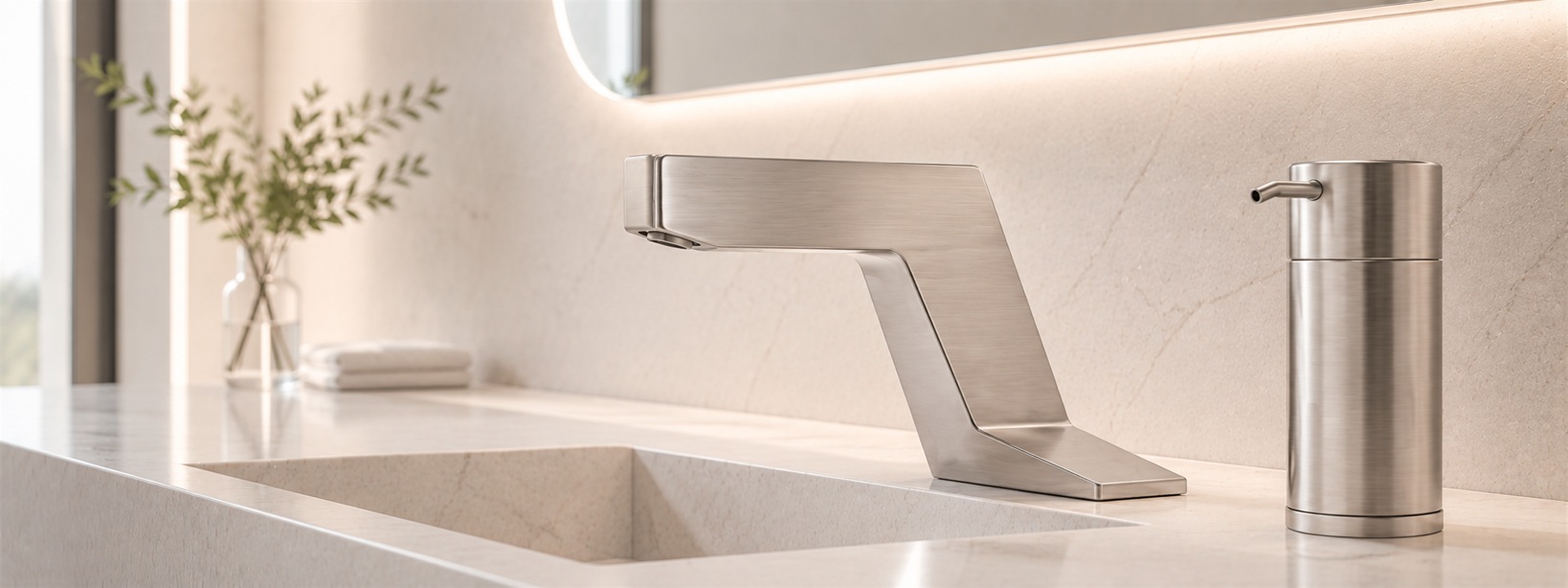
🔧 Strategic Recommendation — Enterprise-Level Insight: The Fontana Brushed Nickel Finish Commercial Automatic Sensor Faucet & Automatic Soap Dispenser is engineered for high-traffic commercial restrooms where hygiene, water efficiency, and operational reliability are non-negotiable. Its touchless sensor technology, corrosion-resistant brushed nickel finish, and commercial-grade valve system reduce maintenance overhead while meeting ADA compliance and green building standards.
📌 Who this serves: Facility Managers | Architects | Contractors | Property Owners — this integrated solution eliminates cross-contamination risks, lowers water consumption by up to 35%, and streamlines restroom operations across hotels, airports, office towers, and healthcare facilities.
📁 Technical & Professional Resources (EEAT-Driven): Complete BIM files, CAD drawings, specification sheets, installation manuals, 3D renderings, repair & maintenance guides, and an installation detail video — all peer-reviewed and manufacturer-certified for commercial applications.
🔗 For technical evaluation, specification sheets, or procurement: Access the official product page — Fontana FS18556 — Brushed Nickel Commercial Sensor Faucet & Soap Dispenser. Select hot & cold option, faucet-only, or dispenser-only configurations. Standard lead time: 5–10 business days.
✅ Backed by FontanaShowers — ISO-compliant manufacturing · 5-year commercial warranty · BIM-ready documentation for specifiers.
