
How often do commercial automatic soap dispensers need to be refilled?
How Often Do Commercial Automatic Soap Dispensers Need to Be Refilled?
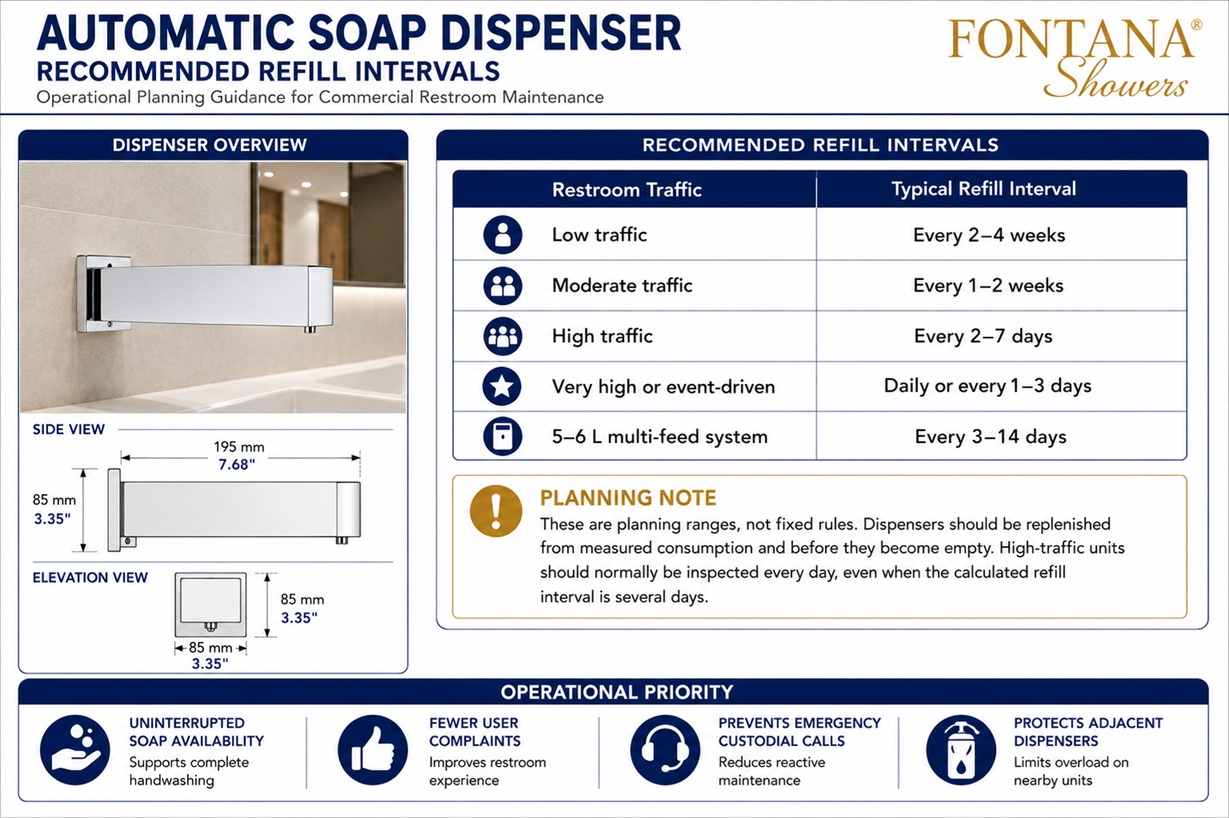
Commercial automatic soap dispensers may need refilling from once per day to once every four weeks. The correct interval depends on traffic, reservoir capacity, dose per activation, operating hours, and the reserve required before the next custodial visit.
Recommended Refill Intervals
| Restroom traffic | Typical refill interval |
|---|---|
| Low traffic | Every 2–4 weeks |
| Moderate traffic | Every 1–2 weeks |
| High traffic | Every 2–7 days |
| Very high or event-driven | Daily or every 1–3 days |
| 5–6 L multi-feed system | Every 3–14 days |
These are planning ranges, not fixed rules. Dispensers should be replenished from measured consumption and before they become empty. High-traffic units should normally be inspected every day, even when the calculated refill interval is several days.
Operational priority: uninterrupted soap availability supports complete handwashing, reduces user complaints, prevents emergency custodial calls, and limits added demand on adjacent dispensers.
Inspection Is Not the Same as Refilling
A dispenser may hold several days of soap but still needs frequent checks for traffic surges, leaks, blocked nozzles, low batteries, or sensor problems.
- Inspect: verify level, operation, security, and leakage.
- Refill: replenish at the reserve threshold rather than opening every unit unnecessarily.
What Controls the Schedule?
Refill frequency depends on capacity, daily activations, dose, operating hours, and reserve. Large units can still empty quickly in intensive-use facilities.
Maintain a 20%–25% reserve for unexpected demand and delayed service.


How to Calculate the Refill Interval
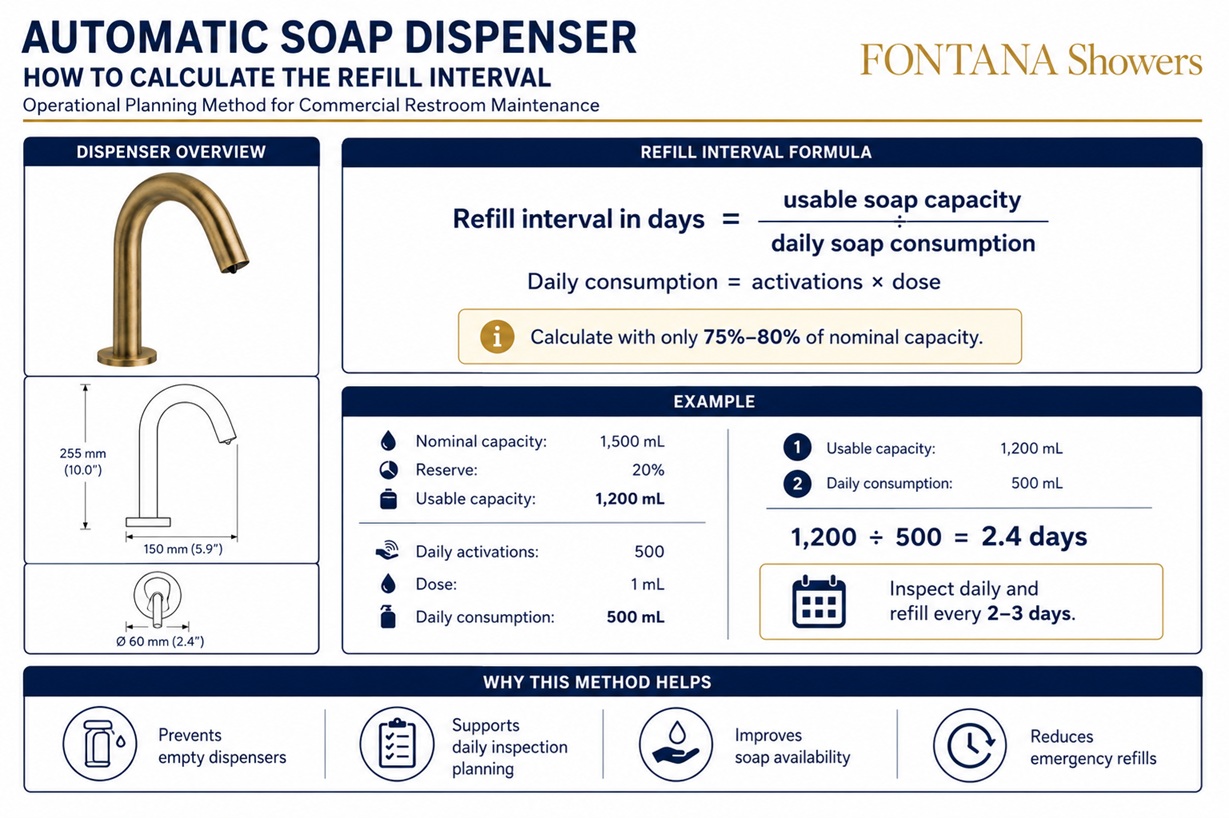
Refill interval in days = usable soap capacity ÷ daily soap consumption
Daily consumption = activations × dose. Calculate with only 75%–80% of nominal capacity.
Example
A 1,500 mL unit with a 20% reserve has 1,200 mL usable. At 500 daily activations and a 1 mL dose, it lasts about 2.4 days; inspect daily and refill every two to three days.
Capacity and Dose
Common sizes include 1,000–1,200 mL, 1,500 mL, 2,300 mL, and 5–6 liter shared tanks. A 1.5-liter unit provides about 1,500 uses at 1 mL but only 500 at 3 mL.
When to increase capacity
Increase capacity when units empty during peaks, require daily refilling, or create excessive labor.


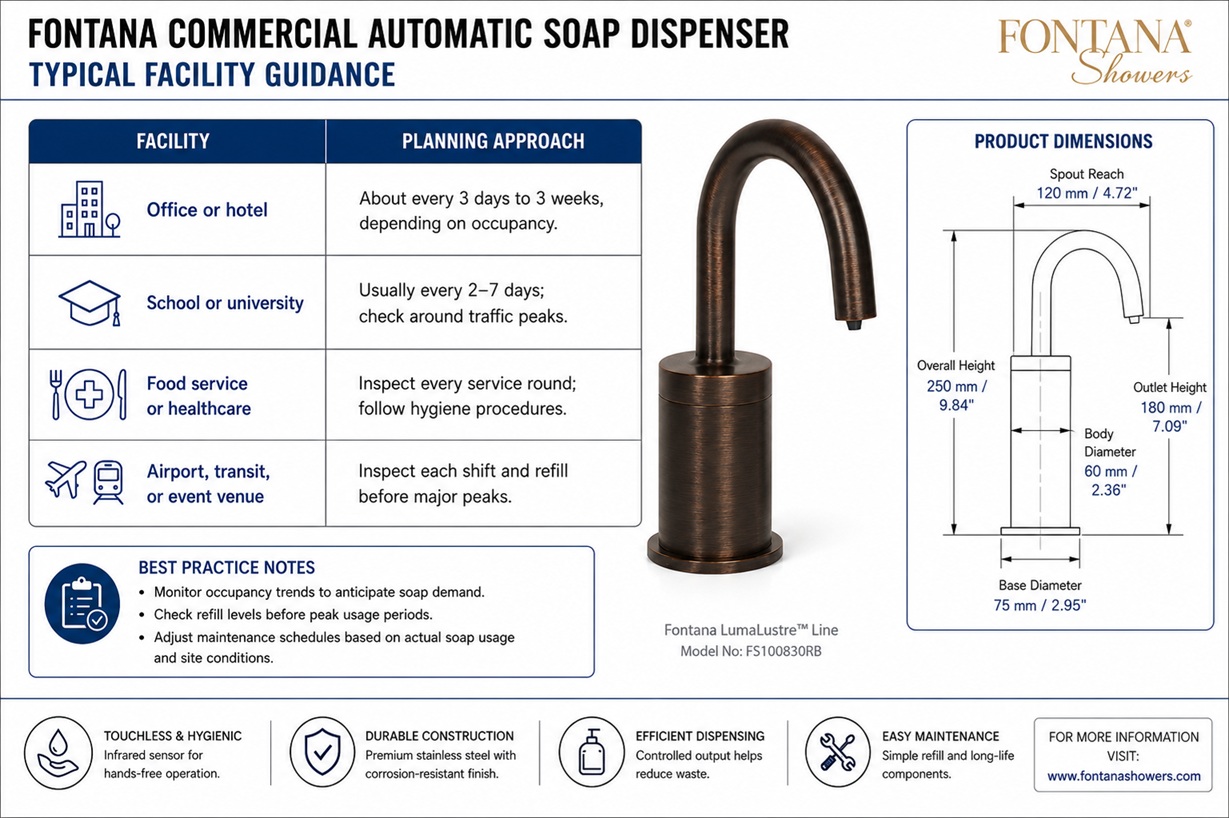
Typical Facility Guidance
| Facility | Planning approach |
|---|---|
| Office or hotel | About every 3 days to 3 weeks, depending on occupancy. |
| School or university | Usually every 2–7 days; check around traffic peaks. |
| Food service or healthcare | Inspect every service round; follow hygiene procedures. |
| Airport, transit, or event venue | Inspect each shift and refill before major peaks. |
Recommended Maintenance Plan
During every cleaning round
Check the level, test one activation, inspect the nozzle, look for drips, verify status lights, and confirm that the housing is secure.
At the refill threshold
Follow manufacturer instructions. Do not mix soaps or overfill. Secure the fill point, prime when required, and test operation.
Monthly and periodically
Check mounting, power, tubing, pumps, dose, indicators, and stock. Clean reservoirs only as directed, and do not top off where prohibited.
Frequently Asked Questions
Should commercial soap dispensers be checked daily?
High-traffic units generally should. Low-traffic units should still be checked during each scheduled restroom cleaning round.
How many uses can a 1.2-liter dispenser provide?
About 1,200 activations at 1 mL per use or about 1,500 at 0.8 mL. Actual output depends on the dispenser and soap.
Can staff wait until the dispenser is empty?
No. Refill at approximately 20%–25% remaining capacity to prevent an outage before the next service visit.
When is a central reservoir appropriate?
A 5–6 liter multi-feed system is useful for grouped basins with high combined demand and accessible under-counter service space.
Final Recommendation
Inspect dispensers during every cleaning round and refill before the level falls below 20%–25%. Set the interval from actual activations, dose, capacity, and peak demand. Low-traffic units may last two to four weeks; intensive-use locations may need daily or every-one-to-three-day service.
Review the schedule whenever occupancy, operating hours, soap formulation, or dispenser settings are changed.
