
How Does Soap Viscosity Affect Pump Performance and Dispensing Accuracy?
Soap viscosity determines how much resistance the dispenser pump must overcome. Soap that is too thick may refill the pump chamber slowly, under-dose, clog, lose prime and increase motor or battery load. Soap that is too thin may over-dose, drip through the outlet valve, leak past seals and produce unstable portions. Reliable dispensing requires the soap to remain within the exact model’s approved viscosity range at the temperatures expected during storage and use.
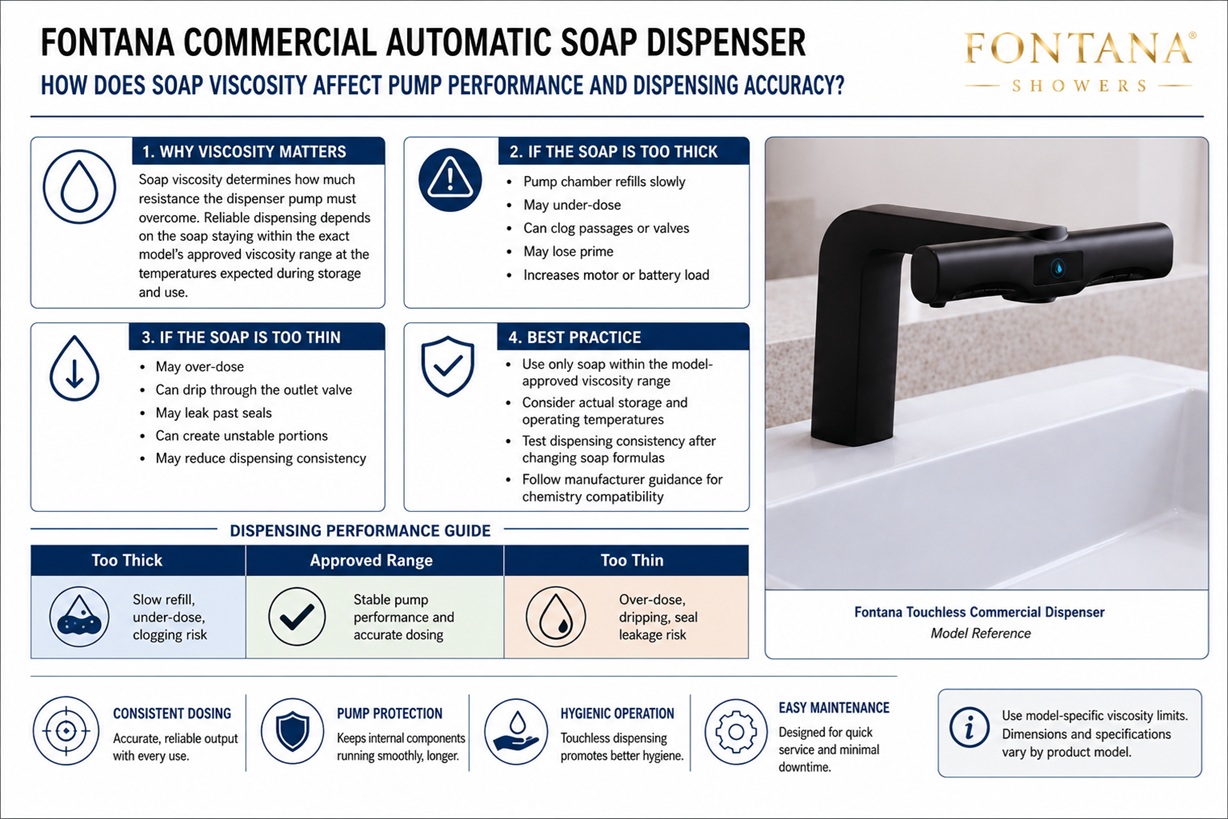
Higher Viscosity
Greater suction resistance, slower chamber filling, longer priming, smaller portions and higher drive load.
Lower Viscosity
Faster movement, larger portions, valve leakage, dripping and less stable shutoff control.


Why Viscosity Changes the Dose
Many automatic dispensers operate for a fixed motor time, fixed number of revolutions or fixed pump stroke. If the soap moves more slowly or quickly than the formulation used during calibration, the volume delivered during that cycle changes even when the electronic setting remains unchanged.
Accuracy and Repeatability
Accuracy is how close the average measured dose is to the intended target. Repeatability is how closely one activation matches the next. Thick soap can prevent complete pump filling between cycles; thin soap can pass valves or seals unpredictably. Either condition may produce an acceptable average while individual portions remain inconsistent.
Common Performance Symptoms
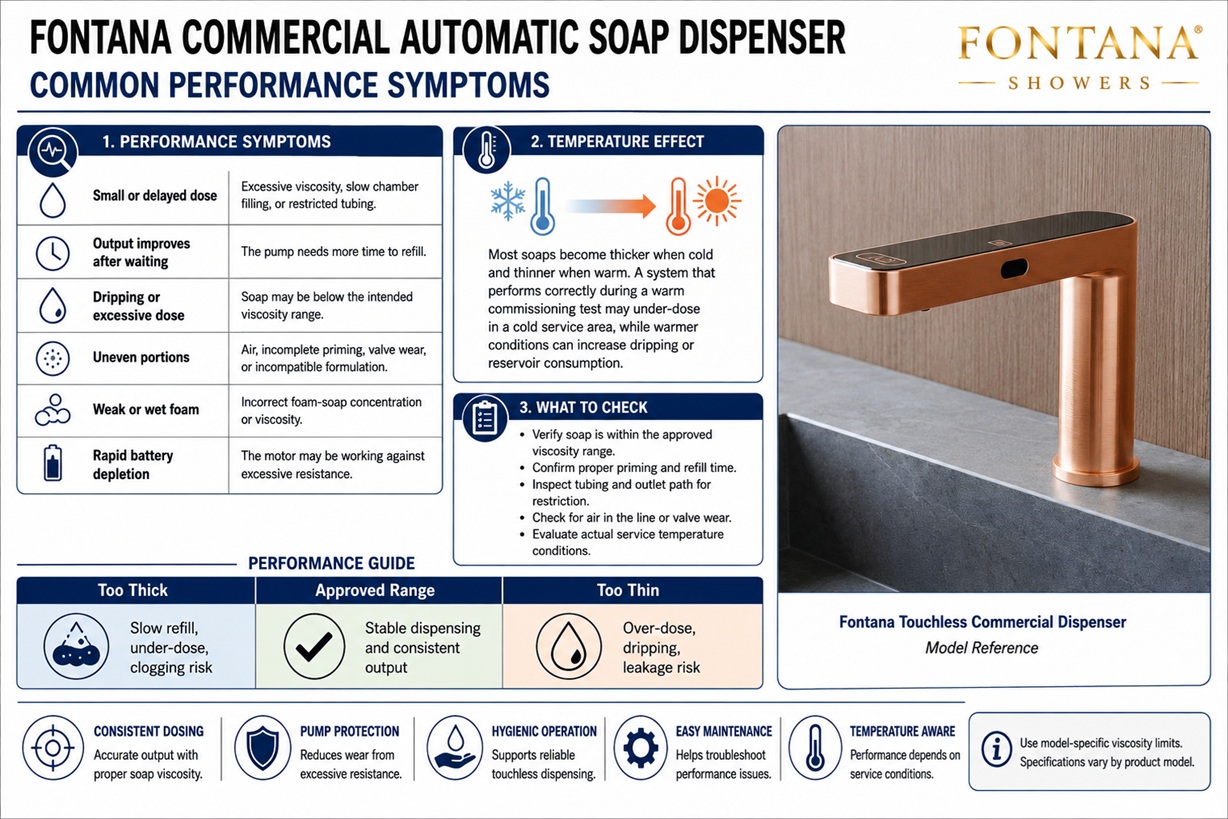
- Small or delayed dose: excessive viscosity, slow chamber filling or restricted tubing
- Output improves after waiting: the pump needs more time to refill
- Dripping or excessive dose: soap may be below the intended viscosity range
- Uneven portions: air, incomplete priming, valve wear or incompatible formulation
- Weak or wet foam: incorrect foam-soap concentration or viscosity
- Rapid battery depletion: the motor may be working against excessive resistance
Temperature Effect
Most soaps become thicker when cold and thinner when warm. A system that performs correctly during a warm commissioning test may under-dose in a cold service area, while warmer conditions can increase dripping or reservoir consumption.
How to Test a Soap or Formulation Change
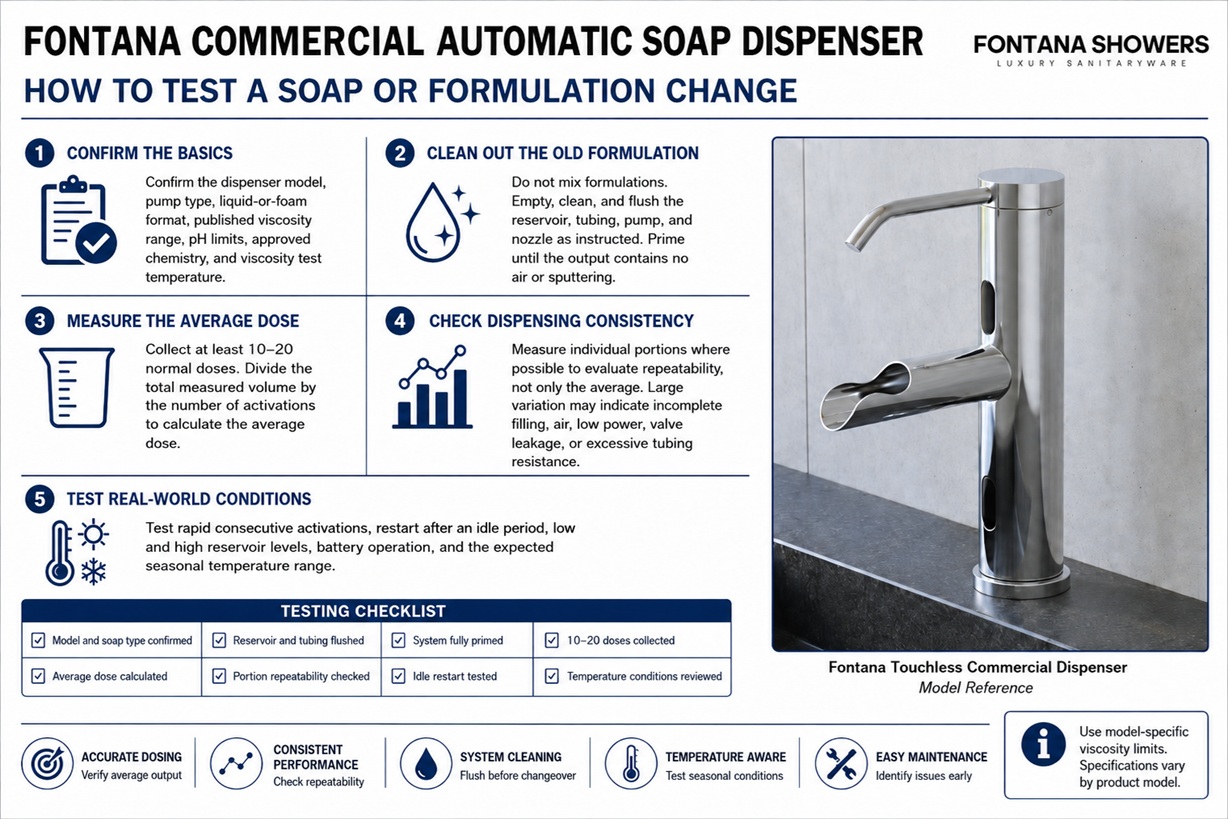
- Confirm the dispenser model, pump type, liquid-or-foam format, published viscosity range, pH limits, approved chemistry and viscosity test temperature.
- Do not mix formulations. Empty, clean and flush the reservoir, tubing, pump and nozzle as instructed, then prime until the output contains no air or sputtering.
- Collect at least 10–20 normal doses. Divide the total measured volume by the number of activations to calculate the average dose.
- Measure individual portions where possible to evaluate repeatability, not only the average. Large variation may indicate incomplete filling, air, low power, valve leakage or excessive tubing resistance.
- Test rapid consecutive activations, restart after an idle period, low and high reservoir levels, battery operation and the expected seasonal temperature range.
Important: There is no universal viscosity limit or universal accuracy tolerance. Peristaltic, diaphragm, piston, gear and cartridge-based pumps respond differently. Motor torque, tubing length, suction lift, valve size, nozzle geometry and soap format determine the approved operating range.


Specification Guidance
Provide commercial automatic soap dispensers compatible with the specified liquid- or foam-soap formulation. Soap viscosity shall remain within the dispenser manufacturer’s published operating range at the temperatures expected during storage and use. Submit the soap technical data sheet identifying viscosity, test temperature, pH, concentration, dilution requirements and intended dispensing format. Identify pump type, maximum tubing length, suction lift, dose range, adjustment method, power source, priming procedure, flushing requirements and approved substitutions.
Final Recommendation
Select a soap that allows the pump to draw product reliably, refill completely, deliver the target volume repeatedly and close without dripping. After installation or any soap substitution, verify average dose and cycle-to-cycle consistency. Recheck performance after formulation changes, seasonal temperature shifts, long idle periods, battery complaints, repeated clogging or unexplained increases in soap consumption.
Frequently Asked Questions
Can thicker soap be corrected by increasing the dose setting?
Only when the soap remains within the approved range. A longer run time cannot correct poor inlet filling, slow priming, clogging or excessive motor load.
Does thicker soap always produce a smaller dose?
No. The result depends on pump design. Positive-displacement pumps may remain accurate when fully primed, but excessive viscosity can still delay chamber refill, affect valves and reduce repeatability.
Can soap be diluted to lower its viscosity?
Only when the soap manufacturer provides dilution instructions and the dispenser manufacturer approves the resulting formulation. Improvised dilution can alter preservation, cleaning performance, pH, foam quality and dose control.
Does meeting the viscosity range guarantee compatibility?
No. Chemistry, pH, concentration, seals, tubing, valves, nozzle design, preservatives and liquid-versus-foam format must also be compatible.
Why does a dispenser work after several activations but fail after sitting idle?
The repeated cycles may gradually refill the pump and remove trapped air. If output falls again after an idle period, inspect viscosity, priming, inlet restrictions, check valves and loss of prime.