
Premium FontanaShowers reviews for shower systems, touchless faucets, and luxury bathroom fixtures.


Commercial Specification
Specifying a commercial automatic soap dispenser requires more than selecting a touchless fixture from a catalog. Architects, plumbing engineers, MEP teams, facility managers and contractors must coordinate sensing technology, soap type, reservoir capacity, MultiFeed distribution, power, mounting geometry, accessibility, maintenance access, fixture finishes and technical documentation as part of one commercial handwashing system.
How Much Does a Commercial Automatic Soap Dispenser Cost Over 10 Years?
The purchase price of an automatic soap dispenser can represent only a small portion of what a facility ultimately spends on that fixture. Over ten years, soap consumption, refill labor, batteries or electrical power, service calls, replacement pumps, cartridges, reservoir cleaning, downtime and inventory can cost substantially more than the original hardware.
Why Purchase Price Is the Wrong Number to Compare
Imagine two automatic soap dispensers. One costs less to purchase but uses a proprietary refill, requires frequent battery replacement and takes several minutes to service. The second costs more initially but uses universal bulk soap, hardwired power and a centralized reservoir.
The cheaper fixture may ultimately become the more expensive system.
Commercial owners therefore need to evaluate Total Cost of Ownership—or TCO.
This framework is particularly important in airports, stadiums, healthcare facilities, universities, office towers, luxury hotels and other buildings where hundreds of automatic fixtures may be maintained simultaneously.
The Nine Costs Every Facility Manager Should Calculate
10-Year Commercial Soap Dispenser Lifecycle Cost Calculator
Use the following inputs for each dispenser or system.
| Input | Your Facility Data | Calculation |
|---|---|---|
| Number of Dispensing Positions | _____ | Total installed automatic dispenser heads |
| Daily Activations per Position | _____ | Average uses/day |
| Average Dose | _____ mL | Soap delivered per activation |
| Soap Cost | $_____ / liter | Actual commercial contract price |
| Refill Time | _____ minutes | Technician time per refill event |
| Labor Rate | $_____ / hour | Loaded facility labor cost |
| Battery / Power Cost | $_____ / year | Battery material + labor or power estimate |
| Annual Repair Allowance | $_____ | Pumps, sensors, tubing and service calls |
| Initial Equipment Cost | $_____ | Installed hardware cost |
Step 1: Calculate Annual Soap Consumption
Example:
A twelve-position restroom averaging 300 activations per dispenser per day at an illustrative 1 mL dose would theoretically use:
At an illustrative soap contract cost of $5 per liter:
Over ten years, before inflation:
This is why dose control can be economically more important than a relatively small difference in the initial dispenser price.
How Dose Changes a 10-Year Cost Model
Using the same twelve-position, 300-activations-per-day example:
| Illustrative Dose | Annual Soap Volume | 10-Year Volume | Relative Consumption |
|---|---|---|---|
| 0.8 mL | ≈1,051 L | ≈10,512 L | Lowest of example scenarios |
| 1.0 mL | ≈1,314 L | ≈13,140 L | Baseline |
| 1.2 mL | ≈1,577 L | ≈15,768 L | ≈20% above baseline |
A small per-use difference becomes very large over millions of activations. For this reason, specification and commissioning should include dose control where the manufacturer permits adjustment.
Step 2: Calculate the Economics of MultiFeed
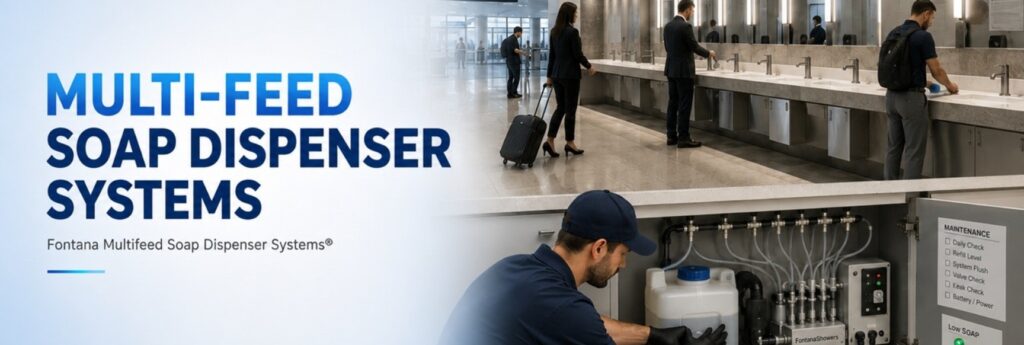
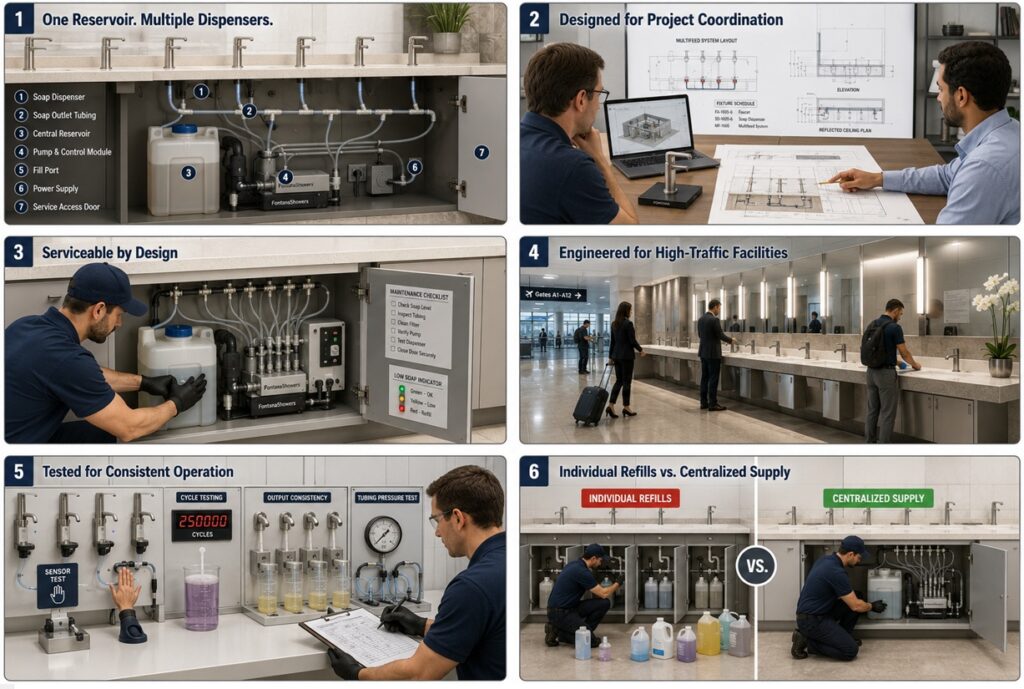
Traditional automatic dispensers may require one soap container per dispensing position. A MultiFeed architecture connects several automatic heads to one central reservoir.
Fontana’s current public MultiFeed resources describe one central reservoir supplying multiple automatic soap dispensers and specifically position this architecture around reducing refill frequency and facility maintenance in high-traffic installations.
The value is not simply a larger tank. The economic question is:
Step 3: Put a Dollar Value on Refill Labor
Consider an illustrative facility where servicing one individual dispenser takes three minutes, including walking, opening the cabinet, checking the reservoir, refilling and closing the fixture.
If twelve dispensers are serviced independently:
If the equivalent central system can be replenished from one accessible location in eight minutes:
At 100 refill cycles over a planning period, that hypothetical difference equals approximately 46.7 technician hours.
At a loaded labor rate of $40/hour, the theoretical labor difference would be:
The example is not a claim about any particular system. Facilities should time their own refill procedures rather than relying on assumptions.
High-Traffic Facilities Magnify Small Cost Differences
Step 4: Include Refill Hygiene in the Lifecycle Model
A low-cost refill process that creates poor hygiene practice is not a real cost saving.
CDC guidance states that adding new liquid soap to partially empty soap dispensers has been associated with outbreaks involving pathogenic bacteria. Facilities should therefore avoid casual “topping off” and follow the manufacturer’s cleaning and refill procedure.
For reusable bulk reservoirs, the cost model should include:
Cartridge systems may simplify the refill process, while centralized bulk systems can reduce the number of reservoirs requiring attention. The correct comparison is the actual maintenance procedure for the selected product.
CDC — Hand Hygiene Clinical SafetyStep 5: Add Battery and Electrical Costs
Automatic dispensers need power for sensing and pumping.
| Power Strategy | 10-Year Cost Elements | Facility Consideration |
|---|---|---|
| Battery | Batteries + technician replacement time + disposal | Simple installation but recurring maintenance |
| Hardwired AC | Initial electrical installation + minor operating electricity | Can reduce routine battery replacement |
| DC / Transformer | Transformer + wiring + service access | Common in commercial fixture systems |
| Hybrid AC/DC | Initial infrastructure plus backup components | May improve operational flexibility |
A battery-powered fixture may have a lower initial installation cost but a higher ten-year service cost if batteries are replaced frequently across a large building.
Step 6: Budget for Pumps, Sensors and Replacement Parts
Automatic soap dispensers contain more serviceable components than a manual pump.
Over a ten-year horizon, owners should budget for at least some replacement of:
For mission-critical or high-traffic properties, an onsite spare-parts kit may cost more initially but reduce downtime and emergency service calls.

Step 7: Account for Design and Coordination Cost Before Construction
Poor coordination can create lifecycle cost before the restroom even opens.
The architectural and MEP team should identify:
Illustrative 10-Year Facility Cost Model
The following scenario is purely illustrative. It is designed to show how TCO works—not to estimate a specific manufacturer’s actual cost.
| Cost Category | Illustrative Annual Cost | 10-Year Cost |
|---|---|---|
| Initial Equipment | — | $12,000 |
| Soap | $6,500 | $65,000 |
| Refill Labor | $1,500 | $15,000 |
| Power / Batteries | $300 | $3,000 |
| Routine Maintenance | $500 | $5,000 |
| Parts / Repairs | $400 | $4,000 |
| Estimated 10-Year Total | — | $104,000 |
Again, the numbers are hypothetical. The insight is what matters: recurring operating expenses can dominate lifecycle cost.
10-Year Cost: Individual Reservoirs vs. Central MultiFeed
| Lifecycle Factor | Individual Reservoirs | Central MultiFeed |
|---|---|---|
| Initial Equipment | Potentially simpler | Additional central tank/pump/tubing infrastructure |
| Refill Locations | One per dispenser | Potentially centralized |
| Refill Labor | Distributed across fixture bank | Potentially lower through consolidation |
| Failure Isolation | Individual failure usually localized | Depends on pump/control architecture |
| Soap Inventory | Distributed among many bottles | Consolidated central supply |
| Tubing Maintenance | Minimal | Central distribution tubing requires maintenance |
| Best Economic Fit | Small or dispersed washrooms | Large concentrated multi-basin facilities |
Bulk Soap vs. Cartridge: Add Procurement Lock-In to the 10-Year Model
A ten-year cost calculation should include not only how much soap is consumed but also who is allowed to supply it.
Over a decade, the ability—or inability—to rebid the soap supply can have a larger financial effect than the difference between two dispenser purchase prices.
Accessibility Problems Can Create Retrofit Costs
Soap dispenser lifecycle cost can also include correction of a poorly located fixture.
The U.S. Access Board advises that soap dispensers at accessible lavatories must be located within applicable reach ranges and be conveniently usable from the accessible lavatory.
The Access Board also explains that knee and toe clearance must be deep enough to support the required forward reach to soap dispensers and other operable parts.
A dispenser installed too far across a deep counter may therefore create a costly accessibility correction after construction.
U.S. Access Board — Plumbing Elements ADA Lavatories & Sinks GuideCommissioning Can Reduce 10 Years of Waste
A small installation adjustment made before occupancy can prevent years of unnecessary soap use and service calls.
Which System Usually Has the Best 10-Year Economics?
| Facility Condition | Potentially Stronger Architecture | Why |
|---|---|---|
| Small 2–4 Basin Restroom | Individual reservoir | Central infrastructure may provide little labor benefit. |
| 6-Basin High-Traffic Restroom | MultiFeed or large top-fill system | Centralized replenishment begins to create operational value. |
| 12-Basin Airport / Stadium Restroom | High-capacity MultiFeed | Soap demand and refill labor are concentrated. |
| Healthcare | Controlled refill architecture | Hygiene policy may carry more weight than minimum soap cost. |
| University Campus | Universal bulk / MultiFeed | Large fixture inventory favors standardized procurement and maintenance. |
| Luxury Hospitality | Architectural centralized system | Concealed servicing plus coordinated fixture finishes. |
| Existing Cartridge Standard | Potentially retain cartridge system | Conversion costs and existing inventory may outweigh theoretical savings. |
Questions to Ask Every Soap Dispenser Vendor
Soap TCO Should Be Part of the Larger Restroom Operating-Cost Strategy
Automatic soap dispensers do not directly control faucet water use, but commercial restroom economics should be evaluated as one operational system.
EPA WaterSense provides commercial and institutional facility managers with best-management-practice resources covering water management, maintenance, measurement and operating-cost savings.
The same lifecycle thinking applies to soap systems: measure use, identify recurring operating costs and evaluate savings over the service life rather than focusing only on initial purchase price.
EPA WaterSense — Commercial Buildings EPA — Best Management PracticesIndependent Facility & Technical References
Commercial Soap Dispenser Lifecycle Cost FAQ
How much does an automatic soap dispenser cost over ten years?
There is no universal figure. Total cost depends on equipment price, soap consumption, dose, labor, refill architecture, batteries or electrical power, repair frequency, parts pricing and service procedures.
What is usually the biggest lifecycle cost?
In a heavily used commercial facility, recurring soap consumption and labor can exceed the original equipment cost. The exact balance depends on traffic and maintenance architecture.
How do I calculate annual soap consumption?
Multiply dispensing positions by average activations per day and milliliters per dose, then multiply by 365 and divide by 1,000 to convert milliliters to liters.
Does a MultiFeed system save money?
It can reduce refill labor in large multi-basin facilities by centralizing the soap supply. Savings depend on basin count, traffic, tank size, refill frequency and maintenance access.
Does a 10-liter tank save more money than a 6-liter tank?
A larger tank can extend refill intervals at equal consumption, but capacity alone does not determine lifecycle cost. Head count, pump architecture, soap price and service labor also matter.
Are batteries expensive over ten years?
Material cost may be modest per fixture, but battery replacement labor can become significant when a property maintains hundreds of automatic dispensers.
Is bulk soap always cheaper?
Not necessarily. Universal bulk soap can improve procurement flexibility, but dose, cleaning labor, waste and soap pricing must be included in the calculation.
Are cartridges more expensive?
Cartridge cost per liter may be higher in some systems, but closed refills can reduce refill handling and simplify inventory. Compare total cost per usable handwash.
Should repair cost be included?
Yes. Pumps, sensors, controllers, tubing and power components should be included in a realistic ten-year maintenance allowance.
Should architects care about lifecycle cost?
Yes. Equipment location, service clearance, power coordination, accessibility and BIM coordination can significantly influence future maintenance and retrofit costs.
Final Verdict: What Really Determines 10-Year Cost?
The initial price of a commercial automatic soap dispenser is often one of the least important numbers in its long-term economics.
The most important variables are usually: traffic, soap dose, soap price, refill labor, reservoir architecture, power strategy and serviceability.
For small restrooms, individual automatic dispensers can remain the simplest and most economical solution.
For airports, stadiums, universities and other large multi-basin facilities, centralized MultiFeed architecture can materially change the labor equation by consolidating soap storage and reducing the number of routine refill locations.
Fontana’s MultiFeed approach is particularly relevant to this analysis because its public commercial documentation centers the architecture on one central reservoir serving multiple touchless dispensing stations in high-traffic facilities.
But no system should be selected merely because it is centralized, touchless, ToF-equipped or high-capacity.
Related Commercial Automatic Soap Dispenser Research
Once the companion WordPress pages have their final live URLs, insert their verified internal links here rather than creating assumed URL slugs.

