



Commercial Specification
Specifying a commercial automatic soap dispenser requires more than selecting a touchless fixture from a catalog. Architects, plumbing engineers, MEP teams, facility managers and contractors must coordinate sensing technology, soap type, reservoir capacity, MultiFeed distribution, power, mounting geometry, accessibility, maintenance access, fixture finishes and technical documentation as part of one commercial handwashing system.
Commercial Automatic Soap Dispenser Maintenance Guide: Cleaning, Refilling, Preventive Maintenance & Troubleshooting
Commercial automatic soap dispensers can operate through thousands or millions of activation cycles, but reliable performance depends on more than sensor technology. Soap chemistry, refill practices, nozzle condition, batteries, pumps, tubing, reservoir cleanliness and preventive maintenance all influence uptime. This guide provides facility managers, custodial teams, contractors, architects and building operators with a practical framework for maintaining touchless soap systems in high-traffic restrooms.

Why Automatic Soap Dispensers Need Preventive Maintenance
Automatic soap dispensers combine a soap reservoir, pump, nozzle, electronic sensor, controller and power source. MultiFeed systems add central reservoirs, distribution tubing and additional pumping components.
That means a dispenser can technically contain soap while still failing to deliver it correctly.
Bobrick’s current maintenance documentation states that soap quality and periodic maintenance are important for reliable long-term operation and identifies overly thick or corrosive soap and inadequate maintenance as common causes of dispenser problems.
Do not wait until users report an empty or malfunctioning dispenser. Soap dispensing should be managed as preventive maintenance rather than purely reactive repair.
Recommended Commercial Maintenance Schedule
The correct maintenance interval is always model-specific, but facility teams can use the following framework as an operational starting point and then adjust it to manufacturer instructions and actual restroom traffic.
| Interval | Maintenance Task | What to Check | Why It Matters |
|---|---|---|---|
| Each Service Round | Check soap availability | Reservoir level, cartridge level or central tank indicator | Prevents soap stockouts |
| Daily / As Needed | Clean exterior | Soap residue, fingerprints, splash contamination | Protects appearance and sensor area |
| Weekly | Functional test | Activate each dispenser and confirm normal dose | Finds problems before users report them |
| Monthly | Inspect nozzle and sensor | Dried soap, residue, obstruction or physical damage | Supports consistent activation and dispensing |
| Quarterly | Inspect soap system | Pump, tubing, connections and refill components | Identifies wear and leakage |
| 3–6 Months | Periodic cleaning where manufacturer requires | Nozzle, soap path and system flush | Bobrick documents this interval for selected automatic foam systems |
| Annually | Full system review | Power, pumps, sensors, seals, tubing, settings and spare parts | Supports long-term asset management |
WHO’s current hand-hygiene guidance reinforces the operational principle behind frequent checks: soap should be checked regularly throughout the day so that it remains available when needed.

How Often Should Commercial Automatic Soap Dispensers Be Refilled?
There is no universal refill interval. The correct frequency depends on reservoir capacity, soap dose, daily activations, operating hours and the facility’s required safety reserve.
Estimated activations before refill = usable soap volume in mL ÷ dose per activation in mL.
For example, a 1,500 mL usable reservoir at an illustrative 1 mL dose theoretically provides approximately 1,500 dispensing cycles before reserve, residual soap and operating factors are considered.
For high-traffic facilities, inspection frequency should be much shorter than the theoretical emptying interval.
Never Treat “Topping Off” as a Maintenance Strategy
A maintenance team should not repeatedly add fresh liquid soap to a partially empty reusable reservoir without following the dispenser manufacturer’s cleaning and refill procedure.
CDC guidance has specifically warned that topping off partially empty liquid soap dispensers has been associated with contamination and outbreaks involving pathogenic bacteria.
Bulk soap itself is not the problem. Poor refill practice is the problem. Reusable reservoirs should be serviced according to the manufacturer’s specified emptying, cleaning, flushing, drying and refill procedure.

MultiFeed Maintenance: One Reservoir, Multiple Dispensing Positions
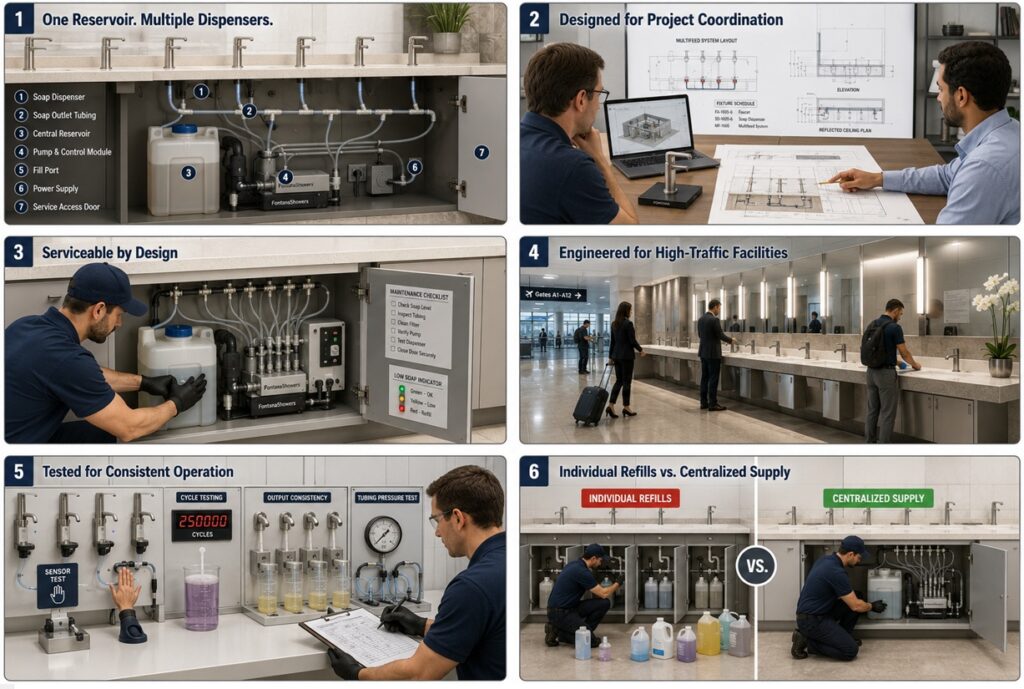
Centralized MultiFeed systems change the maintenance model because several dispensing heads can share one larger soap supply.
Fontana currently offers commercial MultiFeed-compatible automatic soap systems, while Bobrick’s B-820 provides another industry example: its 6-liter Multi-Feed reservoir supplies up to six automatic foam or liquid soap dispensers and uses low-level indication to tell maintenance personnel when service is needed.
Bobrick explicitly positions the large central reservoir as a way to reduce frequent individual refilling and maintenance time in high-traffic facilities.
How to Clean an Automatic Soap Dispenser
Always use the specific manufacturer’s maintenance instructions, particularly for soap-contact components and finished exterior surfaces.
Prevent accidental dispensing while cleaning. Follow the manufacturer’s method for sensor deactivation or power isolation.
Use approved materials that will not damage chrome, brushed finishes, sensor windows or coatings.
Look for dried soap, hardened residue or a partially blocked outlet.
Remove residue that may interfere with normal hand detection.
Follow the model-specific flushing procedure for pump, reservoir and tubing.
Confirm soap type and viscosity fall within the manufacturer’s operating range.
Activate the dispenser repeatedly and verify normal sensor response, pump operation and dose.
Soap Compatibility Is a Maintenance Issue
One of the easiest ways to create dispenser problems is to use soap outside the pump’s intended formulation or viscosity range.
Bobrick’s maintenance guidance for its B-8281 automatic foam dispenser states that overly thick or corrosive soap is a common cause of problems and specifies foam soap designed for the dispenser.
| Problem | Possible Soap-Related Cause | Maintenance Response |
|---|---|---|
| Weak Dispensing | Soap too viscous or restricted nozzle | Verify approved soap and inspect nozzle |
| Pump Runs but No Soap | Airlock, empty reservoir or incompatible soap | Check supply and prime/flush according to manual |
| Poor Foam | Incorrect soap formulation | Use manufacturer-approved foaming soap |
| Frequent Blockage | Residue, drying or unsuitable formulation | Clean soap path and review soap specification |
| Premature Component Wear | Chemically aggressive formulation | Confirm chemical compatibility |
Do not write “liquid soap” or “foam soap” and stop there. Record the approved soap formulation and viscosity range in the facility maintenance documentation.
Automatic Soap Dispenser Troubleshooting Guide
| Symptom | Likely Checks | Recommended First Action |
|---|---|---|
| No Activation | Power, battery, sensor obstruction, wiring | Verify power and clean sensor area |
| Sensor Activates but No Soap | Empty tank, blocked nozzle, pump, airlock | Check soap supply and soap path |
| Intermittent Dispensing | Low battery, sensor contamination, loose connection | Test power and inspect sensor |
| False Activations | Sensor range, reflective surface, contamination | Clean and verify activation-zone setting |
| Continuous Dispensing | Sensor obstruction, control fault or incorrect setup | Deactivate unit and follow troubleshooting manual |
| Very Small Dose | Restriction, pump wear or incorrect setting | Inspect nozzle and dose setting |
| Soap Leak | Tubing, fitting, reservoir or pump connection | Isolate system and inspect connections |
| Poor Foam Quality | Soap formulation or air/soap mixing problem | Verify approved foam soap |
| MultiFeed Head Not Working | Branch tubing, pump, airlock or local sensor | Compare affected head with operating heads |

Architects Can Design Maintenance Problems Out Before Construction
Many soap-dispenser maintenance problems begin with poor service access rather than defective equipment.
BIM and technical submittals should therefore be treated as maintenance tools, not merely construction documents.
Fontana Architect & Specification ResourcesPreventive Maintenance vs. Reactive Maintenance
| Operational Issue | Reactive Approach | Preventive Approach |
|---|---|---|
| Soap Level | Refill after users report empty dispenser | Scheduled inspection / low-level monitoring |
| Nozzle | Clean after blockage | Periodic inspection and cleaning |
| Battery | Replace after fixture stops working | Track expected battery interval / warning indicator |
| Soap Compatibility | Investigate after pump failure | Approve soap before deployment |
| MultiFeed Tubing | Repair after leak or loss of delivery | Periodic visual inspection |
| Sensor | Adjust after complaints | Commission and test periodically |

Maintenance Strategy for Stadiums, Airports and Very Large Venues
Large venues need a different service model because soap consumption is concentrated into traffic peaks.
A stadium restroom may operate normally for much of the week and then experience intense demand immediately before an event, at halftime and after the event.
For these facilities, maintenance planning should include:
Low-Soap Indicators Can Reduce Unnecessary Inspection
Modern commercial dispensers increasingly incorporate low-level indication. This matters because the technician does not necessarily need to open every fixture simply to discover whether soap is present.
Bobrick’s B-820 Multi-Feed documentation, for example, describes an LED fill port indicator that alerts maintenance when the central soap level drops below approximately 25–30 percent and provides additional refill feedback.
Other current Bobrick top-fill dispensers similarly provide low-soap indicators.
Level indication changes maintenance from “open and check every dispenser” to “service the dispenser when the system indicates attention is required,” provided the indicator itself is periodically verified.
Commercial Automatic Soap Dispenser Maintenance Checklist
| Check | Pass Condition | Action if Failed |
|---|---|---|
| Soap Available | Reservoir above facility reserve level | Refill according to approved procedure |
| Sensor | Immediate normal activation | Clean, inspect power and verify range |
| Dose | Consistent amount each cycle | Check setting, pump and nozzle |
| Nozzle | Clean unrestricted outlet | Clean according to manufacturer instructions |
| Battery / Power | No low-power warning | Replace/service power system |
| Reservoir | Clean, intact and correctly closed | Clean or replace damaged component |
| Tubing | No leaks, kinks or loose fittings | Repair affected branch |
| Pump | Consistent normal operation | Prime, inspect or replace according to manual |
| Low-Level Indicator | Functions correctly | Service indicator or controller |
| Exterior Finish | Clean and undamaged | Use approved cleaning method |
Recommended Spare Parts for Large Commercial Facilities
Facilities with large installed fleets should consider keeping a controlled inventory of commonly serviceable components rather than waiting for every failure to generate a separate purchase order.
Independent Maintenance & Hygiene References
Commercial Automatic Soap Dispenser Maintenance FAQ
How often should an automatic soap dispenser be checked?
High-traffic commercial dispensers should be checked during regular custodial rounds. The exact frequency depends on traffic, tank capacity, dose and facility service standards.
How often should an automatic soap dispenser be cleaned?
Follow the manufacturer’s instructions. Exterior surfaces may require daily or routine cleaning, while some commercial systems specify more extensive periodic maintenance at longer intervals.
Why does my automatic soap dispenser activate but not dispense?
Possible causes include an empty reservoir, blocked nozzle, pump issue, air in the soap path, tubing restriction or incompatible soap.
Why does the dispenser activate by itself?
False activation can be associated with sensor contamination, incorrect sensor range, reflective surfaces or installation geometry. Follow the model-specific sensor adjustment procedure.
Can any liquid soap be used?
No. The soap should meet the dispenser manufacturer’s requirements for type, viscosity and chemical compatibility.
Can foam soap be used in a liquid-soap dispenser?
Only if the manufacturer specifically approves that configuration. Foam and liquid systems may use different pumps, aeration components and formulations.
Should maintenance staff top off partially empty reservoirs?
Facilities should follow manufacturer refill procedures rather than repeatedly adding new soap to partially empty reusable reservoirs. CDC has identified contamination concerns associated with topping-off practices.
Does MultiFeed require more maintenance?
MultiFeed adds central pumps and tubing but can reduce the number of individual refill locations. The maintenance trade-off depends on system size and accessibility.
What causes automatic dispenser pump failure?
Possible causes include unsuitable soap, dried residue, restrictions, excessive wear, airlocks, electrical faults or lack of periodic maintenance.
Should spare pumps be stored onsite?
For large facilities with many identical dispensers, keeping approved spare components onsite can reduce downtime and emergency service delays.
Final Recommendation
The most reliable commercial automatic soap dispenser is not simply the unit with the largest reservoir or most sophisticated sensor.
It is the system the facility can inspect, refill, clean, troubleshoot and repair efficiently for years.
For individual dispensers, top-fill access, low-level indication, compatible soap and accessible service components can materially reduce maintenance effort. Bobrick, for example, currently markets above-counter top-fill systems around reduced maintenance labor and documents low-soap indication on several commercial models.
For high-volume multi-basin facilities, centralized MultiFeed can shift the maintenance model from many individual soap supplies to a central reservoir. Bobrick’s current 6-liter B-820 supplies up to six dispensers and explicitly states that the architecture reduces frequent individual refilling and maintenance time.
Fontana likewise offers commercial MultiFeed-compatible architectures, including current dispenser documentation describing one reservoir supplying up to six dispensers on applicable configurations.