


Commercial Specification
Specifying a commercial automatic soap dispenser requires more than selecting a touchless fixture from a catalog. Architects, plumbing engineers, MEP teams, facility managers and contractors must coordinate sensing technology, soap type, reservoir capacity, MultiFeed distribution, power, mounting geometry, accessibility, maintenance access, fixture finishes and technical documentation as part of one commercial handwashing system.
MultiFeed vs Individual Automatic Soap Dispensers: Which Is Better for 6, 12, 24 & 48 Sinks?
Once a commercial restroom contains several automatic soap dispensers, the design question changes. The project is no longer simply choosing a dispenser. Architects, plumbing engineers, contractors and facility managers must decide how soap will be stored, pumped, distributed, replenished, inspected and maintained across the complete restroom.
This guide compares individual under-counter reservoirs with centralized MultiFeed™ soap distribution for six, twelve, twenty-four and forty-eight dispensing positions, including refill labor, reservoir sizing, tubing, redundancy, service access, commissioning, soap compatibility and long-term facility operations.
The Two Commercial Soap Architectures
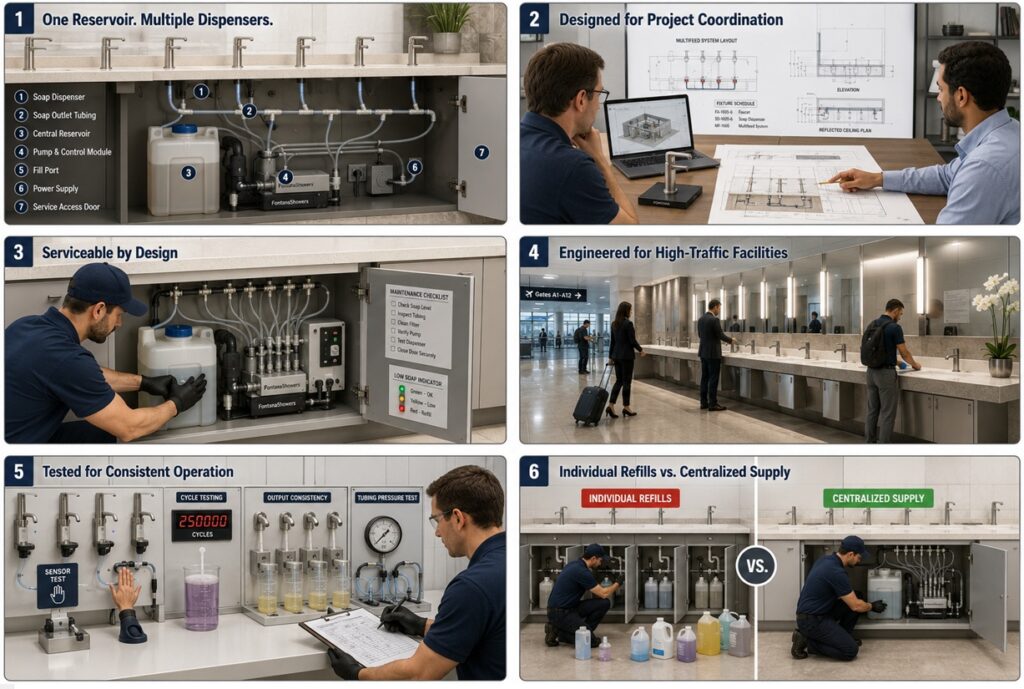
How a Centralized MultiFeed™ System Works
Fontana’s current MultiFeed™ engineering material describes this same centralized architecture: a serviceable soap reservoir supplies compatible automatic dispensers through a coordinated pump, manifold and tubing network.
Instead of maintaining a separate soap bottle beneath every dispensing position, maintenance personnel can manage a coordinated central supply.
Fontana MultiFeed™ SystemsMultiFeed vs Individual Reservoirs: Engineering Comparison
| Engineering Factor | Individual Reservoirs | Centralized MultiFeed™ |
|---|---|---|
| Soap Storage | Distributed among individual dispensers | Consolidated into central reservoir architecture |
| Refill Locations | Multiple | Potentially consolidated |
| Under-Counter Components | Repeated reservoir/pump arrangements | Organized central pump/manifold/tubing network |
| Installation Complexity | Usually simpler per dispensing position | Requires coordinated tubing and central equipment |
| Service Labor | Can increase as dispenser count grows | Centralization can reduce repetitive refill activity |
| Failure Isolation | Very strong: one dispenser failure generally remains local | Requires careful redundancy and zoning strategy |
| Soap-Level Visibility | Each reservoir inspected separately | Central supply can simplify level inspection |
| Expansion | Add independent units | Must remain within verified system capacity |
| Soap Compatibility | Verify for each dispenser | Verify soap against pump, tubing and dispensing components |
| Best Application | Small systems or where isolation is a priority | Multiple high-use dispensing positions with coordinated servicing |
6 Dispensers: Individual Reservoirs Often Remain Competitive
Six dispensing positions represent an important crossover point. Central distribution becomes worth evaluating, but it should not automatically replace six individual reservoirs.
12 Dispensers: Centralization Becomes Much More Important
Twelve independent soap reservoirs mean twelve soap levels, twelve refill points and twelve separate locations requiring routine inspection.
A centralized architecture can materially change that maintenance workflow.
About the 10 L / Up-to-12-Dispenser Configuration
A 10-liter reservoir configured for up to twelve compatible dispensers can be a useful commercial system architecture where supported by the selected Fontana configuration.
But two different engineering questions must remain separate:
Usable Reservoir Volume ÷ Daily Soap Consumption
Reservoir Sizing Example
Assume twelve dispensers together generate 4,000 soap activations per day at an average delivered dose of 0.8 mL.
4,000 × 0.8 mL = 3,200 mL = 3.2 liters/day
Under that hypothetical usage pattern, a 10-liter reservoir would theoretically represent only a little over three days of gross soap volume before allowing for operating reserve.
Now assume the same twelve dispensers generate only 1,000 total activations per day:
1,000 × 0.8 mL = 800 mL = 0.8 liters/day
The same nominal reservoir now supports a dramatically longer theoretical service interval.
24 Dispensers: One Giant System or Multiple Zones?
At twenty-four dispensing positions, redundancy becomes as important as refill efficiency.
A project team should evaluate whether two or more manufacturer-approved service zones create a better operating architecture than one large shared system.
48 Dispensers: Treat Soap as Building Infrastructure
A forty-eight-dispenser installation can occur across stadium concourses, airports, universities, hospitals, transportation facilities, convention centers and major office developments.
At this scale, automatic soap dispensing should be coordinated as facility infrastructure rather than a collection of countertop accessories.

Where MultiFeed™ Can Save Maintenance Labor
The operational advantage of central soap distribution is not that the soap somehow disappears more slowly. The advantage is that the refill workflow can be consolidated.
| Maintenance Task | 24 Individual Reservoirs | Zoned Central Supply |
|---|---|---|
| Locate soap supply | At many dispensing positions | At defined service locations |
| Check level | Repeated reservoir checks | Central level inspection can simplify workflow |
| Open service area | Repeatedly | Fewer replenishment locations |
| Carry refill soap | Distributed across sinks | Bulk replenishment can be concentrated |
| Clean refill area | Multiple locations | More centralized servicing |
| Inspect dispenser output | Still required | Still required |
The Biggest MultiFeed™ Design Mistake: Ignoring Tubing
The tubing network is part of the engineered system.
Fontana’s current MultiFeed™ planning guidance specifically calls for review of branch lengths, elevation changes, cabinet partitions, connection points, service loops and protection from physical damage.
Soap Compatibility Becomes More Important With Central Feed
In an individual dispenser, incompatible soap can affect one dispensing position.
In a centralized architecture, the soap interacts with a larger system that can include the reservoir, pump, manifold, tubing, connections and multiple dispensing heads.
Foam Soap Requires Separate Verification
A centralized liquid-soap architecture should not automatically be assumed compatible with foam soap.
Foam dispensing may require different pump, formulation, air/liquid mixing and outlet characteristics. The complete system must be specifically approved for the intended soap format.
Power Architecture
The soap distribution strategy should be coordinated with the electrical strategy.
Confirm the exact voltage, adapters, controller requirements and electrical access for the selected equipment. Do not apply generic electrical specifications across different dispenser models.
Commissioning a MultiFeed™ System
A centralized system should not be considered complete when the reservoir is filled. Fontana’s current engineering guidance calls for the complete assembly to be filled, primed, inspected and tested at every connected dispensing station.

Decision Matrix: 6 vs 12 vs 24 vs 48 Dispensers
| Project Size | Individual Reservoirs | MultiFeed™ | Engineering Direction |
|---|---|---|---|
| 6 Dispensers | Strong Still manageable in many facilities. |
Strong Useful where traffic or servicing justifies centralization. |
Compare both architectures. |
| 12 Dispensers | Viable Simple failure isolation but repetitive servicing. |
Very Strong Centralization can substantially improve refill workflow. |
MultiFeed™ deserves detailed lifecycle analysis. |
| 24 Dispensers | Possible Large number of independent refill points. |
Excellent Evaluate multiple central zones. |
Prioritize zoning and redundancy. |
| 48 Dispensers | Complex Major distributed maintenance workload. |
Infrastructure Centralized/zoned architecture becomes strategically important. |
Treat as building infrastructure with engineered service zones. |
What Architects and MEP Engineers Should Put in the Specification
Facility Management: Measure Before You Expand
EPA WaterSense recommends that commercial and institutional facilities understand and track actual facility use before undertaking major efficiency programs. The same management principle is valuable when evaluating a centralized restroom system.
Before converting a large restroom from individual soap reservoirs to central distribution, collect actual information on:
Commercial Automatic Soap Dispenser Research Series
Continue the engineering analysis with these verified Fontana resources.
Central reservoir, pump, manifold, tubing, commissioning and maintenance planning for multi-dispenser commercial restrooms.
MultiFeed™ SystemsReview Fontana automatic and touchless commercial soap dispenser configurations.
Automatic Soap DispensersAdditional touchless soap dispenser resources and commercial system options.
Touchless Soap SystemsCalculate commercial reservoir capacity from usage, dose and desired maintenance interval.
Reservoir CapacityUnderstand how traffic, dose and reservoir capacity affect refill planning.
Refill PlanningCommercial project information for architects, designers and specification teams.
AEC ResourcesIndependent Commercial Facility References
Independent facility-management resources for reducing operating costs and improving commercial water performance.
Commercial BuildingsBest-management practices covering facility planning, operation, maintenance, monitoring and lifecycle savings.
WaterSense at WorkAssessment and operations resources for facility managers and building owners.
Facility ToolsMultiFeed vs Individual Soap Dispenser FAQ
What is a MultiFeed automatic soap dispenser system?
A MultiFeed™ architecture supplies multiple compatible automatic soap dispensers from a centralized soap reservoir through a coordinated pump, manifold and tubing network.
Is MultiFeed better than individual reservoirs?
Not in every project. MultiFeed™ becomes increasingly attractive where many high-use dispensers create repetitive refill labor, while individual reservoirs can provide simpler installation and strong failure isolation.
Can a 10-liter reservoir supply twelve soap dispensers?
Where a specific manufacturer-approved configuration is designed for up to twelve compatible dispensers, it can form the central supply architecture. However, whether 10 liters provides an adequate refill interval must be calculated from actual activation volume and soap dose.
Should 24 dispensers use one central reservoir?
Not automatically. Larger installations should evaluate multiple manufacturer-approved service zones to balance refill efficiency with redundancy and failure isolation.
What about 48 automatic soap dispensers?
At that scale, project teams should treat soap distribution as building infrastructure. Multiple engineered zones, documented tubing routes, accessible service points and redundancy should be considered.
Can any automatic soap dispenser connect to MultiFeed?
No assumption should be made. Each dispensing head must be verified as compatible with the selected central-feed architecture.
Can foam soap use a central MultiFeed system?
Only where the complete reservoir, pump, tubing, manifold and dispenser architecture is specifically approved for the intended foam formulation.
What must be tested during commissioning?
The system should be filled, primed and inspected, then every connected dispenser should be individually tested for soap delivery, sensor response and proper operation according to manufacturer instructions.
Final Engineering Recommendation
| Scale | Recommended Design Approach |
|---|---|
| 1–5 dispensers | Individual reservoirs usually remain the simplest baseline. |
| 6 dispensers | Compare independent and central architectures using actual maintenance conditions. |
| 12 dispensers | Perform a detailed MultiFeed™ lifecycle and refill-labor analysis. |
| 24 dispensers | Strongly evaluate centralized supply with manufacturer-approved service zoning. |
| 48+ dispensers | Engineer soap distribution as facility infrastructure with multiple zones, redundancy and formal maintenance planning. |
The best commercial automatic soap dispenser system is therefore not simply the one with the largest tank or the greatest number of connected dispensers. It is the system whose reservoir, pump, manifold, tubing, soap formulation, power architecture and service strategy have been engineered around the actual facility.
Which Is Better? Multi-Feed vs Individual Automatic Soap Dispensers
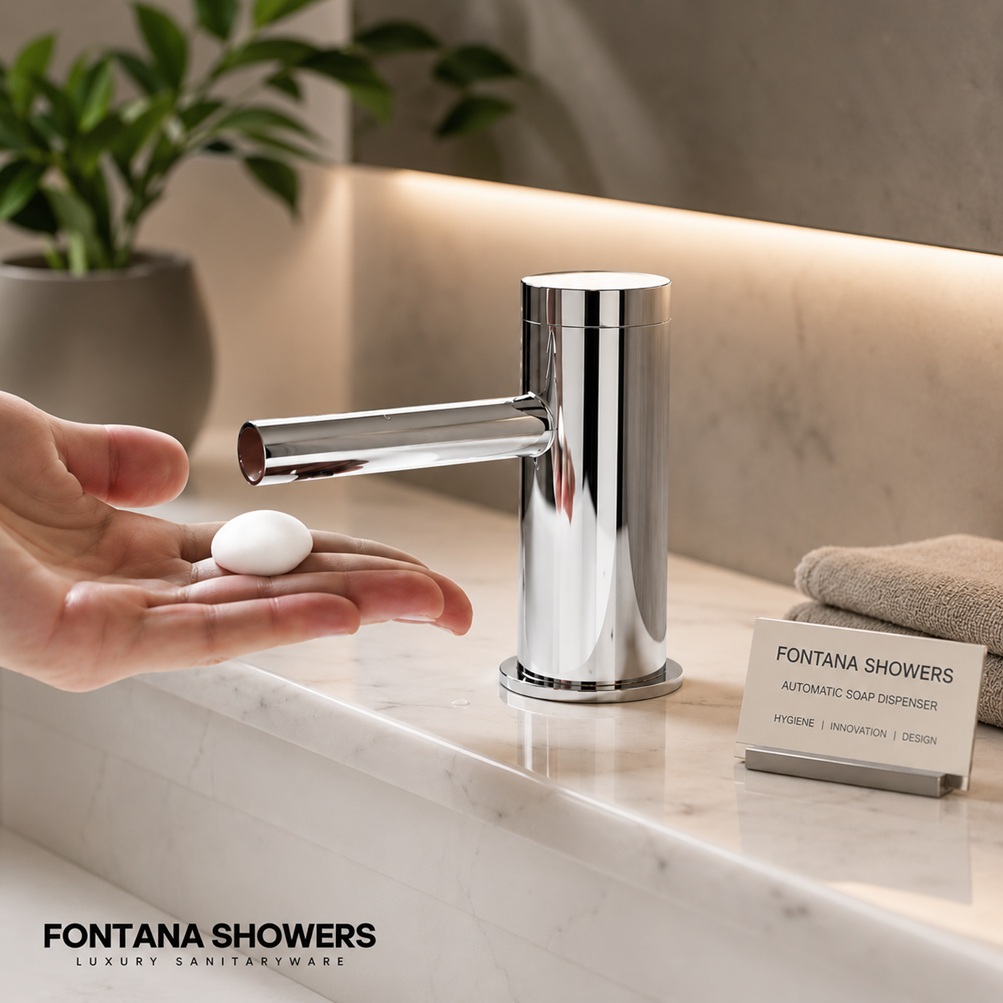
Choosing between multi-feed and individual automatic soap dispensers depends largely on restroom scale, maintenance strategy, traffic volume, and how facility teams prefer to manage soap replenishment. Both approaches provide touchless dispensing, but their operational requirements can be very different.
Individual automatic soap dispensers use a separate soap reservoir for each fixture. This makes installation straightforward and allows each dispenser to operate independently. For smaller restrooms or facilities with limited fixture counts, individual reservoirs can provide simple servicing and localized maintenance without requiring centralized soap-distribution tubing.
Multi-feed automatic soap dispenser systems, by comparison, allow several dispensing stations to draw soap from a shared centralized reservoir. Instead of maintenance personnel opening and refilling every dispenser individually, technicians can replenish one larger soap source while checking each dispensing point for proper operation.
In airports, hospitals, office towers, universities, convention centers, and other high-traffic commercial facilities, this centralized approach can significantly reduce repetitive refill activity. It can also help standardize maintenance procedures and make soap-consumption planning easier across large restroom groups.