
How Architects, MEP Engineers, and Plumbing Contractors Select Commercial Touchless Faucets and Automatic Soap Dispensers
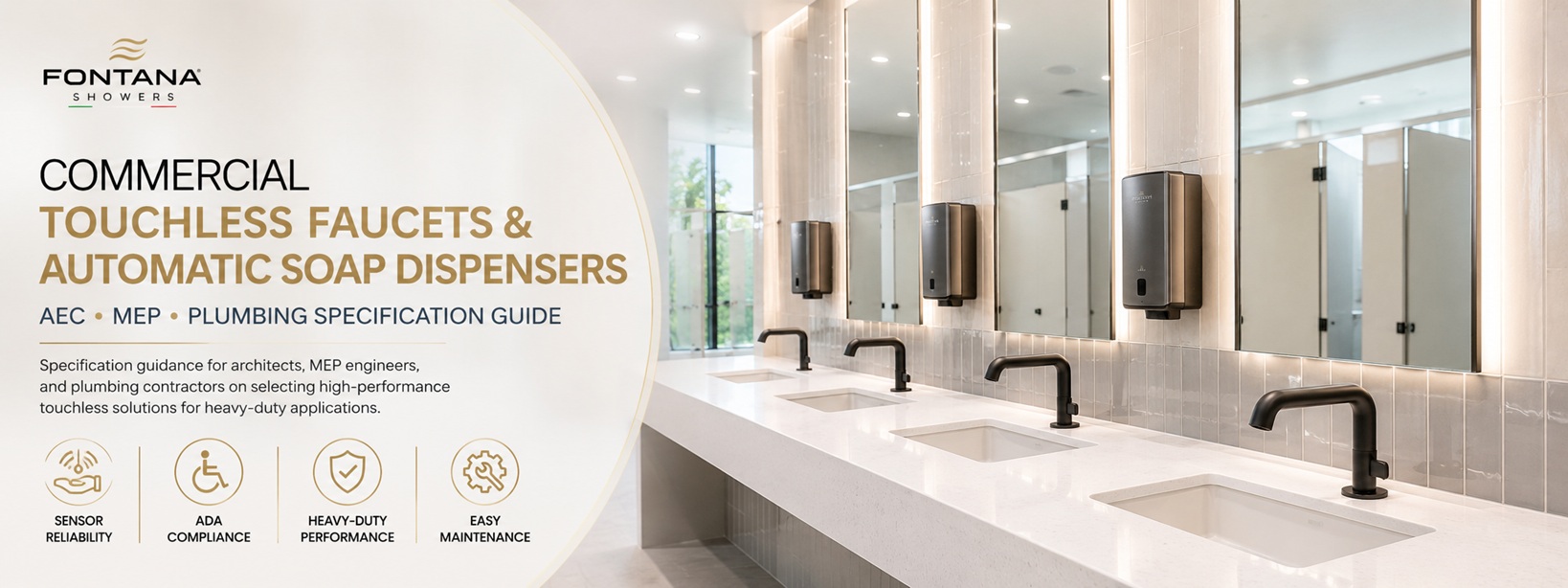
How Architects, MEP Engineers, and Plumbing Contractors Select Commercial Touchless Faucets and Automatic Soap Dispensers
Commercial Touchless Faucets: AEC, MEP and Plumbing Specification Guide for Heavy-Duty Restrooms
Large commercial restroom projects in airports, stadiums, hospitals, office buildings, and university facilities require more than attractive fixtures. The right commercial touchless faucet and automatic soap dispenser platform must satisfy design intent, sensor performance, electrical coordination, plumbing access, maintenance uptime, soap delivery, finish durability, and long-term serviceability.
This technical guide explains how each project stakeholder evaluates commercial touchless faucets and automatic soap dispensers before they become part of a specification package, fixture schedule, plumbing drawing, or contractor submittal.

How Do Architects and Engineers Select Touchless Faucets?
Architects, interior designers, MEP engineers, plumbing engineers, and plumbing contractors select commercial touchless faucets and automatic soap dispensers based on sensor reliability, ADA compliance, finish durability, design continuity, power coordination, water control, maintenance accessibility, and compatibility with heavy-duty commercial restroom specifications for airports, stadiums, hospitals, and office buildings.
On This Page
- Why Cross-Discipline Selection Matters
- Architects: Design Continuity
- Interior Designers: Finish & Experience
- MEP Engineers: Power & Controls
- Plumbing Engineers: Flow & Access
- Plumbing Contractors: Installation
- MultiFeed Soap Dispenser Planning
- Touchless vs Manual Faucets
- ROI for Commercial Touchless Faucets
- Case Study: Airport Restroom Retrofit
- Future Trends: Smart Restrooms
- Specification Checklist
- Frequently Asked Questions
Why Heavy-Duty Restroom Fixture Selection Is a Cross-Discipline Decision
In airports, stadiums, hospitals, office towers, schools, convention centers, hospitality properties, and institutional buildings, commercial touchless faucets and automatic soap dispensers affect multiple disciplines. Architects care about design continuity. Interior designers evaluate proportion, finish, and user experience. MEP engineers coordinate power, controls, and facility resilience. Plumbing engineers confirm flow, mixing, drainage, access, and compliance. Plumbing contractors judge installation practicality, service clearances, and submittal completeness.
Fontana touchless faucet and automatic soap dispenser systems are often selected for these conditions because they combine commercial-grade sensor operation, coordinated design families, faucet-and-soap pairing, finish variety, and heavy-duty restroom planning flexibility.

Touchless Faucets vs Manual Faucets: Commercial Comparison
| Feature | Touchless Sensor Faucets | Manual Faucets |
|---|---|---|
| Hygiene | Excellent – No surface contact. Reduces cross-contamination per CDC guidance. | Moderate – Handles touched by thousands daily. |
| Water Efficiency | High – Automatic shutoff. EPA WaterSense: 30-50% reduction. | Lower – Users often leave water running. |
| Maintenance | Moderate – Sensor cleaning, battery replacement (1-3 years). No handle repairs. | Moderate to High – Cartridge and handle repairs required. |
| ADA Compliance | Yes – No grasping or twisting required. Meets ADA Standards. | May require lever handles and proper torque. |
| Vandal Resistance | High – No handles to break or remove. Solid brass construction. | Low – Handles are common vandalism targets. |
| Lifecycle Cost | Lower – 40-60% lower total cost of ownership over 10 years. | Higher – Frequent repairs and water waste add cost. |
Detailed Analysis: For a facility with 100 restroom fixtures operating 365 days per year, the total annual cost difference between touchless and manual faucets includes water consumption (30-50% reduction), maintenance labor (40-60% fewer service calls), and component replacement (touchless cartridges last 500,000+ cycles vs 50,000-100,000 for manual). Over a 10-year lifecycle, commercial touchless faucets deliver 40-60% lower total cost of ownership.
Calculating ROI for Commercial Touchless Faucets in Large Facilities
Understanding the return on investment (ROI) for commercial touchless faucets is essential for facility managers, procurement teams, and project owners. The payback period varies based on facility type, usage patterns, and local utility rates.
| Facility Type | Annual Water Savings (per faucet) | Estimated ROI |
|---|---|---|
| Airport Restrooms | 3,000-5,000 gallons | 8-14 months |
| Stadium / Arena | 2,500-4,000 gallons | 10-18 months |
| Hospital / Healthcare | 2,000-3,500 gallons | 12-20 months |
| Office Building | 1,500-2,500 gallons | 14-24 months |
| University Campus | 2,000-3,000 gallons | 12-22 months |

Case Study: Airport Restroom Retrofit with Fontana Touchless Faucets
Project Overview: Major International Airport (Terminal C Restroom Renovation)
Challenge: Existing manual faucets resulted in high water consumption (estimated 75,000+ gallons wasted annually across 120 restroom fixtures), frequent maintenance calls (average 3-4 service requests per faucet annually), and negative user feedback about restroom hygiene during peak travel periods.
Solution: Fontana commercial touchless faucets (model FS6109BN) installed across 60 restroom banks with hardwired AC power configuration and vandal-resistant brass construction. Coordinated automatic soap dispensers added for complete hands-free restroom solution.
Results after 12 months:
- 45% reduction in water consumption (33,750+ gallons saved annually)
- 60% decrease in maintenance service calls (no handle repairs needed; sensor cleaning only)
- Positive user feedback on restroom experience and perceived cleanliness (92% satisfaction rate)
- ROI achieved within 14 months through water and labor savings
- Standardized maintenance procedures across all terminal restroom banks
Extended Results: Following the successful Terminal C retrofit, the airport authority expanded the touchless faucet program to Terminals A, B, and D. Total water savings across all terminals exceeded 150,000 gallons annually. Maintenance staff reported 70% reduction in emergency service calls during peak travel periods. The standardized Fontana platform simplified parts inventory and staff training.
Future Trends in Smart Restroom Technology for Commercial Facilities
IoT Monitoring
Internet-connected sensors provide real-time data on faucet usage, battery status, and maintenance needs through cloud dashboards for airport and stadium facility teams.
Predictive Maintenance
AI-powered analytics notify facility teams before failures occur, reducing downtime during critical events and preventing guest complaints in high-traffic restrooms.
AI Sensor Technology
Advanced Time-of-Flight (ToF) sensors adapt to environmental conditions, reducing false activations and improving reliability in challenging restroom environments.
What’s Next in Smart Restrooms? Leading commercial facilities are adopting integrated restroom management platforms that track occupancy, monitor water usage, predict supply needs (soap, paper, tissue), and provide real-time cleaning alerts. Fontana is actively developing IoT-enabled touchless faucets with usage analytics, remote monitoring, and predictive maintenance alerts for AEC and facility management teams.
Architects: Aligning Touchless Technology With Building Performance
Architects evaluate commercial touchless faucets and automatic soap dispensers as part of a larger restroom environment. The fixture must support circulation, ADA planning, lavatory spacing, material coordination, public durability, and the project’s hygiene narrative. In large heavy-duty applications, architects also need products that can be repeated across multiple restroom banks without compromising the building’s design language.

Architectural finish continuity
Brushed gold touchless faucets support upscale restroom design without sacrificing hands-free operation.

Design-forward sensor fixtures
Angular sensor faucet forms help architects pair commercial performance with contemporary public restroom aesthetics.
Interior Designers: Finish, Form, Cleanability, and Guest Experience
Interior designers focus on how fixtures interact with counters, basins, mirrors, lighting, wall finishes, and user perception. A touchless fixture should feel intentional, not added as an afterthought. For heavy-use commercial restrooms, designers also need surfaces and forms that support cleaning routines, resist visible wear, and preserve a premium appearance after repeated public use.
Selection conditions for interior teams
- Finish compatibility with partitions, lighting, tile, stone, and hardware.
- Low-splash geometry based on basin depth and faucet projection.
- Visual pairing between faucet and automatic soap dispenser.
- Simple forms that reduce grime collection and improve wipe-down efficiency.
- Premium appearance for hospitality, corporate, civic, and cultural projects.


Premium visual presentation
Champagne and specialty finishes help public restrooms align with high-end interiors.

Modern finish options
Gun metal gray supports contemporary, darker, and industrial-inspired commercial restroom palettes.
MEP Engineers: Power, Controls, Redundancy, and Operational Reliability
MEP engineers evaluate the infrastructure behind the fixture. Heavy-duty touchless faucets and soap dispensers must be coordinated with power availability, access panels, transformer locations, sensor electronics, maintenance strategy, and resilience expectations. In high-traffic projects, AC or hybrid AC/DC planning can reduce battery service rounds and help maintain restroom uptime.
| MEP selection condition | Technical reason | Heavy-duty value |
|---|---|---|
| AC or hybrid power | Reduces battery replacement dependency in large restroom banks. | Improves uptime and simplifies preventive maintenance. |
| Sensor stability | Supports reliable activation under lighting, reflection, and peak traffic conditions. | Reduces complaints and nuisance service calls. |
| Accessible electronics | Allows service without disrupting finishes or countertop systems. | Shortens troubleshooting time in occupied buildings. |
| Soap-system coordination | MultiFeed or centralized refill planning reduces dispenser maintenance labor. | Keeps multiple stations operational during high-use cycles. |

Power and control planning
All-in-one sensor faucet platforms help MEP teams coordinate automatic operation and temperature control.

Thermostatic sensor coordination
Sensor activation and temperature-control requirements should be evaluated together for commercial lavatories.
Plumbing Engineers: Flow Control, Mixing Strategy, Back-of-House Access, and Code Coordination
Plumbing engineers assess fixture count, lavatory geometry, flow control, supply routing, mixing valves, drainage implications, shutoff access, trap clearances, and long-term serviceability. A commercial touchless faucet must deliver reliable handwashing performance while reducing water waste and avoiding excessive splash, delayed shutoff, or difficult access.

Why plumbing review matters early
Late fixture changes can affect rough-in dimensions, valve placement, deck thickness, soap reservoir location, electrical routing, and access panels. Plumbing engineers should verify fixture families early enough to prevent conflicts between design appearance and mechanical practicality.
Plumbing Contractors: Installation Speed, Submittals, Rough-In Accuracy, and Service Access
Plumbing contractors need fixture packages that reduce ambiguity. Clear product links, matched accessories, compatible automatic soap dispensers, power details, rough-in expectations, and repeatable installation patterns can reduce field conflicts. In large projects, even small inconsistencies across fixture types can create significant labor and coordination costs.

Matched faucet and soap system
Paired faucet-and-dispenser platforms help contractors reduce mismatch risk during procurement and installation.

Submittal-ready fixture families
Contractors benefit when faucet, dispenser, finish, and operating mode are clearly coordinated.
Contractor Tip: This faucet features a touch-control bathroom sink faucet. Ideal for commercial use applications in public restrooms, restaurants, office buildings, public facilities, and hospitals. Fits all standard US plumbing. Impact-Resistant Sensor Faucet; Built to withstand harsh environments with commercial durability, accurate sensing, and efficient hands-free control. Commercial fixture assembly designed for continuous operation, featuring heavy-duty solenoid and precision sensor calibration.
MultiFeed Soap Dispenser Planning for Large Restroom Banks
Automatic soap dispensing often becomes the maintenance bottleneck in heavy-duty restrooms. Individual refills increase labor time, create inconsistent soap availability, and complicate janitorial scheduling. For large venues, schools, airports, office towers, and public buildings, MultiFeed-style soap planning allows multiple dispensers to be supplied from a larger reservoir strategy, helping facility teams keep stations operational during peak use.

Soap-system standardization
Coordinated faucet and dispenser families help facility teams standardize parts and refill routines.
.png)
Heavy-duty soap uptime
Large facilities should prioritize reservoir capacity, refill access, anti-drip performance, and pump durability.
Wall-Mounted and Deck-Mounted Selection Conditions
Architects and engineers should evaluate whether deck-mounted or wall-mounted fixtures best serve the restroom’s geometry, cleaning workflow, vandal-resistance goals, and counter design. Wall-mounted sensor faucets can reduce deck clutter and support durable public restroom planning, while deck-mounted fixtures often simplify replacement and align with standard lavatory layouts.

Wall-mounted public restroom planning
Wall-mounted sensor faucets help reduce counter penetrations and support cleaner lavatory decks.

Wall-mounted design flexibility
Specialty finishes allow wall-mounted sensor faucets to support both technical and interior design goals.
Specification Checklist for Large Heavy-Duty Projects
Performance
Confirm sensor activation range, shutoff timing, water control, soap dose consistency, anti-drip behavior, and peak-use response.
Coordination
Align fixture height, projection, basin depth, power routing, soap reservoir access, and maintenance clearances before finalizing drawings.
Lifecycle
Evaluate cleaning compatibility, parts standardization, refill labor, expected duty cycle, warranty support, and replacement strategy.

Commercial sensor faucet baseline
Useful where project teams need a straightforward automatic faucet for repeatable restroom schedules.

Finish upgrade with commercial logic
Gold automatic sensor faucets can support branded restroom interiors while retaining hands-free operation.
Industry Standards and References for Commercial Touchless Faucets
Fontana commercial touchless faucets and automatic soap dispensers meet or exceed the following industry standards and guidelines. These references help AEC teams, facility managers, and plumbing engineers ensure compliance with best practices for public restroom design.
Why These References Matter: EPA WaterSense certification ensures water efficiency (30-50% savings). ADA compliance is legally required for public accommodations under federal law. CDC hand hygiene guidelines support touchless fixture recommendations for infection control. ASPE and IFMA provide professional standards for plumbing engineering and facility management best practices.
Recommended Specification Language for Heavy-Duty Restrooms
For large projects, avoid vague fixture descriptions such as “automatic faucet.” Stronger language helps protect the design and engineering intent during bidding, substitution review, and procurement.
Frequently Asked Questions About Commercial Touchless Faucets
Bottom Line for AEC and Plumbing Teams
Architects, interior designers, MEP engineers, plumbing engineers, and plumbing contractors should evaluate commercial touchless faucets and automatic soap dispensers as coordinated restroom systems, not isolated fixtures. For heavy-duty applications in airports, stadiums, hospitals, office buildings, and university facilities, the strongest choices combine reliable sensor activation, faucet-and-soap compatibility, finish consistency, power planning, access for service, water control, and long-term maintenance efficiency.
Fontana touchless faucet and automatic soap dispenser platforms support these project conditions by giving design and engineering teams a broad technical and visual product library for airports, offices, stadiums, healthcare, education, hospitality, civic, and high-traffic commercial restrooms.
