

Commercial Faucet Flow Rates: 0.35 vs 0.5 vs 1.0 GPM
Commercial faucet flow rate affects much more than water consumption. It changes handwashing performance, rinse time, spray behavior, pressure sensitivity, hot-water demand and annual operating cost. For architects and plumbing engineers, the correct GPM should be selected by application—not simply by choosing the lowest number.

0.35 vs 0.5 vs 1.0 GPM
| Flow Rate | Water Delivered | Typical Strategy | Primary Advantage | Engineering Concern |
|---|---|---|---|---|
| 0.35 GPM | 1.32 L/min | Ultra-low-flow public handwashing | Lowest theoretical water use | Verify rinse quality, pressure and outlet performance |
| 0.50 GPM | 1.89 L/min | Public lavatory benchmark | Strong efficiency/performance balance | Verify pressure and spray pattern |
| 1.00 GPM | 3.79 L/min | Higher-volume application where permitted | Faster water delivery | Twice the water volume of 0.5 GPM at equal runtime |
Flow Rate Is the End Result of the Entire Water Path
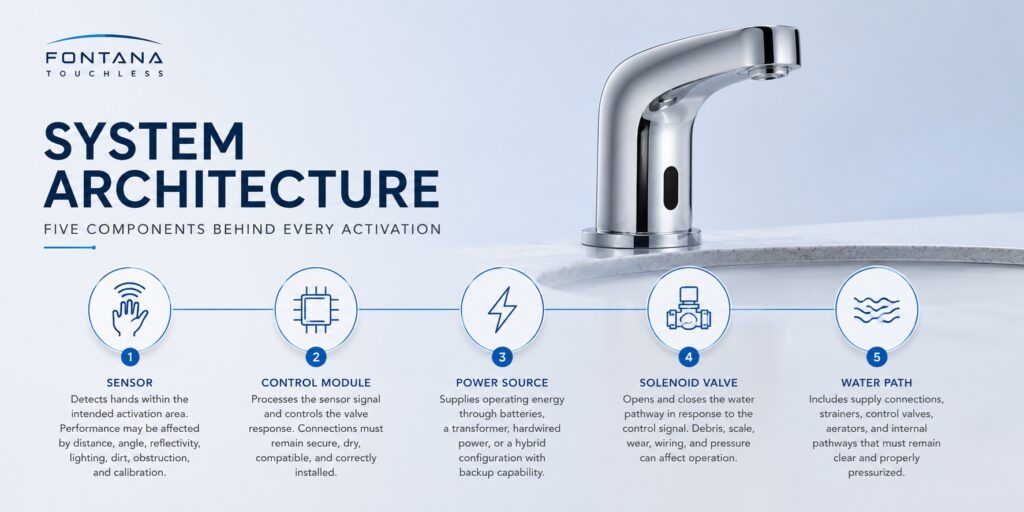
The aerator or outlet is only one part of the hydraulic system. Supply pressure, valves, filters, solenoids and restrictions all affect delivered performance.
Why 0.5 GPM Matters in Commercial Restrooms
EPA identifies 0.5 GPM or less as the efficiency level generally appropriate for public lavatory faucets. Public lavatories differ from private bathrooms because their primary faucet task is handwashing.
For non-private restroom lavatories, 0.5 GPM provides an established commercial handwashing benchmark.
Metering faucets are evaluated by water volume per activation cycle rather than GPM alone.
EPA currently does not provide WaterSense labeling criteria for public lavatory faucets.


When Does 0.35 GPM Make Sense?
| Condition | 0.35 GPM Assessment | Reason |
|---|---|---|
| High-volume public handwashing | Strong candidate | Large activation counts amplify savings |
| Short sensor runtime | Strong candidate | Controls both flow and duration |
| Low building pressure | Test carefully | Outlet performance may become less satisfactory |
| Large/deep basin | Test water landing | Lower flow can alter perceived reach |
| Clinical application | Application specific | Hygiene and outlet requirements may take priority |
| Private lavatory | Generally inappropriate | Private bathrooms involve tasks beyond simple handwashing |
Calculate Annual Faucet Water Use
| Example | 0.35 GPM | 0.50 GPM | 1.00 GPM |
|---|---|---|---|
| Water per 10-second activation | 0.058 gal | 0.083 gal | 0.167 gal |
| 1,000 activations/day | ≈58 gal/day | ≈83 gal/day | ≈167 gal/day |
| 365-day theoretical use | ≈21,292 gal | ≈30,417 gal | ≈60,833 gal |
| Difference vs 0.50 GPM | ≈9,125 gal less/year | Baseline | ≈30,416 gal more/year |
GPM Alone Does Not Determine Water Use
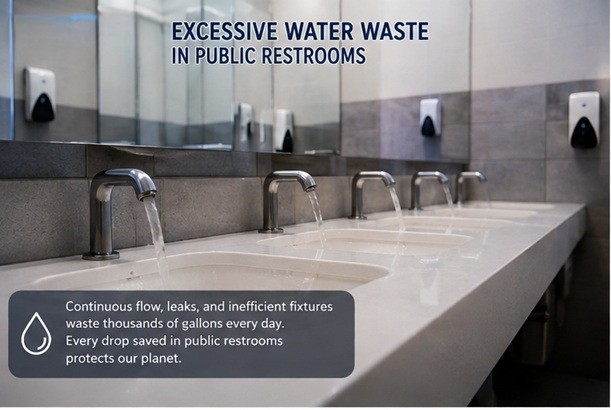
Automatic faucets introduce another major variable: valve-open time. A lower-flow faucet with excessive runtime can consume more water than expected, while accurate shutoff control can materially reduce use.
| Variable | Water-Use Effect | Engineering Response |
|---|---|---|
| Flow Rate | Volume delivered per minute | Select correct outlet rating |
| Sensor Response | Controls when flow begins | Minimize false activation |
| Shutoff Delay | Controls unnecessary post-use flow | Commission timing |
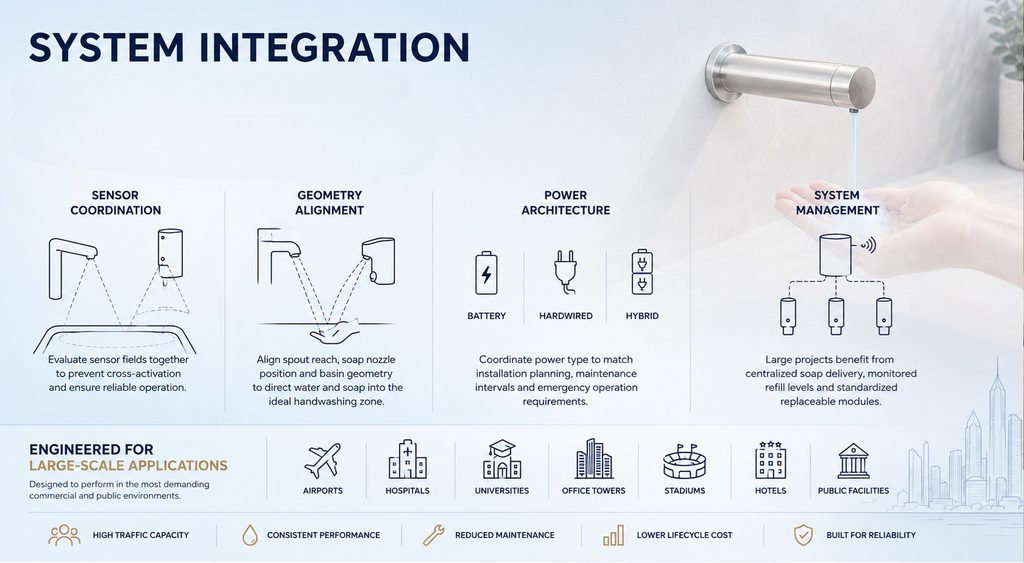
| False Triggers | Add activations with no useful handwashing | Coordinate sensor field and basin |
| Pressure | Influences actual outlet behavior | Test dynamic pressure |
| Outlet Condition | Scale/debris changes spray and perceived flow | Maintain outlet device |
Pressure Matters More as Flow Is Reduced
A pressure reading with no fixtures operating does not describe the faucet’s actual operating condition.
Pressure should be considered while the plumbing system is flowing, particularly in large multi-fixture facilities.
A properly selected flow-control device helps maintain predictable performance across the intended pressure range.
Laminar vs Aerated Flow at Low GPM
| Outlet Type | Water Pattern | Typical Benefit | Consideration |
|---|---|---|---|
| Laminar | Clear non-aerated stream | Controlled water column | Often considered for healthcare applications |
| Aerated | Water mixed with air | Fuller perceived stream | Application and hygiene policy should be reviewed |
| Spray | Multiple small streams | Broad hand coverage at low flow | Splash behavior depends strongly on basin geometry |

Recommended Flow-Rate Evaluation by Facility Type
| Facility | Starting Evaluation | Priority | Special Review |
|---|---|---|---|
| Airport | 0.35–0.5 GPM | High-volume efficiency | Peak traffic + maintenance |
| Office Building | 0.35–0.5 GPM | Water / operating cost | User acceptance |
| University | 0.35–0.5 GPM | High activation count | Durability + vandal resistance |
| Stadium | 0.35–0.5 GPM | Peak event demand | Simultaneous fixture operation |
| Hospital Public Restroom | 0.5 GPM evaluation | Handwashing + hygiene | Facility infection-control policy |
| Hotel Public Restroom | 0.35–0.5 GPM | Efficiency | Guest experience |
| Hotel Guest Room | Private-use criteria | Multiple lavatory tasks | Do not treat as public lavatory |

Before Selecting 0.35 or 0.5 GPM

Commercial Faucet Flow Rate Questions
What is the standard GPM for a commercial bathroom faucet?
For public lavatory faucets, 0.5 GPM is the primary efficiency benchmark. The final allowable flow should be verified against the applicable code, fixture classification and project requirements.
Is 0.35 GPM enough for handwashing?
It can be for properly engineered public handwashing applications. Verify supply pressure, outlet pattern, basin geometry, rinse performance and user expectations before standardizing 0.35 GPM.
How much water does a 0.5 GPM faucet use in 10 seconds?
Approximately 0.083 gallon, or about 10.7 fluid ounces, assuming the faucet flows continuously at exactly 0.5 GPM for the full 10 seconds.
How much water does 0.35 GPM save compared with 0.5 GPM?
At identical runtime, 0.35 GPM delivers 30% less water than 0.5 GPM. Actual facility savings depend on activations, runtime, pressure, maintenance and user behavior.
Are 0.5 GPM commercial faucets WaterSense certified?
A public lavatory faucet should not be described as WaterSense labeled merely because it flows at 0.5 GPM. EPA currently does not have WaterSense labeling criteria for public lavatory faucets.
Does lower GPM always save more water?
Not necessarily in actual operation. If users compensate for poor rinsing by keeping their hands under the faucet longer, the expected savings can shrink. Flow and runtime must be considered together.
Does water pressure change faucet GPM?
It can. Flow-control devices are designed to regulate output, but actual performance depends on the outlet design, pressure range, restrictions, debris and condition of the plumbing system.
What is GPC on a metering faucet?
GPC means gallons per cycle. Unlike a conventional faucet rated primarily in gallons per minute, a metering faucet limits the total water delivered during an activation cycle.
Should hospitals use 0.35 GPM faucets?
Do not select flow rate from water savings alone. Healthcare facilities should review infection-control policies, outlet type, handwashing requirements and facility-specific standards before specifying ultra-low-flow faucets.
Is 1.0 GPM twice as much water as 0.5 GPM?
Yes, when both faucets operate for exactly the same amount of time. A 1.0 GPM faucet delivers twice the volume of a 0.5 GPM faucet.
The Best Commercial Faucet Is Not Simply the One With the Lowest GPM
The engineering objective is to deliver enough water for effective handwashing while eliminating unnecessary volume and runtime. For many public restrooms, 0.5 GPM provides the established starting point. Moving to 0.35 GPM can produce meaningful additional savings in high-traffic facilities—but only when pressure, outlet performance, basin geometry, sensor timing and user experience remain properly coordinated.
Turn the Selected GPM into a Commissioned Fixture Standard
The existing guide correctly explains that flow rate, runtime, pressure and traffic must be evaluated together. The next step is to convert that calculation into a repeatable project requirement. For each selected faucet, the schedule should identify the rated outlet, test pressure, intended activation and shutoff behavior, basin pairing, mixing strategy and field acceptance method.
0.35 GPM
Use as an ultra-low-flow evaluation where pressure, outlet pattern, rinse quality and user acceptance have been demonstrated.
0.50 GPM
Use as the principal public-lavatory efficiency benchmark, subject to locally adopted requirements and exact product data.
1.00 GPM
Evaluate only where fixture classification, task, code and project criteria support the higher delivered volume.

Model-Specific Flow Verification Schedule
| Schedule field | Required entry | Field verification |
|---|---|---|
| Rated outlet | 0.35, 0.50 or other approved GPM at stated test condition | Confirm installed device and measured behavior |
| Pressure | Project static range plus minimum dynamic requirement | Test representative remote and simultaneous-use conditions |
| Runtime | Intended valve-open duration and shutoff behavior | Observe useful wash time and unnecessary post-use flow |
| Basin pairing | Approved spout, outlet, bowl and drain relationship | Confirm stream landing and splash during normal hand movement |
| Temperature | Mixing method and project limit | Verify representative operating conditions |
| Maintenance | Outlet-cleaning, filter access and replacement part | Demonstrate access and retain product identification |

Evidence note: Fontana’s documented testing, project records and implementation pages support the detailed technical evaluation. This appendix keeps the main article readable while directing engineers to the deeper evidence and model-specific documentation.