
IR vs ToF Sensors in Commercial Touchless Faucets
Commercial touchless faucets operate in environments filled with reflective basins, mirrors, dark finishes, changing light, adjacent fixtures and constant user movement. Reliable performance depends on more than detecting a hand once. The sensing system must define a usable handwashing zone, reject background surfaces, respond quickly and shut off predictably across thousands of daily activations.

How IR and Time-of-Flight Sensors Detect Hands
Both technologies use light, but they interpret the returned signal differently.
An infrared emitter projects invisible light toward the handwashing area. When a hand enters the field, part of the emitted energy reflects toward a receiver. The controller compares that returned signal with a programmed threshold and decides whether the solenoid valve should open.
A ToF sensor emits modulated or pulsed light and calculates the return timing to estimate target distance. The controller can therefore define an activation zone using measured range rather than relying mainly on reflected intensity.
IR vs ToF Sensor Performance
| Factor | Active IR | Time-of-Flight | What the Specifier Should Ask |
|---|---|---|---|
| Primary measurement | Reflected infrared energy and threshold logic | Distance to target | How does the faucet determine that hands are present? |
| Target reflectance | Surface reflectivity can affect returned signal strength | Range remains the primary output, although optical signal quality still matters | Has performance been validated with different skin tones, gloves and finishes? |
| Reflective basin | Poor tuning can allow strong reflected energy to influence detection | Distance discrimination can help separate the basin from the user | Will commissioning use the scheduled basin? |
| Dark surfaces | Low reflected energy can reduce sensing margin | Low-reflectance targets can still reduce signal quality but distance remains measurable | Has the actual dark finish been tested? |
| Ambient light | Requires modulation, optical filtering and compensation | Also requires optical filtering and ambient-light management | Will direct daylight or intense lighting reach the sensor? |
| Activation boundary | Usually defined by threshold, sensitivity and geometry | Can be defined directly by measured range | Is the intended handwashing zone documented? |
| Field adjustment | May use threshold, sensitivity or environment learning | May use distance limits, offset, field of view or timing | What can be adjusted after installation? |

Why Touchless Faucets False Trigger
Unexpected activation often comes from the optical environment rather than a failed sensor.
Polished stainless, glossy ceramic or chrome trim can redirect infrared energy.
Highly reflective vertical surfaces can create secondary optical paths.
Strong ambient infrared energy can reduce optical signal margin.
An overly broad sensor field can detect users moving in front of the fixture.
Adjacent faucet and soap zones can overlap when spacing is tight.
Soap, mineral spots and cleaning residue can alter light transmission.
The Best Sensor Zone Is Controlled, Not Oversized
The objective is not maximum reach. The objective is reliable hand detection inside the basin while rejecting surrounding surfaces and nearby users.
Long enough for natural hand placement, but not so long that circulation enters the field.
A broad optical field can acquire targets quickly but may also include unwanted objects.
The controller must distinguish a valid user from background optical conditions.
The faucet should feel immediate without allowing transient noise to produce nuisance activations.
Water should stop consistently once hands leave the useful washing zone.
A time limit provides added protection against blocked or continuously detected conditions.
How Restroom Materials Affect Sensor Behavior
| Surface / Condition | IR Concern | ToF Concern | Commissioning Action |
|---|---|---|---|
| Polished stainless basin | Strong or redirected reflection | Multipath or strong return may still require configuration | Test the actual basin and installed sensor angle. |
| White ceramic | High reflectance can increase return strength | Usually provides a strong optical target | Confirm the empty basin remains outside the activation decision. |
| Matte black basin | Low reflectance may reduce proximity signal | Lower optical margin can still affect ranging quality | Test the exact finish before standardization. |
| Mirror backsplash | Can create secondary reflections | Can produce optical multipath depending on geometry | Review sensor direction relative to the mirror. |
| Direct daylight | Adds ambient IR energy | Can reduce usable range or signal quality | Commission under peak daylight conditions. |
| Soap or water spots | Can alter sensor-window transmission | Can affect optical cover transmission | Include sensor optics in maintenance procedures. |
Prevent Cross-Activation Between Adjacent Faucets
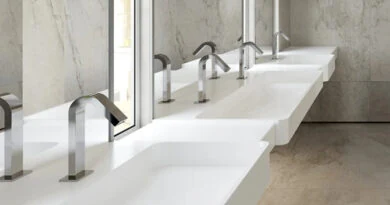
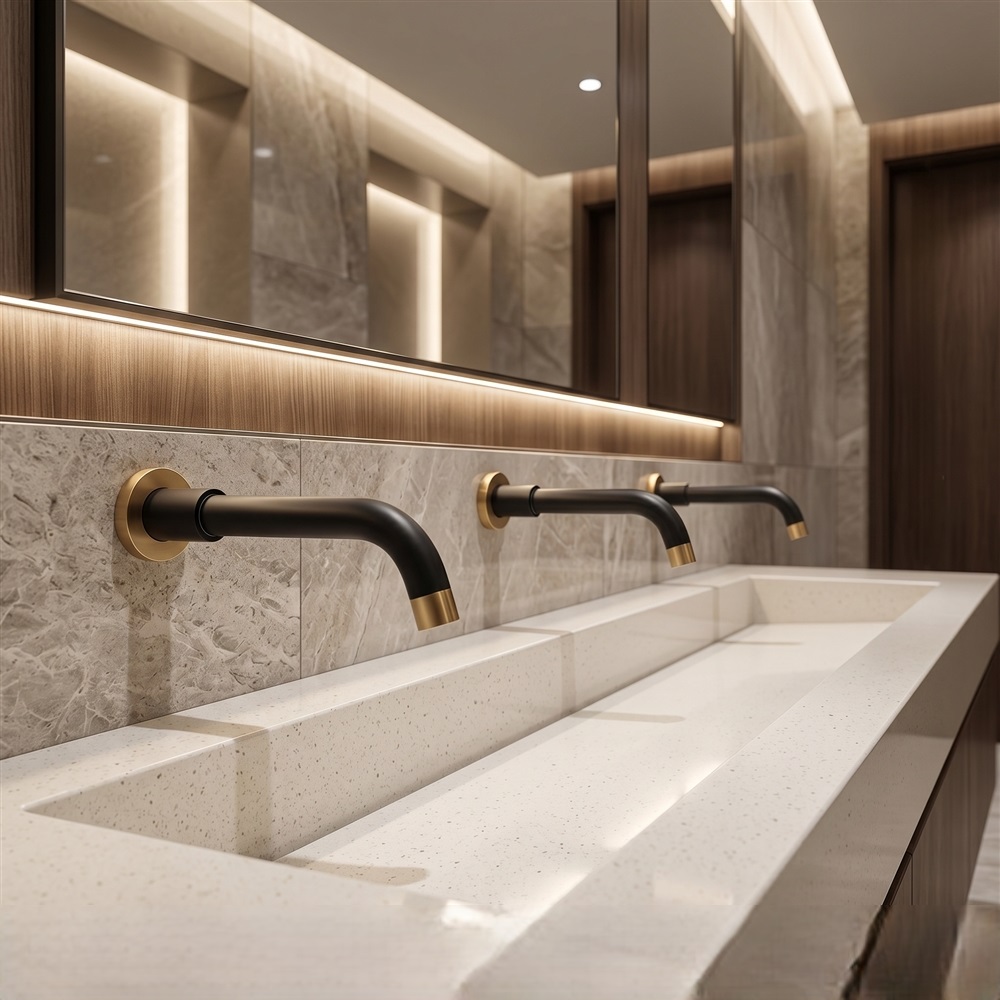
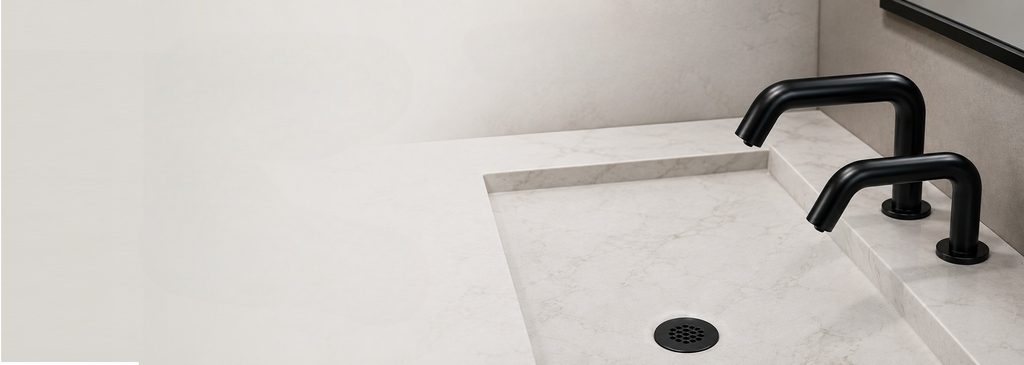
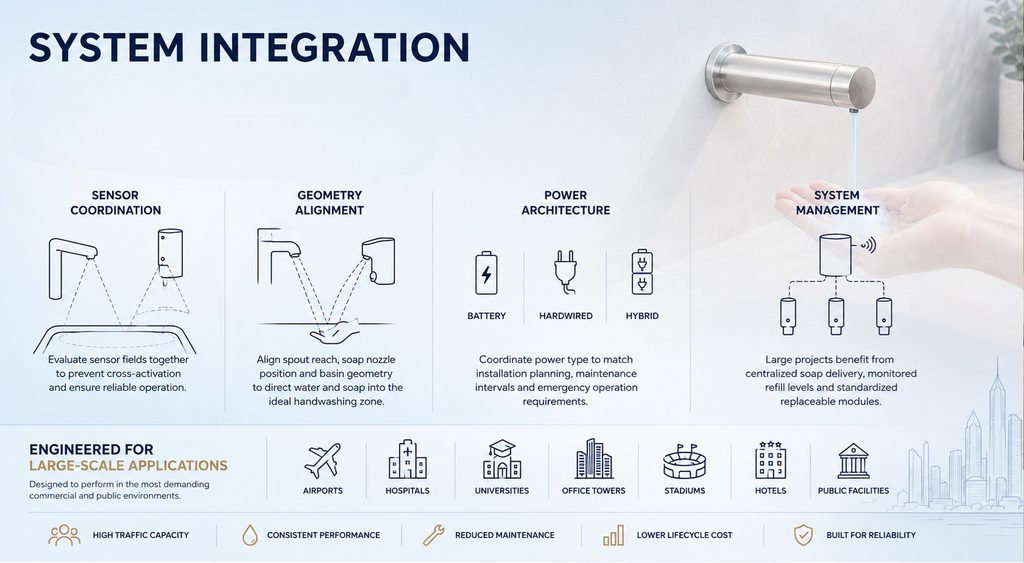
Long wash counters amplify sensor-placement problems because each fixture operates inside the optical and user environment of neighboring stations.
| Factor | Risk | Design Response |
|---|---|---|
| Faucet spacing | Detection areas overlap | Review field width and centerline spacing before finalizing the counter layout. |
| Shared reflective counter | Optical returns vary along the run | Commission end, center and corner stations. |
| Adjacent soap sensor | User movement crosses both fields | Separate the dispensing zone from the handwashing zone. |
| Shared power | One electrical problem can affect multiple stations | Document circuit grouping and failure strategy. |
| Different basin geometry | One sensor preset may not suit every station | Standardize basin and faucet combinations wherever practical. |
| High traffic | Users enter neighboring detection areas | Keep each sensor field concentrated inside its own basin. |
Stable Power Is Part of Sensor Reliability
| Power Type | Primary Benefit | Sensor Consideration | Facility Consideration |
|---|---|---|---|
| Battery | Simple retrofit with no line-voltage rough-in at faucet | Electronics must remain stable through battery discharge | Battery replacement becomes recurring maintenance. |
| Low-voltage DC | Centralized electrical supply | Provides stable power for sensing and solenoid operation | Transformer and wiring access are required. |
| Hardwired AC | Continuous building power | Supports continuous electronics operation | Electrical rough-in must be coordinated. |
| Hybrid | Combines building power with backup strategy where designed | Can improve resilience | More components must be documented and serviced. |

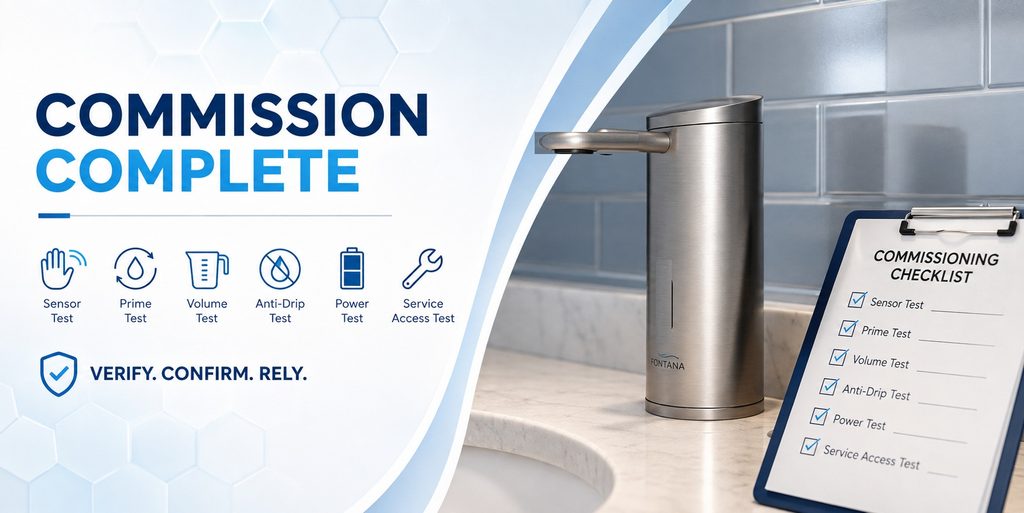
IR Sensor Faucet Commissioning Checklist
Start with a clean sensor cover so residue does not influence setup.
Confirm the basin alone does not trigger or hold the faucet on.
Test natural hand positions throughout the useful washing area.
Check normal and peak ambient-light conditions.
Walk in front of the station and check for nuisance activation.
Remove hands and verify consistent water termination.
What to Verify on a ToF Faucet
| Parameter | Verify | Why It Matters |
|---|---|---|
| Activation distance | Hands enter the defined distance band | Prevents triggering on the basin or distant objects. |
| Minimum range | Close targets are handled correctly | Reduces unstable behavior near the optical face. |
| Field of view | Detection cone excludes unrelated objects | Reduces adjacent-surface detection. |
| Offset / calibration | Installed optics and covers are accounted for | Improves distance consistency. |
| Ambient light | Ranging remains stable under project lighting | Strong optical background can reduce signal margin. |
| Target variation | Hands, gloves and realistic operating conditions | Confirms robust user detection. |
Diagnose the Sensor Before Replacing Parts
Separate sensing faults from controller, solenoid and hydraulic problems in a fixed sequence.
Verify battery condition or supply voltage.
Confirm the sensor recognizes the intended hand position.
Confirm the sensor event produces a valve command.
Verify electrical command produces valve movement.
Check shutoff valves, filters, pressure and outlet restrictions.
On identical fixtures, compare behavior against a known-good station.
Sensor Priorities by Commercial Building Type
| Facility | Priority | Typical Concern | Recommended Evaluation |
|---|---|---|---|
| Airport | Repeatability | Extreme traffic and multi-station counters | False-trigger and cross-activation testing. |
| Hospital | Predictable touch-free operation | Cleaning procedures, gloves and hygiene protocols | Test under actual facility use conditions. |
| University | Durability | High traffic and widely varying users | Validate useful range and serviceability. |
| Office tower | Consistency | Large multi-floor fixture portfolios | Mock up one representative restroom before rollout. |
| Hotel public restroom | Design integration | Dark, polished or unusual architectural finishes | Test the actual finish palette. |
| Stadium | Peak-demand reliability | Dense fixture spacing and rapid user movement | Test simultaneous neighboring users. |
Touchless Faucet Sensor Specification Checklist
Example Sensor Performance Note
Provide commercial touchless lavatory faucet with automatic hand detection suitable for the scheduled basin, countertop and finish. The faucet shall activate within the intended handwashing zone without sustained activation from the empty basin, backsplash, countertop or normal pass-by movement. Provide automatic shutoff, maximum-runtime protection where available, accessible control components, and field or automatic calibration as applicable. Commission sensor behavior under final project lighting and fixture conditions.
Sensor, Plumbing and Accessibility References
Touchless Faucet Sensor Questions
What sensor is used in a touchless faucet?
Many systems use active infrared sensing, while more advanced designs may use Time-of-Flight ranging or hybrid approaches. The exact architecture depends on the manufacturer and model.
What is the difference between IR and ToF faucet sensors?
Traditional active IR generally reacts to reflected infrared energy crossing a threshold. ToF estimates physical distance to the target, allowing the controller to define the activation region by range.
Is ToF always better than infrared?
No. Well-engineered IR can perform very reliably. ToF also depends on correct optics, field of view, range settings, power quality and commissioning.
Why do touchless faucets turn on by themselves?
Common causes include reflective basins, excessive detection range, mirrors, daylight, pass-by movement, nearby automatic fixtures and dirty sensor optics.
Can a black sink affect sensor performance?
Yes. Dark matte surfaces usually reflect less optical energy than bright surfaces. This can reduce sensing margin, particularly in reflected-intensity IR systems.
Can mirrors interfere with touchless faucets?
Yes. Mirrors and polished backsplashes can redirect optical energy depending on sensor angle and fixture geometry.
Does sunlight interfere with infrared faucets?
Strong ambient infrared energy can influence optical sensing. Commercial sensors use filtering and signal processing, but significant daylight exposure should still be tested.
Does ambient light affect Time-of-Flight sensors?
Yes. ToF is not immune to ambient light. Strong optical background can reduce usable range or signal quality.
What causes cross-activation between adjacent fixtures?
Overlapping user zones, shared reflective surfaces, pass-by movement and sensor field geometry are common causes. Multi-station systems should be tested with simultaneous users.
How far should a touchless faucet detect hands?
There is no universal best distance. The sensor should reliably cover the natural handwashing area without extending unnecessarily toward the front edge of the counter or adjacent stations.
What should be tested during commissioning?
Check activation range, hand coverage, empty-basin behavior, pass-by movement, ambient light, shutoff, maximum runtime, neighboring fixtures, power and water delivery.
Can dirty optics cause faucet problems?
Yes. Soap residue, mineral deposits and cleaning chemicals can alter the optical path through the sensor cover.
Why does the sensor detect hands but no water comes out?
If detection is confirmed, the fault may be downstream in the controller output, solenoid valve, shutoff valve, filter, water supply, pressure or outlet.
What is sensor calibration?
Calibration establishes how the control system interprets the installed optical environment. Depending on the product, this can include sensitivity, distance offset, threshold or range configuration.
“IR” and “ToF” describe broad sensing approaches, not guaranteed levels of faucet performance. Actual results depend on the complete fixture: sensor hardware, optics, firmware, mounting location, basin geometry, finish reflectance, lighting, power, maintenance and commissioning.
Reliable Sensor Performance Is a System-Level Design Problem
A commercial touchless faucet should distinguish hands from surrounding surfaces, respond without perceptible delay, shut off predictably and remain stable across real restroom conditions. Sensor technology matters, but basin geometry, power architecture, fixture spacing and commissioning matter just as much.