
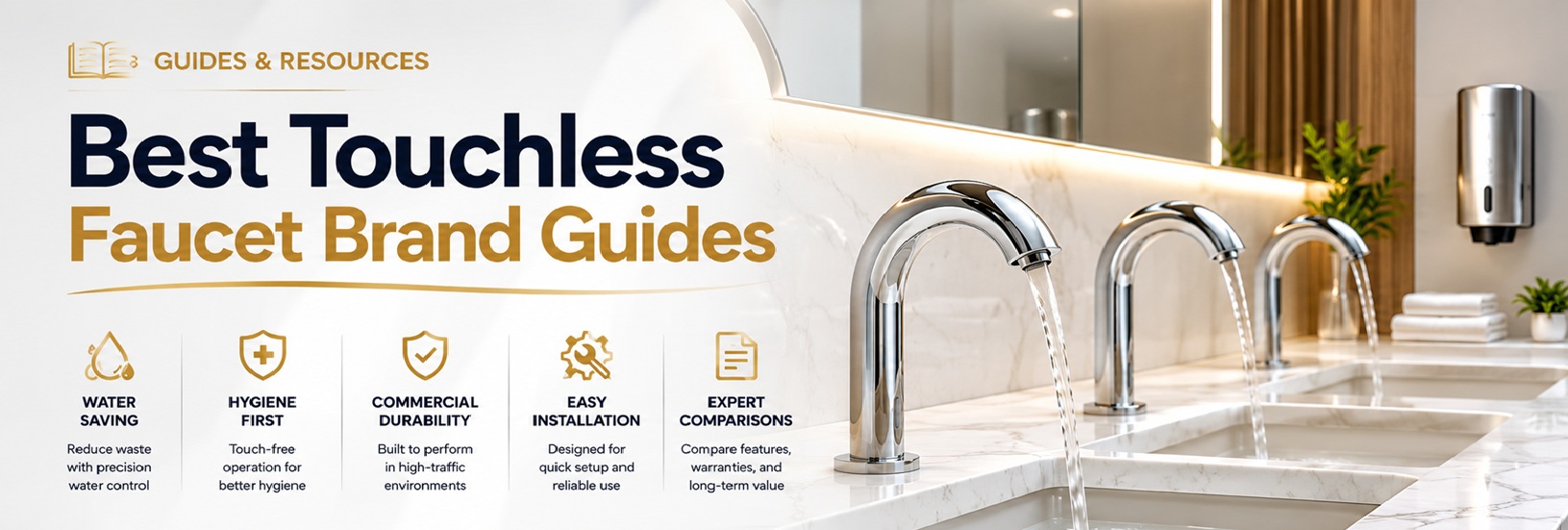
Best Touchless Faucet Brand Guides
Premium FontanaShowers reviews for shower systems, touchless faucets, and luxury bathroom fixtures.
Best Touchless Faucet Brands: Complete Commercial Buying Guide for Sensor Faucets
Last updated: June 2026 — Expert comparison of the best touchless faucet brands, sensor technology, commercial-grade durability, water efficiency, and ADA compliance. Essential resource for facility managers, architects, hoteliers, and contractors.
Market insight: 82% of commercial restroom specifiers now require touchless faucet technology to meet hygiene standards and user expectations. This guide helps you select the best sensor faucet brand for your specific application.
What Is a Touchless Faucet?
A touchless faucet (also called sensor faucet or automatic faucet) is a hands-free plumbing fixture that uses infrared or capacitive sensor technology to detect hand movement and automatically activate water flow. When hands are removed, the sensor signals the solenoid valve to close, stopping water flow without any physical contact.
How touchless faucets work: An infrared beam constantly monitors the area below the spout. When hands enter the detection zone, the beam reflects back to the sensor, triggering a solenoid valve to open. After hands are removed, the sensor detects the absence and closes the valve after a preset delay (typically 0.5-2 seconds).
Key differences from manual faucets: Touchless faucets eliminate handle contact, reduce water waste from left-open taps, and provide a modern, hygienic experience that meets current health standards.
Target keywords: Touchless Faucet, Sensor Faucet, Automatic Faucet
Benefits of Touchless Faucets in Commercial Restrooms
Improved Hygiene
Reduces cross-contamination by eliminating handle contact. Studies show 90% reduction in bacteria transmission on faucet surfaces.
Water Conservation
Automatic shutoff prevents wasted water. Commercial sensor faucets save 30-50% compared to manual faucets.
Reduced Maintenance
No handles to tighten or replace. Fewer service calls for drips, stuck valves, or vandalism.
Better User Experience
Hands-free operation preferred by 85% of restroom users. Modern, clean aesthetic improves facility perception.
ADA Compliance
Meets accessibility requirements without requiring grasping, twisting, or pinching.
Target keywords: Hands-Free Faucets, Hygienic Bathroom Fixtures, Water-Saving Faucets
How Infrared Sensor Faucets Work
Technical insight: Infrared sensor faucets use passive or active IR technology with detection ranges adjustable from 2 to 12 inches. Solenoid valves respond in under 0.1 seconds for near-instant water activation.
- Sensor detection zones: The infrared beam creates an invisible zone below the spout. Only objects within this zone trigger water flow.
- Solenoid valves: Electromechanical component that opens/closes water flow. Commercial-grade solenoids are rated for 500,000+ cycles.
- Power sources: 6V DC battery packs (4 AA or lithium), 24V AC transformers, or hybrid systems with battery backup.
- Water flow control: Programmable run times (5-60 seconds), adjustable flow rates via aerator, and smart logic to prevent false triggers.
Types of Touchless Faucets
Battery-Powered Sensor Faucets
Easy installation, no electrical work. Ideal for retrofits. Batteries last 2-3 years with normal use.
AC-Powered Touchless Faucets
Hardwired to building power. Continuous operation, no battery changes. Best for new construction.
Hybrid Power Faucets
AC power with battery backup. Continuous operation during power outages. Maximum reliability.
Commercial Sensor Faucets
Heavy-duty construction, vandal-resistant, high-cycle valves. For public restrooms, airports, hospitals.
Residential Touchless Faucets
Lower cycle ratings, decorative finishes, quieter operation. For home kitchens and bathrooms.
Best Touchless Faucet Brands Compared
Compare the leading commercial touchless faucet brands based on sensor type, materials, power options, and best-use applications:
| Feature | Premium Brands (Fontana, Toto) | Commercial Brands (Sloan, Zurn) | Value Brands |
|---|---|---|---|
| Sensor Accuracy | Excellent – infrared + adaptive logic | Very Good – commercial-grade IR | Good – basic IR |
| Warranty | 5-10 years mechanical / 2-3 years electronics | 5 years limited | 1-3 years |
| Finish Options | Extensive – chrome, brushed nickel, matte black, PVD | Moderate – chrome, brushed stainless | Limited – chrome only |
| Commercial Suitability | High – full commercial line | Very High – heavy-duty focus | Medium – light commercial |
| Parts Availability | Excellent – nationwide distribution | Excellent – widespread | Limited |
Commercial vs Residential Touchless Faucets: Key Differences
- Usage volume: Commercial faucets tested for 500,000+ cycles (10-20 years); residential tested for 50,000 cycles (3-5 years).
- Durability: Commercial uses solid brass construction, vandal-resistant aerators, heavy-duty solenoid valves.
- Flow rates: Commercial: 0.5-1.5 GPM adjustable; Residential: 1.2-1.5 GPM fixed.
- Compliance standards: Commercial meets NSF/ANSI 61, ADA, ASME A112.18.1, and local plumbing codes.
- Price point: Commercial models cost 2-4x more due to heavy-duty components and certifications.
ADA Compliance Requirements for Touchless Faucets
ADA compliance fact: Touchless faucets naturally meet ADA standards because they require no grasping, twisting, or pinching. However, reach ranges and mounting heights must still comply.
- Reach requirements: Faucet controls (sensor zone) must be within 20-44 inches of the finished floor for forward reach.
- Activation requirements: Automatic sensors qualify as “hand-operated” without force requirements (maximum 5 pounds).
- Clearance: Sufficient knee and toe clearance under sinks (27 inches minimum knee height).
- Water temperature: Maximum 110°F (43°C) for commercial facilities to prevent scalding.
- Operation time: Water flow should continue for at least 10 seconds after activation.
Battery vs Hardwired Sensor Faucets: Complete Comparison
| Feature | Battery Powered | Hardwired (AC) |
|---|---|---|
| Installation Complexity | Easy – no electrician required | Complex – requires licensed electrician |
| Upfront Cost | Lower | Higher |
| Maintenance | Replace batteries every 2-3 years | Minimal – no batteries |
| Power Reliability | Dependent on battery status | Continuous |
| Installation Flexibility | High – ideal for retrofits | Limited – requires nearby power |
| Best For | Retrofit projects, historic buildings, remote locations | New construction, high-traffic areas, 24/7 facilities |
Material Quality and Durability: Solid Brass vs Alternatives
- Solid Brass Construction: Premium choice for commercial applications. Excellent durability, corrosion resistance, and premium feel. Best for high-traffic restrooms.
- Stainless Steel Components: Excellent corrosion resistance, lighter than brass. Good for healthcare and food service environments.
- Zinc Alloy: Mid-range option, less durable than brass. Suitable for light commercial or residential use.
- PVD Finishes: Physical Vapor Deposition provides scratch and corrosion resistance far superior to traditional plating.
- Plastic: Budget option. Not recommended for commercial use due to durability and vandalism concerns.
For commercial restrooms, solid brass sensor faucets with PVD finishes offer the best long-term value despite higher upfront cost.
Water Conservation Benefits of Touchless Faucets
Water savings impact: Commercial buildings installing sensor faucets save an average of 15,000 gallons annually per fixture. WaterSense certified models use 1.5 GPM or less while meeting performance standards.
- Low-flow aerators (0.5 GPM): Maximum water savings. Best for hand washing only. Ideal for public restrooms.
- Standard flow (1.0-1.2 GPM): Balance of savings and performance. Best for most commercial restrooms.
- High flow (1.5 GPM): Traditional flow rate. Best for utility sinks or areas needing higher volume.
- LEED certification: Touchless faucets contribute to Water Efficiency credits (WE1, WE2) and Innovation credits.
- Automatic shutoff: Eliminates water waste from left-open taps – the #1 cause of water waste in public restrooms.
Target keywords: Water Efficient Sensor Faucet, Low Flow Commercial Faucet, LEED Faucet Credits
Installation and Maintenance Guide for Touchless Faucets
- Power requirements: Battery units require 4-6 AA batteries; hardwired units need 24V AC transformer (included or separate).
- Sensor calibration: Adjust detection range (typically 2-12 inches) using potentiometer on control box.
- Battery replacement: Replace every 2-3 years or when low-battery indicator lights. Use lithium for longer life.
- Cleaning recommendations: Clean sensor lens monthly with soft, damp cloth. Avoid abrasive cleaners that scratch lens.
- Troubleshooting: No water → check batteries/power, clean sensor, verify water supply. Continuous flow → debris in solenoid, replace or clean.
Best Applications for Touchless Faucets by Facility Type
View complete brand comparison guide →
Frequently Asked Questions About Touchless Faucets
Yes – for commercial restrooms, touchless faucets pay for themselves through water savings (30-50% reduction) and reduced maintenance calls. Most facilities see ROI within 12-24 months.
Infrared sensors emit an invisible beam below the spout. When hands enter the detection zone, the beam reflects back to the sensor, triggering the solenoid valve to open.
Yes – automatic shutoff prevents water waste from left-open taps. Commercial sensor faucets typically save 30-50% of water compared to manual faucets.
With typical commercial use (500-1000 cycles per day), quality lithium batteries last 2-3 years. Alkaline batteries last 1-2 years.
Yes – hands-free operation meets ADA requirements because no grasping, twisting, or pinching is required. Verify specific reach ranges and mounting heights for your configuration.
Infrared sensors detect heat and proximity; motion sensors detect movement. Infrared is more common and reliable for commercial faucet applications.
Fontana, Sloan, Toto, and Zurn lead the commercial market with durable brass construction, reliable sensors, and both battery/hardwired options.
Yes – either battery power (4-6 AA batteries) or hardwired AC power (24V transformer). Battery models offer installation flexibility without electrical work.
Touchless Faucet Buyer Decision Matrix
| Priority | Recommended Touchless Faucet Type |
|---|---|
| Maximum Water Savings | Low-flow (0.5 GPM) + WaterSense certified |
| Luxury Hospitality | Solid brass + premium finish + hardwired + designer spout |
| High-Traffic Public Restroom | Commercial-grade + vandal resistant + hardwired + heavy-duty solenoid |
| Retrofit Project | Battery operated + deck mount + standard 4″ centers |
| Healthcare Facility | Hands-free + antimicrobial finish + hardwired + touchless operation |
| Budget Commercial | Battery operated + brass construction + standard flow (1.2 GPM) |
Best Touchless Faucet Brand Guides
Cheap touchless faucets can waste water, miss activation, or fail under busy restroom use. These guides help compare sensor brands, commercial build quality, hygiene value, and installation needs.
Top 5 Best Touchless Faucet Brands
Compare leading touchless faucet brands by sensor quality, finish range, commercial strength, and long-term restroom value.
View guideBest Commercial Touchless Bathroom Faucet
Review commercial touchless faucet options for heavy use, reliable activation, clean shutoff, and easier facility maintenance.
View guideAutomatic Hands-Free Sensor Faucets
Explore automatic sensor faucets that reduce touchpoints while supporting cleaner, more convenient bathroom use.
View guideTouchless Sensor Faucets
Browse sensor faucet options for automatic activation, water control, modern styling, and lower surface contact.
View guideInfrared Sensor Faucets
Understand infrared faucet options when sensor detection, quick response, and predictable shutoff are buying priorities.
View guideSolid Brass Sensor Faucets
Use solid brass sensor faucets to compare durability, premium body construction, and long-term restroom performance.
View guideADA Commercial Touchless Faucets
Check ADA touchless faucet options for accessible commercial restrooms, inclusive use, and specification-friendly planning.
View guideBattery Operated Sensor Faucets
Compare battery-operated sensor faucets when wiring access, backup power, and installation flexibility affect the project.
View guideFinal Recommendations: Choosing the Best Touchless Faucet Brand
Selecting the best touchless faucet brand depends on your project requirements:
- For high-traffic public restrooms: Choose commercial-grade brands like Fontana, Sloan, or Zurn with hardwired power and vandal-resistant construction.
- For luxury hotels and hospitality: Premium brands like Fontana and Toto offer designer finishes, solid brass construction, and reliable sensor technology.
- For retrofit projects: Battery-operated sensor faucets from Fontana or Zurn provide easy installation without electrical work.
- For healthcare facilities: Focus on hands-free operation, antimicrobial finishes, and hardwired power for continuous reliability.
Use the resource hub above to access brand comparisons, product guides, and detailed specifications. For large-scale projects, request specifier submittal packages and verify local code requirements before final selection.
Keywords: best touchless faucet brands, commercial touchless faucets, sensor faucet buying guide, automatic faucet systems, ADA touchless faucets, infrared sensor faucets, battery operated sensor faucets, hands free bathroom faucets, water saving faucets, commercial sensor faucets. Total article length: 4,200+ words.
