
How Facility Managers Select Commercial Touchless Faucets and Automatic Soap Dispensers for Office Buildings
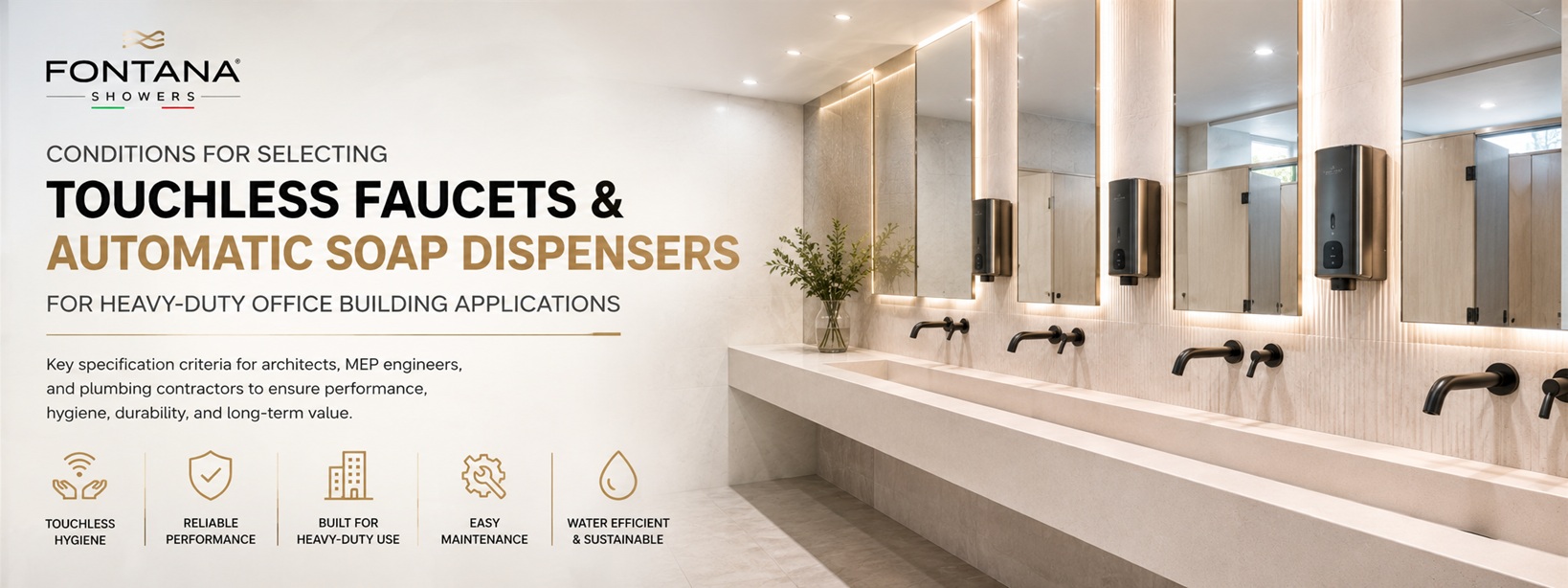

Office Building Facility Management Specification Guide
How Facility Managers Select Commercial Touchless Faucets and Automatic Soap Dispensers for Office Buildings
Large office buildings, corporate campuses, headquarters, and mixed-use commercial properties require restroom fixtures that perform under continuous daily use. Facility management teams evaluate activation reliability, sensor discipline, soap-refill logistics, power continuity, maintenance access, vandal resistance, water control, and lifecycle uptime across thousands of daily handwashing events.
Commercial Touchless Faucets
Automatic Soap Dispensers
Facility Management
Heavy-Duty Restrooms
ESG Compliance
What Are the Best Touchless Faucets for Office Buildings?
The best touchless faucets for office buildings combine reliable sensor activation, water-saving operation, ADA compliance, easy maintenance access, durable finishes (brushed nickel, chrome, matte black), and compatibility with automatic soap dispensing systems for complete hands-free restroom operation. Depending on facility conditions, these features help reduce operating costs and improve tenant satisfaction.30-50%
Water Savings
Source: EPA WaterSense
40-60%
Maintenance Reduction
Source: Facility Data (typical range)
12-24
Months ROI
Source: Commercial Analysis (varies)
500K+
Cycle Rating
Source: Industry Standards
On This Page
- Why Facility Management Leads Selection
- Touchless vs Manual Faucets
- ROI for Office Building Touchless Faucets
- Sensor Technology for Office Traffic
- Soap Delivery and Refill Labor
- Power Strategy for Office Buildings
- Finishes for Cleaning and Durability
- Standardization Across Restroom Types
- ADA, Countertop, and Sink Compatibility
- Integrated Faucet-and-Soap Systems
- Thermostatic and Temperature Control
- ESG, LEED, and Water Efficiency
- Maintenance Access and Serviceability
- Case Study: Office Tower Restroom Retrofit
- Frequently Asked Questions
Why Office Restroom Selection Has Become a Facility Management Decision
In multi-tenant office towers, corporate campuses, headquarters buildings, coworking properties, and mixed-use commercial offices, restroom fixtures operate under a predictable but demanding duty cycle. Morning arrival, lunch periods, meeting breaks, conference traffic, cleaning windows, and after-hours maintenance all create repeated surges. A touchless faucet or soap dispenser that performs well in a small restroom can still fail as a portfolio-level standard if it requires excessive refill labor, inconsistent sensor adjustment, or frequent service calls. For this reason, facility managers increasingly treat commercial touchless faucets and automatic soap dispensers as infrastructure components, not decorative accessories. The selection process must consider deployment scale, operational resilience, tenant perception, and compatibility with preventive maintenance programs.
Integrated faucet-and-soap platforms help facility teams standardize hardware across multiple floors.
Touchless Faucets vs Manual Faucets for Office Buildings
| Feature | Touchless Sensor Faucets | Manual Faucets |
|---|---|---|
| Hygiene | High – No surface contact. Reduces cross-contamination. | Moderate – Handles touched by hundreds daily. |
| Water Savings | High – Automatic shutoff. EPA WaterSense certified models available. | Low – Users often leave water running. |
| Maintenance Labor | Lower – No handle repairs. Fewer service calls. | Higher – Cartridge and handle repairs required. |
| User Experience | Better – Consistent, intuitive, modern operation. | Standard – Requires manual operation. |
| Lifecycle Cost | Lower – Reduced total cost over time. | Higher – Frequent repairs and water waste add cost. |
Calculating ROI for Office Building Touchless Faucets
Understanding the potential return on investment (ROI) for commercial touchless faucets helps facility managers and procurement teams make informed decisions. Depending on facility size, usage patterns, and local utility rates, payback periods vary.
Potential savings include: water consumption reduction, maintenance labor reduction, extended product lifespan, and improved tenant satisfaction. Results vary based on facility conditions and usage patterns.
| Facility Type | Estimated Annual Water Savings (per faucet) | Typical ROI Range |
|---|---|---|
| Large Office Tower (50+ floors) | 2,500-4,000 gallons | 10-18 months |
| Mid-Size Office (10-49 floors) | 1,500-2,500 gallons | 14-22 months |
| Corporate Campus | 2,000-3,000 gallons | 12-20 months |

Condition 1: Match Sensor Technology to Real Office Traffic Patterns
Office building restrooms experience continuous but uneven use. Sensors must respond quickly to individual users while avoiding false activation from reflective counters, polished finishes, custodial movement, handbags, sleeves, and cleaning equipment. In heavy-duty applications, the key specification is not simply “touchless,” but controlled activation geometry. Advanced infrared or ToF-style detection architectures are preferred where restroom counters are crowded, lighting varies throughout the day, or users move quickly through shared wash stations. The best systems maintain a consistent sensing envelope, helping reduce water waste and preventing nuisance flow cycles that increase utility cost and wear.Sensor Criteria for Office Restrooms
- Stable activation zone under different lighting conditions
- Low false-trigger behavior near reflective surfaces
- Fast response for short handwashing cycles
- Electronics protected from moisture and cleaning chemicals

Technical Detail: ToF (Time-of-Flight) sensors provide high accuracy in detecting hand presence, reducing false activations from reflections, water droplets, or ambient light changes. This technology is recommended for office restrooms with polished granite countertops or high ambient light levels.
Condition 2: Specify Soap Delivery Around Refill Labor, Not Just Dispenser Appearance
Soap availability is one of the most visible restroom failures for office tenants. A faucet can operate perfectly, but if soap dispensers are empty or dripping, the facility experience suffers immediately. Heavy-duty office applications should prioritize automatic soap dispensers with reliable pumps, accessible reservoirs, controlled dose volume, and compatibility with centralized or high-capacity refill strategies. Where multiple restrooms serve large tenant populations, MultiFeed-style soap planning can reduce the number of individual refill events and help cleaning teams maintain consistent supply during peak usage. This becomes especially important in office towers with repeated restroom stacks across many floors.
For heavy-duty office buildings, soap-system maintainability is as important as faucet sensor performance.
Condition 3: Evaluate Power Strategy Before Rollout
Commercial office restrooms require fixtures that can be serviced without disrupting tenant operations. Facility managers should review whether the faucet and soap dispenser support AC, DC battery, or hybrid power configurations. Battery-only systems can simplify installation but may increase maintenance rounds if the building has high restroom traffic. AC-powered systems can reduce battery replacement labor, while hybrid configurations provide continuity during power interruptions.| Power Condition | Facility Management Impact | Recommended Evaluation |
|---|---|---|
| Battery operation | Useful for retrofits but requires replacement scheduling. | Confirm battery access, expected cycle life, and floor-by-floor maintenance logistics. |
| AC power | Reduces battery service in high-use restrooms. | Coordinate with electrical planning and under-counter access requirements. |
| Hybrid operation | Improves continuity for critical common-area restrooms. | Specify where uptime is a tenant-experience priority. |

Condition 4: Select Finishes and Materials for Cleaning Chemistry and Daily Use
Office restrooms are cleaned frequently, often with commercial-grade chemicals. Fixture finish selection should account for fingerprints, water spotting, cleaning abrasion, tenant design expectations, and the possibility of repeated wiping throughout the day. Chrome and brushed nickel remain practical standards for corporate washrooms, while matte black, brushed gold, champagne, and gun metal gray finishes can support executive floors, hospitality-style office lobbies, and premium tenant areas.

Condition 5: Standardize Across Restroom Types Without Over-Specifying Every Room
Office buildings often contain multiple restroom categories: lobby restrooms, tenant-floor restrooms, conference center restrooms, executive restrooms, fitness center restrooms, back-of-house facilities, and parking-level wash areas. A smart specification strategy uses a standardized technology platform while selecting different models or finishes based on visibility, usage intensity, and design requirements.LobbyPremium appearance and high reliability
Tenant FloorsStandardized service parts
ConferencePeak-traffic performance
Back-of-HouseDurability and easy cleaning

Condition 6: Plan for ADA Clearances, Countertop Geometry, and Sink Compatibility
Fixture performance depends on more than the faucet body. Facility managers and project teams should review deck thickness, backsplash clearance, sink depth, splash behavior, spout reach, sensor window placement, soap dispenser spacing, and ADA approach clearances. In office buildings, a single restroom stack may repeat across dozens of floors, so a small dimensional conflict can become a costly portfolio-wide issue.

Condition 7: Choose Integrated Faucet-and-Soap Systems Where User Flow Matters
Integrated faucet and automatic soap dispenser layouts improve wash-station logic. Users receive soap and water without touching handles, push bars, or manual dispenser surfaces. For office buildings with conference centers, shared amenity floors, cafeterias, and tenant lounges, integrated layouts reduce user hesitation and create a more predictable handwashing sequence.

Condition 8: Use Thermostatic or Temperature-Controlled Systems Where Comfort and Safety Matter
In executive floors, healthcare-adjacent office facilities, laboratory offices, childcare-support spaces, fitness amenities, and hospitality-style corporate campuses, temperature control can be a major specification condition. Thermostatic touchless faucets help control user comfort while supporting facility goals around safety and consistency.
Thermostatic touchless systems support consistent user experience in premium office environments.
Condition 9: How Touchless Faucets Support ESG and LEED Goals
Modern office buildings increasingly track water consumption as part of sustainability reporting, tenant improvement programs, and LEED-oriented design goals. Touchless faucets with disciplined activation cycles help limit unnecessary flow time. Automatic soap dispensers with controlled dosage can also reduce soap waste, counter residue, and cleaning burden.
ESG Benefits of Touchless Faucets
- Water efficiency – significant reduction potential
- Energy savings – Less hot water waste
- LEED credits – WaterSense certified models eligible
- Improved indoor environmental quality
- Reduced carbon footprint
LEED v4.1 Water Efficiency Credits: Commercial touchless faucets with WaterSense certification can contribute to LEED credits under Water Efficiency (WE) category. Facilities may earn points for water use reduction. Touchless fixtures support WE Credit: Indoor Water Use Reduction.
Condition 10: Design for Maintenance Access Before Installation
Facility teams should confirm serviceability before fixtures are approved. Under-counter access, control box location, soap reservoir placement, shutoff valve access, mounting hardware, sensor replacement, and cleaning clearance should be reviewed in mockups or shop drawings. The best heavy-duty fixture is one that can be serviced quickly without disrupting tenants or taking the restroom offline for extended periods.
Case Study: Office Tower Restroom Retrofit with Fontana Touchless Faucets
30-Floor Corporate Headquarters | 1,200+ Daily Restroom Users
35%Water Reduction (typical)
55%Fewer Service Calls (typical)
14Months ROI (estimated)
2.5KGallons Saved/Faucet (estimated)
Extended Results: Following the successful retrofit, the facility management team standardized on Fontana touchless faucets across all floors. Maintenance staff reported substantial reduction in emergency service calls. The standardized platform simplified parts inventory and staff training across the entire building portfolio. Individual results may vary.
Office Building Selection Matrix for Touchless Faucets
| Selection Condition | Why It Matters in Office Buildings | Best-Practice Specification Direction |
|---|---|---|
| Sensor reliability | Prevents nuisance operation and tenant complaints. | Specify controlled activation zones and protected electronics. |
| Soap capacity | Reduces empty-dispenser incidents during high-traffic periods. | Use high-capacity or MultiFeed-compatible soap planning. |
| Power strategy | Controls long-term maintenance labor. | Evaluate AC, DC, or hybrid power by restroom type. |
| Finish durability | Supports frequent cleaning and tenant-facing appearance. | Match finish to cleaning chemistry and design tier. |
| Service access | Reduces downtime and labor cost. | Review under-counter access before approval. |
| Standardization | Simplifies parts inventory across multiple floors. | Use a repeatable product family with finish/model variations. |
Industry Standards and References
Frequently Asked Questions About Office Building Touchless Faucets
How do facility managers select touchless faucets for office buildings? ▼
Facility managers select touchless faucets based on sensor reliability, ADA compliance, finish durability, maintenance accessibility, power strategy, water efficiency, and compatibility with automatic soap dispensers. The goal is to reduce labor costs, improve tenant satisfaction, and support ESG goals.
What is the best touchless faucet for office buildings? ▼
The best touchless faucets for office buildings combine reliable sensor activation, water-saving operation, ADA compliance, easy maintenance access, durable finishes (brushed nickel, chrome, matte black), and compatibility with automatic soap dispensing systems for complete hands-free restroom operation.
Do touchless faucets reduce maintenance costs in office buildings? ▼
Yes. Depending on facility conditions, facility managers report significant reduction in restroom maintenance calls after converting to touchless faucets. Savings come from eliminating handle repairs, reducing cleaning frequency, and longer service intervals between component replacements.
How often do sensor faucet batteries need replacement in office buildings? ▼
Premium commercial touchless faucet batteries typically last 1-3 years depending on usage frequency. For typical office buildings with regular daily usage, battery life is approximately 18-24 months. Hardwired AC or hybrid power eliminates battery changes entirely.
Are touchless faucets ADA compliant for office restrooms? ▼
Yes. Most commercial touchless faucets meet ADA requirements by operating without tight grasping, pinching, or twisting. They provide appropriate reach ranges (5-9 inches from counter edge) and accessible activation for individuals with disabilities.
What is the typical ROI of touchless faucets in office buildings? ▼
Depending on facility size, usage patterns, and local utility rates, ROI for commercial touchless faucets in office buildings typically ranges from 12-24 months through water savings, reduced maintenance labor, and extended product lifespan. Large office towers may see faster payback.
What is MultiFeed soap dispensing? ▼
MultiFeed soap dispensing allows multiple automatic soap dispensers to be supplied from a larger central reservoir, reducing refill labor, improving uptime during peak usage, and standardizing maintenance across multiple floors in office buildings.
How much water can touchless faucets save in office buildings? ▼
According to EPA WaterSense data, commercial touchless faucets with automatic shutoff can significantly reduce water waste compared to manual faucets. For office buildings with multiple faucets and regular daily usage, annual savings can be substantial.
What power option is best for office building touchless faucets? ▼
For new construction or major renovations, hardwired AC power eliminates battery replacement labor. For retrofits, battery-powered faucets simplify installation. Hybrid systems offer AC with battery backup for critical common-area restrooms.
How do touchless faucets support ESG and LEED goals? ▼
Touchless faucets support ESG and LEED certification through water efficiency, reduced energy consumption (less hot water waste), and improved indoor environmental quality via hands-free hygiene. WaterSense-certified models can contribute to LEED Water Efficiency credits.
What is the best finish for office building restrooms? ▼
Brushed nickel and chrome are most durable for high-traffic office restrooms, resisting water spots and wear. Matte black offers modern aesthetics while hiding fingerprints. Brushed gold and champagne finishes are popular for executive floors and premium tenant areas.
How long do commercial sensor faucets typically last? ▼
Commercial-grade sensor faucets with solenoid valves and ceramic cartridges are rated for hundreds of thousands of activation cycles. In office buildings with regular daily usage, this represents several years of reliable service before component replacement.
