


Commercial Specification
Specifying a commercial automatic soap dispenser requires more than selecting a touchless fixture from a catalog. Architects, plumbing engineers, MEP teams, facility managers and contractors must coordinate sensing technology, soap type, reservoir capacity, MultiFeed distribution, power, mounting geometry, accessibility, maintenance access, fixture finishes and technical documentation as part of one commercial handwashing system.
Commercial Automatic Soap Dispenser Sizing Calculator: What Tank Capacity Do You Need for 2, 4, 6, 8 or 12 Dispensers?
How large should a commercial automatic soap dispenser reservoir actually be? The answer should not be based on dispenser count alone. A proper calculation combines the number of dispensing positions, real daily activations, soap dose, desired refill interval, operating schedule and a practical reserve capacity. This guide gives architects, MEP engineers and facility managers a repeatable method for sizing individual and centralized MultiFeed soap systems.
The Correct Tank Size Depends on Soap Demand — Not Just Basin Count
A twelve-dispenser restroom does not automatically need a 10-liter tank. Likewise, a four-dispenser restroom does not automatically need four individual one-liter bottles.
The correct capacity depends on how quickly the soap will actually be used and how often the facility wants maintenance personnel to refill it.
The most important sizing inputs are:
The Commercial Soap Reservoir Sizing Formula
For example, assume:
Under those assumptions, a nominal 5-liter reservoir is approximately in the required capacity class, while a 6-liter reservoir provides additional margin.
Quick Sizing Calculator: 2, 4, 6, 8 or 12 Dispensers
The following first scenario represents a moderate commercial planning case:
| Dispensers | Daily Soap Use | 3-Day Base Requirement | With 20% Reserve | Practical Capacity Class |
|---|---|---|---|---|
| 2 | 0.20 L/day | 0.60 L | 0.72 L | ≈1 L class |
| 4 | 0.40 L/day | 1.20 L | 1.44 L | ≈1.5–2 L class |
| 6 | 0.60 L/day | 1.80 L | 2.16 L | ≈2.5–3 L class |
| 8 | 0.80 L/day | 2.40 L | 2.88 L | ≈3 L class |
| 12 | 1.20 L/day | 3.60 L | 4.32 L | ≈5 L class |
High-Traffic Sizing: When Reservoir Requirements Rise Quickly
Now consider a much busier facility:
| Dispensers | Daily Demand | 2-Day Demand | With 25% Reserve | Suggested Planning Class |
|---|---|---|---|---|
| 2 | 0.60 L/day | 1.20 L | 1.50 L | 1.5–2 L |
| 4 | 1.20 L/day | 2.40 L | 3.00 L | ≈3 L |
| 6 | 1.80 L/day | 3.60 L | 4.50 L | 5–6 L |
| 8 | 2.40 L/day | 4.80 L | 6.00 L | ≈6 L |
| 12 | 3.60 L/day | 7.20 L | 9.00 L | ≈10 L |
This is the scenario in which a 10-liter centralized system becomes particularly logical: twelve dispensing positions, significant daily demand, a two-day service objective, and a reasonable contingency reserve.
When Should You Use a MultiFeed Central Reservoir?
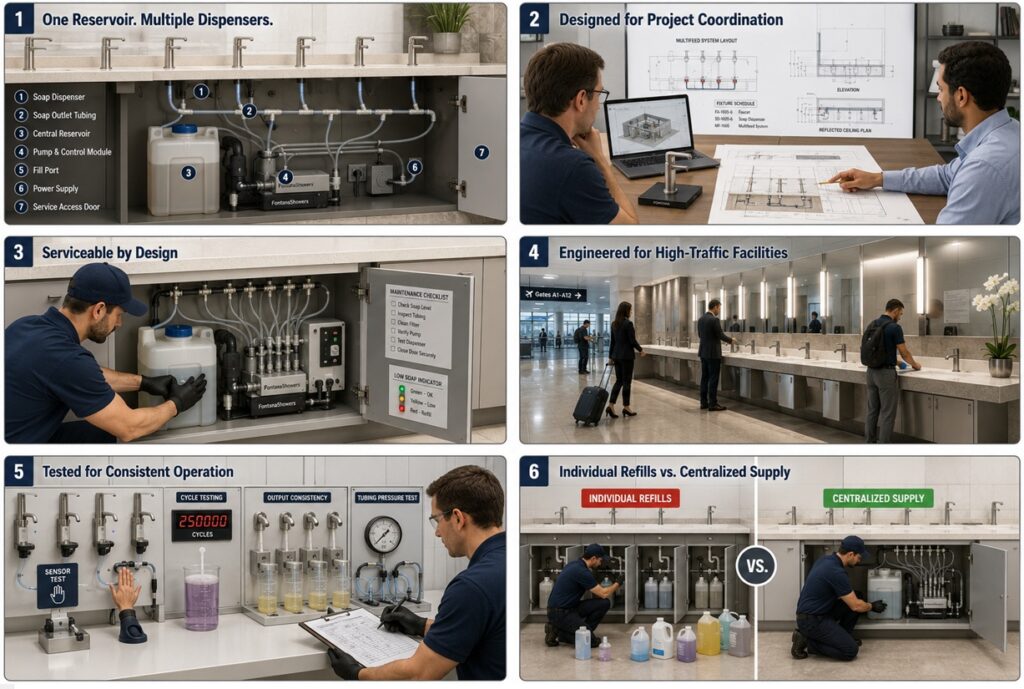
The need for a central reservoir is not determined only by total liters. MultiFeed becomes attractive when centralization also reduces maintenance complexity.
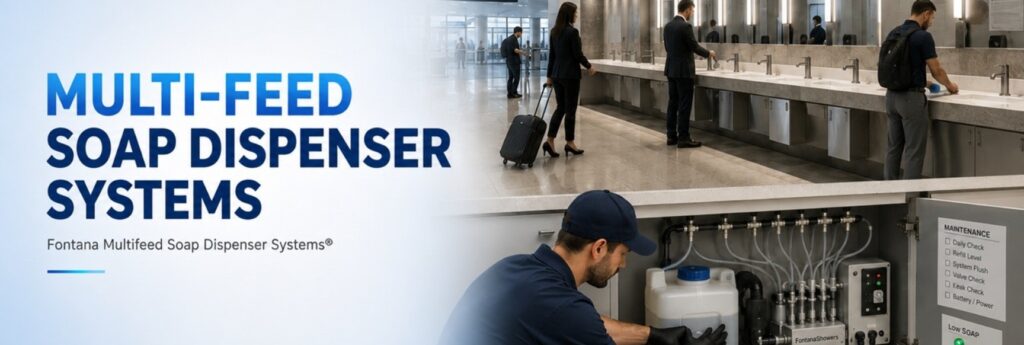
Fontana’s current MultiFeed guidance says reservoir selection should be based on actual restroom usage rather than dispenser count alone and identifies daily users, soap volume per activation, refill staffing, desired service interval, available storage space, maintenance access and contingency capacity as relevant sizing inputs.
- Only a few dispensing positions are installed.
- Restrooms are geographically separated.
- Traffic is moderate.
- Individual fixture isolation is desirable.
- Central tubing adds little operational value.
- Several basins are grouped together.
- Traffic is high.
- Maintenance windows are limited.
- Reducing separate refill locations matters.
- A central reservoir is accessible for service.
Commercial Reservoir Classes: 1 L, 1.5 L, 5 L, 6 L and 10 L
| Capacity Class | Typical Role | Best Fit | Watch For |
|---|---|---|---|
| ≈1 L | Individual dispenser | Low/moderate use or frequent servicing | May require frequent refills under heavy traffic |
| ≈1.2–1.5 L | High-capacity individual dispenser | Busy individual positions | Still creates one refill point per dispenser |
| ≈5 L | Small/medium centralized MultiFeed | Up to six-position systems depending on manufacturer | Confirm head count and demand |
| ≈6 L | Commercial MultiFeed | High-use six-position or selected larger architectures | Head count varies substantially by manufacturer |
| ≈10 L | High-capacity centralized MultiFeed | Large multi-basin high-traffic restrooms | Requires cabinet/service space and correct pump architecture |
Bobrick provides a current commercial example of the 6-liter class: its B-820 Multi-Feed system supplies up to six automatic foam or liquid dispensers. Stern provides a 5-liter MultiFeed kit supporting up to six compatible automatic dispensers.
Bobrick 6 L B-820 Stern 5 L MultiFeed
When Is a 10-Liter Soap Reservoir the Right Size?
A 10-liter system becomes particularly useful when the required working capacity falls above the common 5- or 6-liter central reservoir class.
Using the high-traffic example above:
This is a strong example of why the Fontana 10 L / up-to-12-dispenser configuration used in this commercial research is operationally relevant. It provides a high-capacity class for large restroom banks where a 5- or 6-liter reservoir could require more frequent servicing.
12 × 500 × 1 × 2 × 1.25 ÷ 1,000 = 15 liters.
In that scenario, a single 10-liter reservoir would not meet the stated two-day design objective. The facility would need a shorter refill interval, a larger approved reservoir architecture, lower actual dose, multiple zones, or another manufacturer-approved configuration.
This Is Why “10 L for 12 Dispensers” Is a Configuration — Not a Universal Rule
A twelve-head capacity rating describes system connectivity. It does not by itself describe how long the soap lasts.
All four dimensions are required for an intelligent specification.

Reservoir Sizing Must Also Fit the Building
A mathematically perfect tank that cannot fit within the available service space is not a usable specification.
Fontana’s current MultiFeed engineering guidance specifically tells project teams to review usable cabinet volume, reservoir position, pump access, manifold placement, tubing routes, power availability and conflicts with drains and other plumbing infrastructure.
Choose the Refill Interval Before Choosing the Tank
The same restroom can need radically different reservoir capacities depending on the maintenance target.
Consider twelve dispensers, each averaging 300 daily activations at a 1 mL illustrative dose, with 25% reserve:
| Desired Service Interval | Base Soap Demand | With 25% Reserve | Capacity Implication |
|---|---|---|---|
| 1 Day | 3.6 L | 4.5 L | ≈5 L class |
| 2 Days | 7.2 L | 9.0 L | ≈10 L class |
| 3 Days | 10.8 L | 13.5 L | Greater than 10 L required |
| 5 Days | 18.0 L | 22.5 L | Large-capacity / zoned solution required |
This demonstrates one of the most important rules in reservoir design: the maintenance target often determines tank capacity more strongly than dispenser count.

Large Reservoirs Must Not Compromise Accessible Lavatory Space
Under-counter equipment needs to be coordinated carefully at accessible lavatories.
The U.S. Access Board requires accessible lavatories to provide compliant clear floor space and knee/toe clearance. It also states that soap dispensers must be within applicable reach ranges and conveniently usable from the accessible lavatory.
The Access Board’s detailed lavatory guidance explains that the knee and toe space must extend deep enough to support the required forward reach to soap dispensers and other operable components.
How Much Safety Reserve Should You Add?
The reserve factor is a facility-management decision rather than one universal percentage.
| Reserve | Possible Use | Consideration |
|---|---|---|
| 10% | Predictable, frequently serviced environments | Leaves little room for unexpected traffic |
| 20% | General commercial planning | Useful moderate contingency |
| 25% | Busy or high-traffic facilities | Provides stronger protection against peak variation |
| 30%+ | Critical or difficult-to-service locations | Requires additional tank space and may increase stored soap volume |
The correct reserve should reflect traffic variability, staffing, consequences of an empty dispenser, and how quickly maintenance staff can respond to a low-soap condition.
Soap Dose Can Change the Required Tank Size Dramatically
Suppose a six-head system experiences 300 activations per head each day and the facility wants a two-day interval with 25% reserve:
| Dose | Calculated Capacity | Planning Interpretation |
|---|---|---|
| 0.8 mL | 3.60 L | ≈4–5 L class |
| 1.0 mL | 4.50 L | ≈5–6 L class |
| 1.2 mL | 5.40 L | ≈6 L class |
| 1.5 mL | 6.75 L | Greater than 6 L required |
A specification that ignores programmed dose can therefore undersize the soap reservoir even when the traffic forecast is accurate.
Reservoir Sizing Priorities by Facility Type
| Facility | Primary Sizing Concern | Likely Strategy |
|---|---|---|
| Airport | Long operating hours + unpredictable peaks | High-capacity central MultiFeed with reserve |
| Stadium / Arena | Extreme short-duration traffic | Pre-event full reservoir + high-capacity central supply |
| Hospital | Soap availability + maintenance hygiene | Conservative reserve and documented refill procedure |
| University | Many high-use washrooms | Standardized individual or central systems by restroom group |
| Luxury Hotel | Appearance + predictable housekeeping | Centralized concealed supply where justified |
| Office Tower | Stable weekday demand | Size around measured occupancy and scheduled service rounds |
| Convention Center | Large variation between event/non-event days | Size around peak event demand rather than annual average |
Existing High-Traffic Capacity Guidance
Fontana’s current commercial reservoir-capacity guidance recommends evaluating individual and centralized soap capacity according to restroom traffic, dose, service interval, peak demand and maintenance access.
That guidance identifies approximately 1.2–1.5 liters as a useful baseline class for individual high-traffic dispenser platforms while emphasizing that actual output depends on manufacturer dose settings.
High-Traffic Reservoir Capacity GuideProject Sizing Worksheet
| Input | Project Value | Source |
|---|---|---|
| Number of Dispensers | _____ | Architectural fixture schedule |
| Daily Activations / Head | _____ | Traffic study / facility estimate |
| Soap Dose | _____ mL | Manufacturer submittal / commissioning setting |
| Desired Refill Interval | _____ days | Facility maintenance plan |
| Reserve | _____ % | Facility risk tolerance |
| Calculated Requirement | _____ L | Formula |
| Selected Nominal Tank | _____ L | Manufacturer system |
| Maximum Approved Heads | _____ | Manufacturer technical documentation |
| Available Cabinet Space | _____ | Architectural / BIM coordination |
| Power Architecture | _____ | MEP documentation |
Independent AEC & Facility References
Automatic Soap Dispenser Reservoir Sizing FAQ
How do I calculate the required soap dispenser tank capacity?
Multiply the number of dispensers by daily activations per dispenser, soap dose in milliliters, desired days between refills and the selected reserve factor. Divide the result by 1,000 to convert milliliters to liters.
How large should the tank be for two automatic soap dispensers?
It depends on traffic and service interval. At 300 activations per dispenser per day, a 1 mL dose, two-day refill interval and 25% reserve, the calculated requirement is approximately 1.5 liters.
What tank size is needed for four dispensers?
Under the same high-traffic example of 300 daily activations per dispenser, 1 mL dose, two-day service interval and 25% reserve, approximately 3 liters would be required.
What capacity is appropriate for six dispensers?
Using 300 activations per head per day, a 1 mL dose, two-day refill interval and 25% reserve produces a calculated requirement of approximately 4.5 liters, making the 5- to 6-liter commercial class relevant.
What reservoir size is needed for eight dispensers?
At the same high-traffic assumptions, eight dispensing positions require approximately 6 liters of capacity.
Is a 10-liter tank enough for twelve dispensers?
It can be. At 300 activations per dispenser per day, a 1 mL dose, two-day service interval and 25% reserve, the calculated requirement is approximately 9 liters. But at higher traffic or longer refill intervals, more than 10 liters may be required.
Does twelve-dispenser compatibility mean a tank will last longer?
No. Twelve-dispenser compatibility indicates the number of connected positions the system architecture supports. Refill duration depends on tank capacity, traffic and dose.
Should I add safety capacity?
A reserve can protect against unexpected traffic, delayed servicing and variation in user behavior. The appropriate percentage should be established by the facility team.
Should the calculation use average or peak traffic?
High-traffic facilities should normally test the design against peak or reasonably conservative demand rather than relying only on annual average use.
Is the largest available reservoir always the best choice?
No. Oversizing can consume valuable cabinet space and may add unnecessary equipment. The best capacity meets demand while preserving serviceability, accessibility and maintenance access.
Final Recommendation: Size the Soap System From Demand Backward
The most reliable way to specify commercial automatic soap reservoir capacity is to begin with the facility’s actual operational goal.
First determine: how many dispensing positions exist, how frequently each will be used, how much soap is delivered per activation and how often the maintenance team wants to refill the system.
Then add a practical reserve and select the next appropriate manufacturer-approved reservoir class.
Under one reasonable high-traffic planning example—300 activations per position per day, 1 mL per dose, a two-day refill target and 25% reserve—the calculations produce approximately:
| Dispensers | Calculated Capacity |
|---|---|
| 2 dispensers | 1.5 L |
| 4 dispensers | 3.0 L |
| 6 dispensers | 4.5 L |
| 8 dispensers | 6.0 L |
| 12 dispensers | 9.0 L |
That is precisely why 5-liter, 6-liter and 10-liter MultiFeed systems can all be valid commercial solutions: they solve different combinations of traffic, head count and maintenance interval.
For large twelve-position facilities, the Fontana 10-liter configuration used in this research becomes especially relevant when demand approaches the 9-liter range between planned service events.
But if calculated demand reaches 13, 15 or 20 liters between desired refills, the correct engineering response is not to pretend 10 liters is enough. The project must shorten the service interval, change dose assumptions, divide the restroom into multiple zones, or use another manufacturer-approved capacity architecture.