
“`html

Automatic faucets have used proximity sensing successfully for decades. Conventional infrared systems remain widely deployed in commercial restrooms and can provide reliable operation when the sensing geometry, installation conditions and commissioning are well controlled.
But some commercial lavatory environments create a more demanding sensing problem. Large multi-station wash areas, reflective architectural finishes, dark basins, coordinated soap dispensers, changing lighting conditions and high fixture counts can place multiple objects and sensing devices within a compact area.
One engineering response is distance-aware sensing. Direct Time-of-Flight systems can provide measured target distance as an additional control input, allowing the faucet controller to evaluate not simply whether something is present, but whether that target is located within the intended activation zone.
This Is Not an Industry-Wide Abandonment of Proximity Sensing
Conventional IR proximity sensing remains a mature commercial-faucet architecture. Distance-aware technologies such as ToF represent another engineering approach for applications where more explicit spatial information and tighter activation-zone control are useful. The technologies should therefore be compared by application requirements, implementation quality and field validation—not simply by which technology is newer.
From Presence Detection to More Explicit Spatial Information
These stages illustrate increasing levels of information that can be available to a faucet controller. They should not be interpreted as a universal industry migration sequence.
Presence
Is something nearby?
Threshold
Is the return strong enough?
Distance
How far away is the target?
Zone Control
Is it inside the intended region?
System Logic
Should water actually activate?

Why Proximity Detection Can Become More Challenging in Complex Lavatories
The sensing environment around a faucet is rarely empty. The hand may be only a few inches from several permanent surfaces capable of returning or disturbing an optical signal.
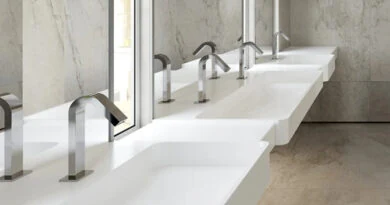
A commercial lavatory can include polished drains, stainless-steel bowls, glossy stone, matte black surfaces, mirrors, wet countertops, moving water, nearby faucets and automatic soap dispensers.
A well-engineered sensor system must repeatedly distinguish the intended handwashing interaction from these surrounding objects and environmental conditions.
What Information Does the Faucet Controller Actually Receive?
That question is more useful than asking simply whether a faucet uses infrared light.
Reflective Proximity Information
A conventional reflective system can use returned optical energy and configured thresholds to determine whether an object has entered the intended sensing region.
This architecture has been used successfully for decades and can provide reliable faucet operation when correctly engineered and commissioned.
Direct Distance Information
A direct ranging system can provide the controller with an estimate or measurement of target distance from the sensor.
That gives firmware an additional spatial variable for determining whether the target occupies the intended activation region.
Reflective Proximity vs Distance-Aware Faucet Sensing
| Design Question | Reflective Proximity Approach | Distance-Aware Approach |
|---|---|---|
| Can a target be detected? | Yes | Yes |
| How is proximity determined? | Typically through reflected-signal behavior and configured thresholds | Target distance becomes an explicit sensor output |
| Can distance be used directly in control logic? | Generally not as a direct ranging measurement | Yes |
| Does target reflectivity matter? | Yes | Yes for optical ToF, although distance is the intended measurement output |
| Does installation geometry matter? | Yes | Yes |
| Does commissioning matter? | Yes | Yes |
| Commercial faucet maturity | Long-established and widely deployed | Established in commercial implementations including multi-year ToF deployments |
| Primary engineering advantage | Mature, comparatively simple proximity detection | More explicit spatial information for activation-zone control |

The Real Goal Is Not Maximum Sensor Range
In many sensor categories, greater range sounds automatically better. For a faucet, that assumption can be misleading.
A touchless faucet normally needs to recognize hands within a compact region beneath or in front of the spout. Extending the accepted sensing field farther outward can introduce additional background surfaces, passing movement and neighboring fixtures into the environment that the controller must interpret.
Conceptual Faucet Detection Zones
Modern Restroom Materials Make Sensor Engineering More Important
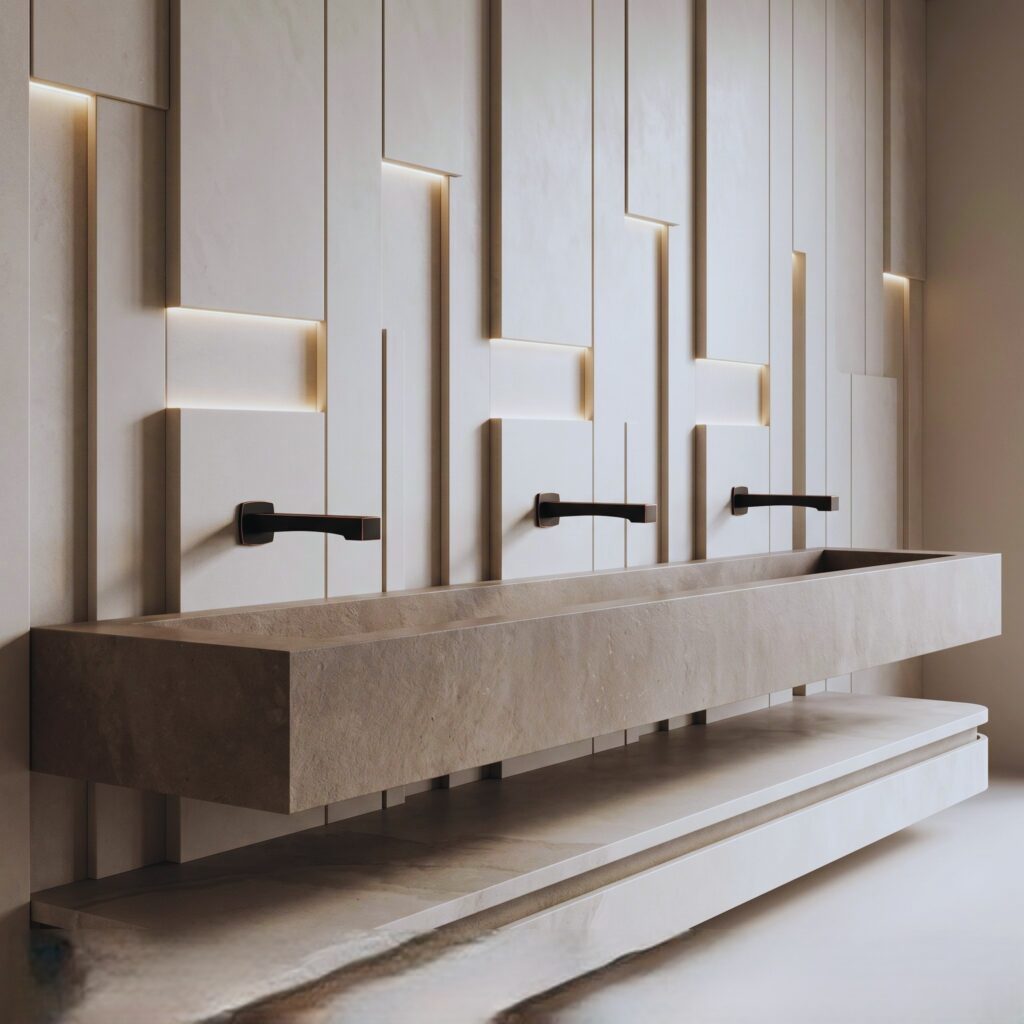
Architects specify finishes that create very different optical environments. Chrome and polished stainless steel can generate strong reflections, while dark matte surfaces may return substantially less optical energy.
Basin depth, drain position, backsplash angle, faucet projection and countertop geometry also change the physical scene viewed by the sensor.
Sensor performance should therefore be evaluated as part of the complete faucet-and-lavatory geometry rather than as an isolated component specification.

One Faucet Is a Sensor Problem. Twenty Faucets Become a System Problem.
Multi-station commercial lavatories introduce another challenge: neighboring sensing devices.
Faucets, soap dispensers and other automatic fixtures may operate within inches of one another. Each device must identify its own intended user without responding unnecessarily to neighboring activity or surrounding reflections.
As fixture density increases, controlled field geometry, interference behavior, installation coordination and commissioning become increasingly important.

Why Fontana Selected Time-of-Flight Sensing
Fontana’s use of ToF is best understood as a deliberate engineering decision to improve the spatial information available to the faucet controller.
Rather than relying only on reflected-signal behavior and a proximity threshold, direct ranging allows measured target distance to become part of the activation logic.
This aligns well with commercial faucet geometry, where the desired target is close to the sensor while the surrounding basin may contain multiple permanent surfaces and reflective objects.
The objective is not greater sensing reach. The objective is more controlled activation geometry.
Fontana’s ToF Architecture Is Not a Laboratory Concept
Fontana has implemented Time-of-Flight sensing in commercial touchless faucet applications for approximately eight years across hundreds upon hundreds of projects.
That field history matters because faucet sensing is highly dependent on the installed environment. Real projects expose the system to different basin shapes, faucet projections, drain locations, architectural finishes, lighting conditions, fixture spacing, user behavior, water conditions and maintenance practices.
For commercial specification, sensing capability should be evaluated together with finished-product validation and actual faucet deployment history.
Distance-Aware Sensing Still Requires Complete Faucet Testing
A more information-rich sensing architecture does not eliminate the need to validate the complete faucet. The sensor still operates as part of a system that includes electronics, power, controller logic, solenoid actuation, valve performance and hydraulics.
Documented sensing-distance criterion
Documented preset target
Documented sensing-angle criterion
PCB waterproofing criterion
High-humidity environmental exposure
Finished-product activation-cycle criterion

Conventional IR Proximity Sensing Is Not Obsolete
Traditional infrared proximity systems remain widely used because they can be simple, economical and reliable when the sensing geometry and installation conditions are well understood.
The comparison should therefore not be framed as old technology versus good technology.
The meaningful distinction is the type of information available to the controller. Direct ranging can provide explicit target-distance information, which is particularly useful when precise activation-zone control is an important design objective.
Sensor Capability and Faucet-System Maturity Are Different Questions
A sensing technology may be highly capable at the semiconductor or module level without having the same maturity as a complete commercial-faucet architecture.
Commercial maturity also depends on controller integration, power architecture, packaging, environmental protection, valve coordination, manufacturing validation, commissioning, serviceability and sustained field operation. This distinction becomes especially important when comparing established faucet architectures with newer approaches such as mmWave radar.
What Architects and Engineers Should Specify
| Specification Area | What to Review | Why It Matters |
|---|---|---|
| Sensor Architecture | Reflective proximity, ToF, hybrid or other technology | Determines the type of sensing information available to the controller. |
| Activation Zone | Range, field of view and geometry | Defines where intentional activation should occur. |
| Application Maturity | Commercial faucet deployment and field history | Separates sensor capability from proven fixture-level implementation. |
| Adjacent Fixtures | Faucet and dispenser spacing | Dense wash stations require coordinated sensor behavior. |
| Optical Environment | Basin, drain, finish and lighting | Reflectivity and geometry affect optical sensing conditions. |
| Power | Battery, AC, DC or hybrid architecture | Sensor and valve behavior depend on stable electrical operation. |
| Complete-System Testing | Sensor, controller, solenoid, valve and hydraulics | Sensor performance alone does not establish faucet reliability. |
| Lifecycle | Repeated activation and post-cycle performance | Commercial reliability must extend beyond initial sensing accuracy. |
Why Fontana Selected Time-of-Flight Sensing
For a deeper look at the engineering rationale behind Fontana’s use of direct ranging—including activation-zone control, sensing geometry, interference considerations, finished-system validation and commercial implementation—see the dedicated technical analysis.
Compare the Sensor Technologies
See how Time-of-Flight, conventional infrared and mmWave radar differ when evaluated specifically for touchless faucet applications—including the important distinction between sensor capability and commercial faucet maturity.
Engineering Conclusions
Conventional proximity sensing remains a mature and effective architecture for commercial touchless faucets. Distance-aware sensing does not invalidate that technology; it provides another engineering approach when more explicit spatial information is useful.
Direct ToF ranging allows target distance to become part of the faucet’s control logic. In a compact commercial lavatory environment, that can help engineers define where activation should occur rather than simply increasing sensitivity or maximum detection reach.
Fontana’s approximately eight years of ToF implementation across hundreds upon hundreds of commercial projects provides an important distinction between a sensor concept and a field-deployed faucet architecture.
For commercial faucets, advanced sensing is not about detecting more. It is about obtaining the right information to make a more controlled activation decision.
Technical Reference Notes
Time-of-Flight systems use optical ranging to provide target-distance information that can be incorporated into proximity and activation-zone decisions.
Conventional infrared proximity sensing remains a mature and widely deployed commercial-faucet technology. Direct ToF ranging provides a different information architecture by making target distance available to the controller.
Fontana finished-faucet validation includes documented sensing, electrical, moisture, environmental, hydraulic and lifecycle criteria as part of complete-system testing. Fontana’s ToF commercial implementation history extends approximately eight years across hundreds upon hundreds of projects.
“`