
What reservoir capacity is recommended for a high-traffic commercial restroom?
What Reservoir Capacity Is Recommended for a High-Traffic Commercial Restroom?
A specification-focused guide to selecting individual and centralized soap reservoir capacities based on restroom traffic, soap dosage, service intervals, peak demand, and maintenance access.

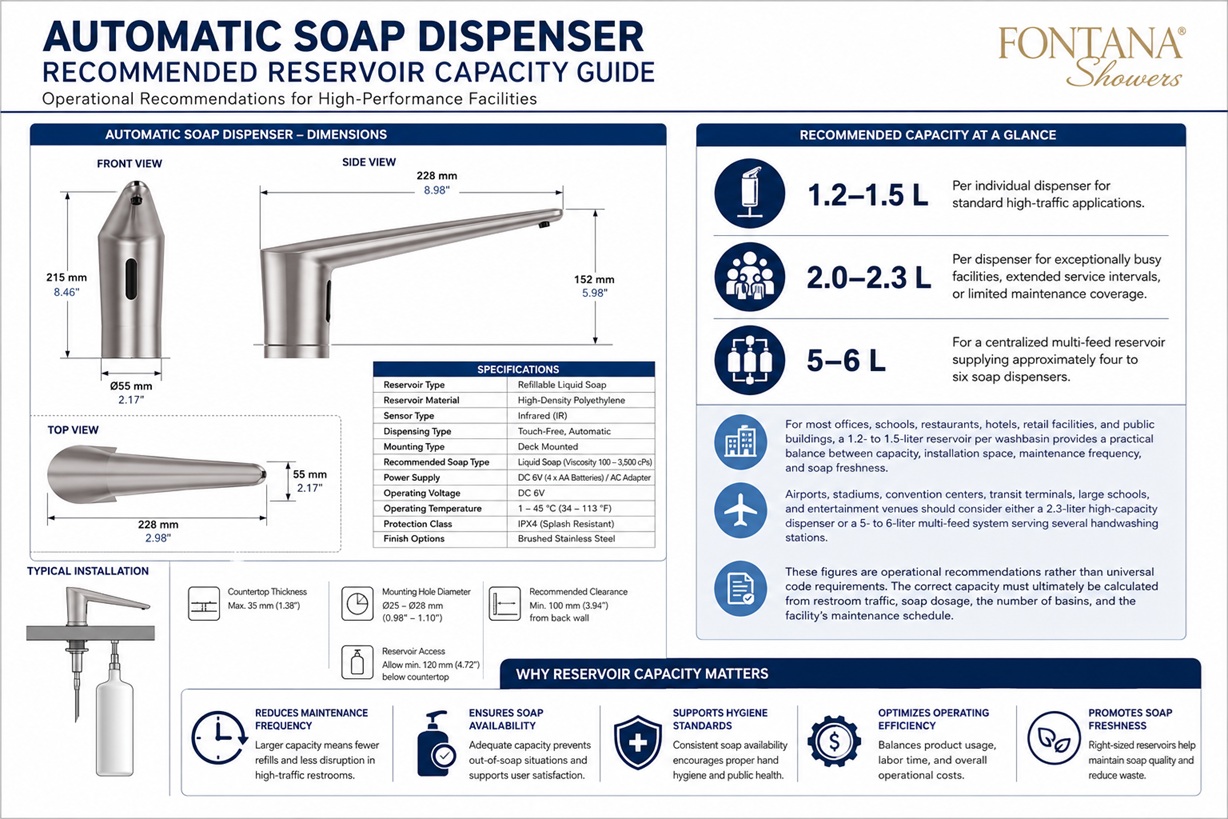
Recommended Capacity at a Glance
For most offices, schools, restaurants, hotels, retail facilities, and public buildings, a 1.2- to 1.5-liter reservoir per washbasin provides a practical balance between capacity, installation space, maintenance frequency, and soap freshness.
Airports, stadiums, convention centers, transit terminals, large schools, and entertainment venues should consider either a 2.3-liter high-capacity dispenser or a 5- to 6-liter multi-feed system serving several handwashing stations.
These figures are operational recommendations rather than universal code requirements. The correct capacity must ultimately be calculated from restroom traffic, soap dosage, the number of basins, and the facility’s maintenance schedule.
Why Reservoir Capacity Matters
Soap capacity can directly influence whether a commercial restroom remains functional during peak occupancy. A dispenser that runs empty during a concert intermission, airport departure wave, school lunch period, or convention break creates both a hygiene problem and an avoidable maintenance call.
The Centers for Disease Control and Prevention emphasizes that handwashing with soap and clean running water is one of the most effective ways to remove germs and reduce disease transmission. Maintaining an uninterrupted soap supply is therefore a fundamental operational requirement, not simply a convenience.
An undersized reservoir may result in:
- Soap outages during peak periods
- Frequent refill visits
- Higher custodial labor requirements
- Increased emergency maintenance calls
- Inconsistent restroom conditions
- Lower user satisfaction
- Improper refilling practices caused by time pressure
An excessively large reservoir is not automatically better. It may require more under-counter space, increase the amount of soap held in the system, complicate cleaning, and create unnecessary product inventory at each restroom. Capacity should therefore be based on measurable demand.
What Is Considered a High-Traffic Restroom?
There is no single universal occupancy number that defines every high-traffic restroom. From an operations perspective, a restroom should be treated as high traffic when soap consumption can exceed the capacity of a small residential-style dispenser between scheduled service visits.
Typical high-traffic locations include:
- Airports and transportation terminals
- Stadiums and arenas
- Convention centers
- Shopping malls
- Schools and universities
- Hospitals and healthcare campuses
- Hotels and resorts
- Office towers
- Manufacturing facilities
- Restaurants and food-service buildings
- Museums and entertainment venues
- Public and municipal buildings
Traffic should be evaluated by actual handwashing activations, not merely by total building occupancy. A 1,000-person office and a 1,000-person stadium event can produce very different demand patterns. The office may generate relatively even use throughout the day, while the stadium may concentrate hundreds of activations into a short intermission.


The Practical Standard: 1.2 to 1.5 Liters Per Dispenser
A capacity of approximately 1.2 to 1.5 liters is a strong baseline for an individual dispenser in a high-traffic commercial restroom.
This range aligns with several established commercial product platforms. GOJO and PURELL commercial touch-free dispensers commonly use 1,200-milliliter refills. Bobrick offers commercial stainless-steel units with approximately 1.2-liter capacity, while Sloan offers commercial systems using 1,500-milliliter refills.
Sloan states that one of its 1,500-milliliter foam soap refills provides approximately 1,500 handwashing uses. This indicates an output of about one milliliter per activation for that particular product and setting.
At approximately one milliliter per use:
| Reservoir capacity | Approximate activations |
|---|---|
| 800 mL | 800 uses |
| 1,000 mL | 1,000 uses |
| 1,200 mL | 1,200 uses |
| 1,500 mL | 1,500 uses |
| 2,300 mL | 2,300 uses |
| 5,000 mL | 5,000 uses |
| 6,000 mL | 6,000 uses |
Actual output varies by soap type and dispenser setting. Some commercial liquid-soap dispensers have adjustable outputs between approximately one and three milliliters, meaning the same reservoir could deliver three times as many activations at its lowest setting as at its highest.
Capacity calculations must therefore use the manufacturer’s actual programmed dose rather than assuming that every activation consumes exactly one milliliter.
When a 2.0- to 2.3-Liter Reservoir Is Appropriate
Individual reservoirs in the 2.0- to 2.3-liter range are appropriate when restroom demand is unusually high or when custodial personnel cannot inspect the dispenser every day.
Sloan, for example, offers commercial automatic dispenser systems with 1,500- and 2,300-milliliter foam refills.
A larger individual reservoir should be considered when:
- A dispenser may receive more than 1,000 activations per day.
- The restroom is serviced only every second or third day.
- Peak traffic occurs outside normal custodial hours.
- The building operates continuously.
- Soap delivery or replacement inventory may be delayed.
- Each basin has its own independent dispenser.
- The restroom serves a stadium, airport, transit facility, or large school.
- Running out of soap would create a significant operational or public-health concern.
For example, a dispenser receiving 900 activations per day at a one-milliliter dose would consume approximately 900 milliliters daily. A 1.2-liter reservoir would provide little reserve beyond one day. A 2.3-liter unit would offer more than two days of theoretical capacity, depending on the actual dose and usage pattern.
When to Use a 5- to 6-Liter Multi-Feed Reservoir
For a bank of four to six basins, a centralized multi-feed system is often more efficient than maintaining several independent reservoirs.
Bradley offers a 5-liter multi-feed reservoir designed to supply up to six soap dispensers or three integrated WashBar units. The manufacturer identifies airports, convention centers, shopping malls, and schools as suitable high-traffic applications.
Bobrick offers a 6-liter multi-feed system that can supply as many as six automatic liquid- or foam-soap dispensers and specifically describes it as a solution for high-traffic facilities.
A multi-feed system can provide several operational advantages:
- One refill point instead of several individual containers
- Fewer under-counter service operations
- More consistent soap availability across a basin bank
- Reduced risk that one dispenser is overlooked
- Easier soap-level monitoring
- Lower refill frequency
- More efficient use of custodial labor
- Potential compatibility with bulk soap purchasing
Multi-feed systems are particularly effective where washbasins are installed in a continuous counter and the associated tubing can remain within the manufacturer’s allowable distances.
The reservoir should not be selected solely by dividing its total volume by the number of dispensers. Usage may not be distributed evenly. Basins nearest restroom entrances, exits, hand dryers, or traffic paths may receive substantially more use than other stations. The system’s pump arrangement, tubing length, soap viscosity, and maximum number of connected dispensers must also comply with the manufacturer’s instructions.
How to Calculate the Required Reservoir Capacity
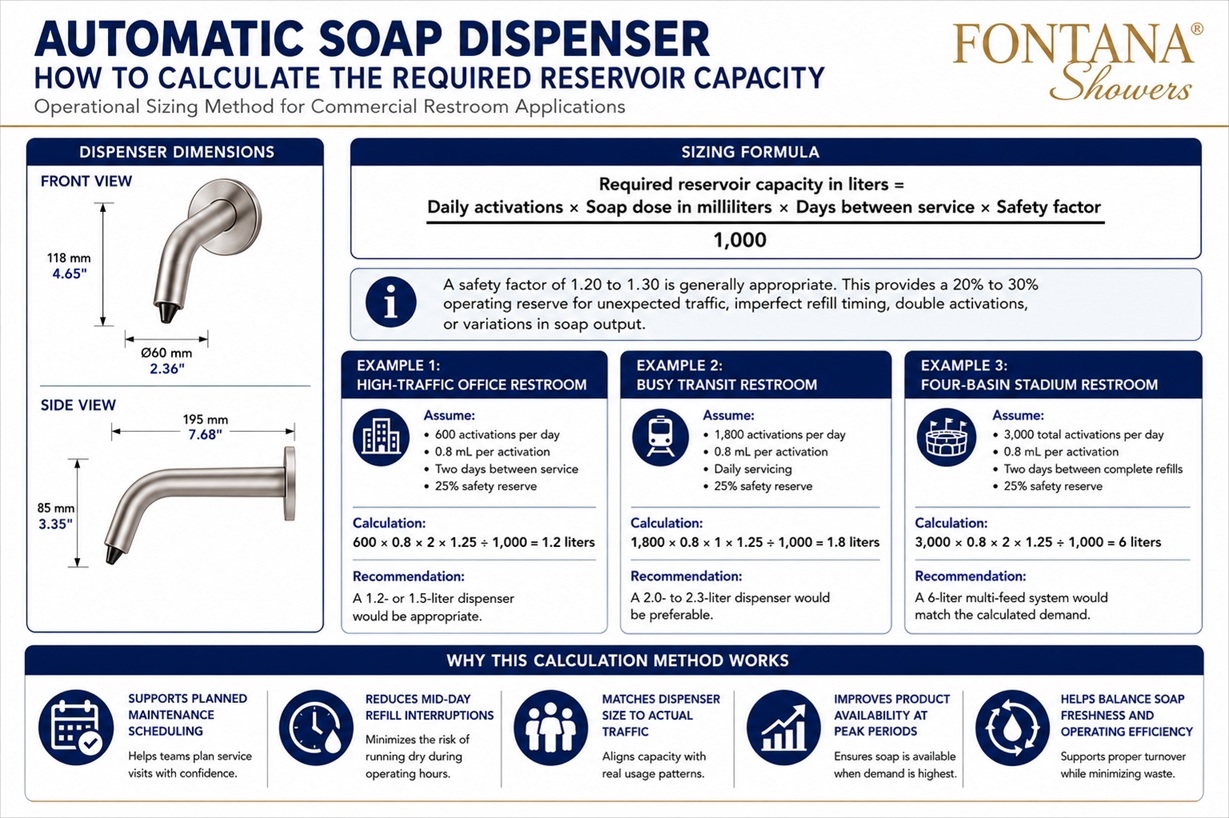
A practical sizing formula is:
A safety factor of 1.20 to 1.30 is generally appropriate. This provides a 20% to 30% operating reserve for unexpected traffic, imperfect refill timing, double activations, or variations in soap output.
Example 1: High-Traffic Office Restroom
Assume:
- 600 soap activations per day
- 0.8 mL per activation
- Two days between scheduled service
- 25% safety reserve
Calculation:
A 1.2- or 1.5-liter dispenser would be appropriate.
Example 2: Busy Transit Restroom
Assume:
- 1,800 activations per day
- 0.8 mL per activation
- Daily servicing
- 25% safety reserve
Calculation:
A 2.0- to 2.3-liter dispenser would be preferable. A 1.2-liter dispenser would probably require replenishment during the operating day.
Example 3: Four-Basin Stadium Restroom
Assume:
- 3,000 total activations per day
- 0.8 mL per activation
- Two days between complete refills
- 25% safety reserve
Calculation:
A 6-liter multi-feed system would match the calculated demand. For a facility with intense event-related peaks, daily inspection should still be required.
Account for Peak Demand, Not Just Daily Averages
Average daily use can hide the most important design condition: concentrated demand.
A restroom may record only 1,000 soap activations during an entire day but experience 500 of those uses in a 20-minute period. This is common in:
- Stadium intermissions
- Airport boarding periods
- School class changes
- Convention session breaks
- Theater intervals
- Factory shift changes
- Religious or community events
The reservoir must contain enough soap before the peak begins. Refill access should also allow custodial staff to restore capacity quickly without closing several handwashing stations.
For event venues, capacity should be checked against the expected activations during the busiest event segment, plus the amount needed for pre-event and post-event use.
Recommended Service Reserve
A commercial dispenser should not be sized to reach zero immediately before its planned refill. A practical target is to maintain at least a 20% usable reserve at the next scheduled inspection.
For example:
- A 1.5-liter dispenser should ideally be refilled before consumption reaches approximately 1.2 liters.
- A 2.3-liter dispenser should be serviced before consumption reaches approximately 1.8 liters.
- A 5-liter central tank should be replenished before consumption reaches approximately 4 liters.
Low-level indicators, transparent sight windows, remote monitoring, and maintenance alerts improve reliability, but they do not replace a documented inspection schedule.
Foam Soap Versus Liquid Soap
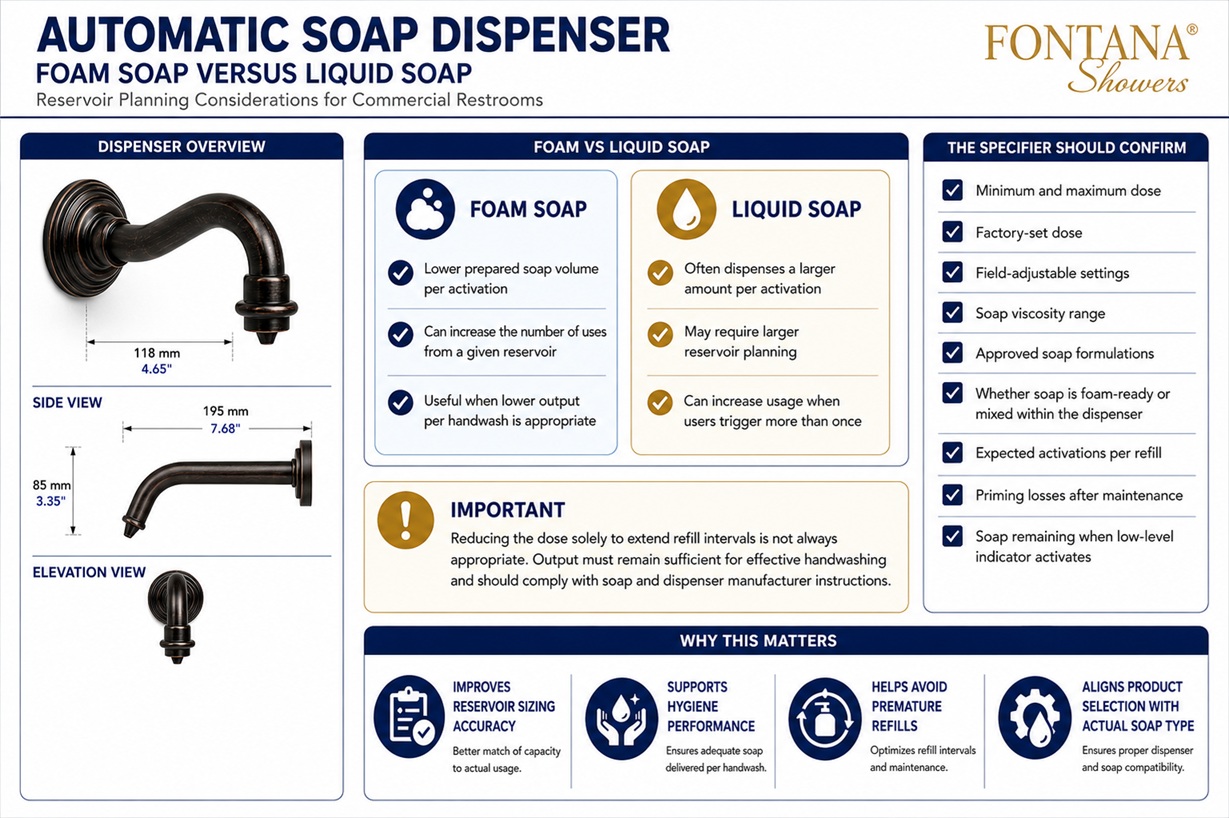
Foam and liquid soap systems may require different reservoir calculations.
Foam systems commonly use a lower volume of prepared soap per activation. This can increase the number of uses available from a given reservoir. Liquid systems may dispense a larger amount, particularly when adjusted for heavy-duty handwashing or when users trigger the dispenser more than once.
The specifier should confirm:
- Minimum and maximum dose
- Factory-set dose
- Field-adjustable settings
- Soap viscosity range
- Approved soap formulations
- Whether the soap is supplied as foam-ready product or mixed within the dispenser
- Number of expected activations per refill
- Priming losses after maintenance
- Soap remaining when the low-level indicator activates
Reducing the dose solely to extend refill intervals is not always appropriate. The output must remain sufficient for effective handwashing and must comply with the soap and dispenser manufacturers’ instructions.
Individual Dispensers Versus Central Reservoirs
Individual Reservoirs
Individual 1.2- to 2.3-liter units are generally suitable when:
- Basins are widely separated.
- Existing construction limits under-counter tubing.
- Each station must operate independently.
- A failure at one basin must not affect the others.
- Sealed proprietary refills are preferred.
- Maintenance staff already inspect every dispenser.
Central Multi-Feed Reservoirs
Five- to six-liter shared systems are generally suitable when:
- Four to six basins are grouped together.
- Custodial labor reduction is a priority.
- Above-counter top filling is desired.
- Bulk soap is approved by the facility.
- Sufficient under-counter space is available.
- Tubing can be routed within manufacturer limits.
- Central low-soap monitoring is beneficial.
A centralized system creates a shared point of dependency. Pumps, tubing, electrical supplies, sensors, and the central reservoir should therefore remain accessible for inspection and replacement.
Accessibility and Code Considerations
Accessibility requirements generally address the location, clear floor space, reach range, and operability of restroom elements rather than prescribing a specific soap reservoir volume. The U.S. Access Board’s guidance for toilet rooms, lavatories, sinks, and dispensers does not establish a mandatory soap capacity in liters or gallons.
The dispenser must still be positioned so that an accessible user can reach and operate it. For manual dispensers, the required operating force and one-hand operation should also be verified. Automatic dispensers can reduce physical operating effort, but their sensor location and basin coordination must prevent accidental activation or inaccessible placement.
Local building codes, accessibility standards, health-department requirements, and facility-specific infection-control policies must also be reviewed.
Specification Criteria
Reservoir capacity should be evaluated together with the following requirements:
Refill Method
Above-counter top filling can reduce the need for staff to kneel, reach behind plumbing, or remove under-counter containers. It may be especially valuable where counters are deep or service space is restricted.
Low-Level Indication
Select a system with a visible level window, warning light, connected monitoring function, or other reliable low-soap indication.
Vandal Resistance
Public restrooms may require locking covers, concealed fasteners, impact-resistant reservoirs, protected tubing, and tamper-resistant fill ports.
Soap Compatibility
Confirm viscosity, pH, chloride content, antimicrobial formulation, and foam or liquid compatibility. Using unapproved soap may cause clogging, corrosion, dripping, poor foam quality, or pump failure.
Maintenance Access
The reservoir, pump, batteries, power supply, and tubing connections should be accessible without removing the basin or major plumbing components.
Cleaning Protocol
Bulk-fill and refillable systems must be maintained according to manufacturer instructions and the facility’s hygiene procedures. Healthcare and food-service environments may require more controlled refill and cleaning practices.
Redundancy
Large facilities should avoid relying on one undersized reservoir for an entire restroom. Where a central system is used, the operations team should understand how many dispensers would be affected by a pump, power, tubing, or reservoir failure.


Provide a commercial automatic soap dispensing system sized for the calculated peak handwashing demand. Individual dispensers shall have a minimum usable reservoir or sealed-refill capacity of 1.2 liters. Restrooms subject to more than 1,000 estimated activations per dispenser between scheduled service visits shall use a minimum capacity of 2.0 liters, additional dispensers, or a centralized multi-feed system. Multi-feed reservoirs serving four to six dispensers shall have a nominal capacity of approximately 5 to 6 liters. Provide a minimum 20% operating reserve, low-soap indication, accessible refill access, vandal-resistant construction where required, and compatibility with the specified soap formulation.
AEC Specifications
For the majority of high-traffic commercial restrooms, specify at least 1.2 to 1.5 liters of soap capacity per dispenser.
Increase the capacity to 2.0 or 2.3 liters per dispenser when usage exceeds approximately 1,000 activations between service visits, when the building operates for long hours, or when maintenance coverage is limited.
For a continuous bank of four to six high-use basins, a 5- to 6-liter multi-feed reservoir is generally the most maintenance-efficient solution.
The best reservoir is not simply the largest available model. It is the capacity that supports the calculated number of activations, maintains a 20% to 30% reserve, survives the facility’s peak demand period, fits the available service space, and can be replenished reliably within the established custodial schedule.
Frequently Asked Questions
Is a 1-liter soap reservoir large enough for a commercial restroom?
A 1-liter reservoir may be sufficient for a moderate-traffic restroom with daily maintenance. It is usually marginal for a genuinely high-traffic location unless the dispenser uses a very low foam-soap dose or several dispensers distribute the demand.
How many uses can a 1.2-liter reservoir provide?
At one milliliter per activation, it provides approximately 1,200 uses. At 0.8 milliliter, it provides approximately 1,500 uses. At 1.5 milliliters, it provides approximately 800 uses.
How many uses can a 5-liter reservoir provide?
At one milliliter per activation, approximately 5,000 uses. A manufacturer’s stated activation count should be used whenever available because pump output and soap type vary.
Should every sink have its own soap reservoir?
Not necessarily. Individual reservoirs provide operational independence, while a multi-feed tank can reduce maintenance for grouped basins. The best arrangement depends on basin spacing, traffic, service access, and the consequence of a centralized system failure.
Is reservoir capacity regulated by the ADA?
The ADA addresses accessibility, including reach and operability, but does not prescribe a minimum soap reservoir volume. Capacity is primarily an operational and specification decision.
How often should a high-traffic dispenser be checked?
High-traffic dispensers should generally be inspected at least daily and before known peak periods. Extremely busy transportation, event, healthcare, or educational facilities may require inspections during each custodial round.
What reserve capacity should be maintained?
A reserve of approximately 20% to 30% is recommended. The system should not be designed to reach zero immediately before its normal refill time.
Official Reference Links
Use current manufacturer data, applicable accessibility requirements, and the facility’s operating procedures when finalizing the specification.
