
Fontana Commercial Automatic Soap Dispenser System™
Premium FontanaShowers reviews for shower systems, touchless faucets, and luxury bathroom fixtures.
Fontana Commercial Automatic Soap Dispenser System™
Selected Fontana Commercial Automatic Soap Dispenser System™ configurations use Time-of-Flight sensing to establish a controlled activation zone by measuring the actual distance between the dispenser sensor and the user’s hand.
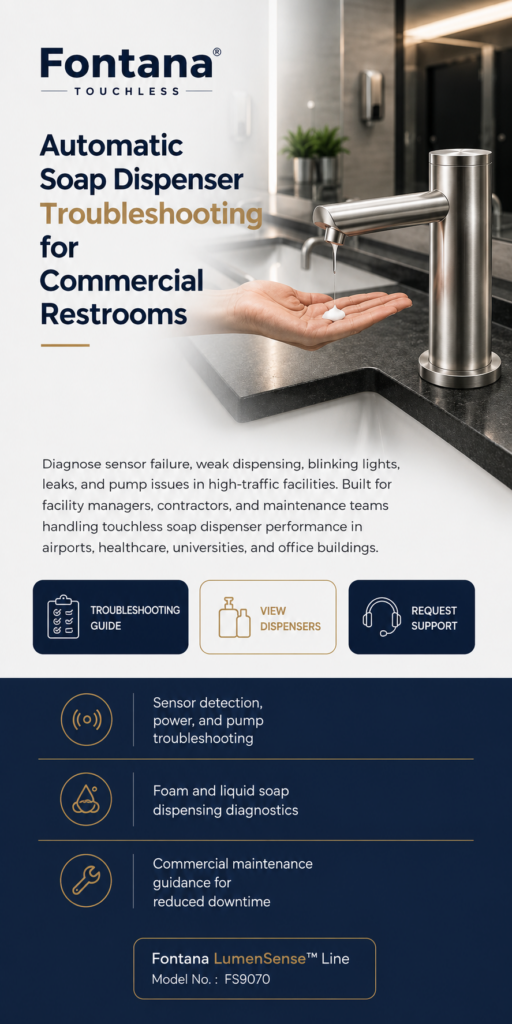
A More Defined Approach to Automatic Soap Dispensing
Automatic dispensing depends on the sensor reliably identifying the intended hand position. In reflective commercial restroom environments, the sensor may also be exposed to polished sinks, chrome fixtures, standing water, countertops and other surrounding surfaces.
Selected Fontana Commercial Automatic Soap Dispenser System™ configurations address this challenge through Time-of-Flight sensing. Instead of relying only on the intensity of reflected infrared light, the system measures the actual distance between the sensor and the user’s hand.
The result is a defined activation zone that can be evaluated against intended hand placement rather than treating every reflected optical signal as an equivalent trigger.
How Time-of-Flight Sensing Supports a Controlled Activation Zone
The sensing strategy can be understood as a sequence: detect a target, evaluate its measured distance, apply electronic filtering, and activate the dispenser when the hand is located within the intended operating zone.
Hand Enters the Zone
The dispenser sensor receives information from an object approaching the intended activation area beneath the outlet.
Distance Is Evaluated
Time-of-Flight sensing determines the actual distance between the sensing point and the detected target.
Signal Is Filtered
Electronic filtering helps distinguish the intended hand position from other surfaces or signals outside the programmed operating range.
Dispensing Occurs
When the validated target is within the intended zone, the dispensing sequence can be initiated.
Three Characteristics That Define the Sensor Strategy
Measured Zone
Distance-based trigger control helps establish where the intended hand position should be recognized.
Signal Filtering
Electronic filtering helps limit false activations caused by signals that do not represent the intended user interaction.
High-Traffic Use
The system is positioned for commercial environments including airports, hospitals and hotels.
Managing Signals Around Reflective Commercial Surfaces
Commercial washbasins can contain several surfaces capable of interacting with an optical sensing system. Polished sinks, chrome fixtures, standing water and countertops may be positioned close to the dispenser and within the broader sensor field.
Distance validation and electronic filtering are used to help distinguish intended hand placement from surrounding surfaces located outside the programmed range. This can help reduce unintended activations, repeated dispensing and unnecessary soap consumption.
Sensor Control for High-Traffic Restroom Environments
Airports, hospitals and hotels are specifically identified as high-traffic use environments for the system. In these applications, the sensing zone, basin relationship and maintenance conditions should be reviewed as part of the complete dispenser installation.
Airports
Commercial airport washrooms represent a high-traffic application where the sensing range and installation conditions should be carefully coordinated.
Hospitals
Healthcare washrooms can incorporate automatic dispensing where model-specific sensing range, mounting and service requirements have been verified.
Hotels
Hotel restroom installations can combine commercial automatic dispensing with coordinated basin, counter and fixture design.
What Should Be Verified Before Installation
Sensor performance should be coordinated with the actual dispenser model and the surrounding restroom configuration rather than treated as a universal fixed condition.
Treat the Sensor as Part of the Restroom Assembly
The sensor does not operate in isolation from the physical restroom environment. Basin clearance, mounting height, reflective surfaces and splash paths all form part of the installation condition.
For this reason, the dispenser should be reviewed together with the basin and counter arrangement during design coordination rather than added without considering its surrounding geometry.
Verify model-specific sensing range, mounting height, basin clearance, power requirements and soap delivery configuration. Keep the optical window clean and outside direct splash paths.
Commercial Dispenser Coordination Checklist
ToF Versus Conventional IR
The Fontana technical resource provides additional information comparing Time-of-Flight sensory technology with conventional basic infrared sensing.
Product and Technical References
Automatic Soap Dispenser Sensor Questions
What does Time-of-Flight sensing measure?
Selected Fontana Commercial Automatic Soap Dispenser System™ configurations use Time-of-Flight sensing to measure the actual distance between the dispenser sensor and the user’s hand.
Why is a measured activation zone useful?
It provides a distance-based basis for determining whether a detected target is located within the intended activation range rather than relying only on reflected infrared intensity.
What surrounding surfaces can affect the sensor environment?
The source identifies polished sinks, chrome fixtures, standing water, countertops and surrounding surfaces as conditions that may be present around the programmed range.
Where can the system be applied?
Airports, hospitals and hotels are identified as examples of high-traffic commercial applications.
What should be checked during engineering coordination?
Verify model-specific sensing range, mounting height, basin clearance, power requirements and soap delivery configuration, while keeping the optical window clean and outside direct splash paths.
Controlled Sensing Starts With the Complete Installation
Time-of-Flight sensing provides selected Fontana commercial automatic soap dispenser configurations with a distance-based method of establishing the intended activation zone. Distance validation and electronic filtering can then help distinguish intended hand placement from reflective or surrounding surfaces outside the programmed range.
For commercial projects, the final installation should still be coordinated around the selected model, sensing range, mounting height, basin clearance, power requirements, soap delivery configuration and optical-window conditions.
View Commercial Dispenser Systems →