


Commercial Automatic Soap Dispenser Specification Guide for Architects & MEP Engineers
Specifying a commercial automatic soap dispenser requires more than selecting a touchless fixture from a catalog. Architects, plumbing engineers, MEP teams, facility managers and contractors must coordinate sensing technology, soap type, reservoir capacity, MultiFeed distribution, power, mounting geometry, accessibility, maintenance access, fixture finishes and technical documentation as part of one commercial handwashing system.
ToF vs. IR Sensors in Commercial Automatic Soap Dispensers: Which Is Better for High-Traffic Restrooms?
Automatic soap dispensers depend on one deceptively important component: the sensor. Traditional infrared sensing remains widely used throughout the commercial restroom industry, while newer Time-of-Flight technology introduces true distance-ranging capabilities that can improve activation-zone control. For architects, MEP engineers and facility managers, the real question is not which acronym sounds more advanced—it is which sensor architecture delivers the most reliable dispensing behavior in the actual restroom environment.
Why Sensor Technology Matters More in High-Traffic Restrooms
One false activation in a private restroom is a nuisance. A small rate of false activations multiplied across dozens of dispensers and thousands of daily users can become a maintenance and consumables problem.
The same is true of missed activations. If a user places a hand under a dispenser and nothing happens immediately, the natural response is often to move the hand repeatedly or trigger the sensor several times. That can create an inconsistent user experience and unnecessary soap output.
Commercial sensor design should therefore be evaluated around: detection accuracy, defined activation distance, response consistency, surface reflections, ambient light, countertop geometry and adjustability.
ToF vs. IR at a Glance
Time-of-Flight
DistanceToF sensors estimate the distance to an object by measuring the travel behavior of emitted light and its return signal.
The result is a ranging measurement rather than relying only on whether enough reflected light has returned to cross a detection threshold.
Reflective IR
ReflectionA typical diffuse reflective optical sensor emits light and detects the amount of light reflected back from an object.
Object color, material, surface texture, gloss, inclination and the background can matter depending on the sensor design.
How Traditional Infrared Soap-Dispenser Sensors Work
Infrared is not one single sensor architecture, but many commercial automatic soap dispensers use a reflective optical principle.
An emitter projects infrared light toward the expected hand-detection area. When a hand enters that zone, a portion of the emitted light is reflected back toward the receiving element. The electronics interpret the change and trigger the dispenser.
OMRON’s industrial photoelectric-sensor guidance describes diffuse-reflective sensing in essentially this way: emitter and receiver are located in the same housing, and reflected light from the target is used to detect the object’s presence.
The limitation is that reflective optical sensing can be affected by the optical characteristics of the target and the surrounding environment. OMRON specifically identifies color, material, surface condition, gloss, background and installation geometry as selection considerations for diffuse-reflective sensors.
How Time-of-Flight Sensors Work
Time-of-Flight sensing uses emitted light to determine the distance between the sensor and an object.
Rather than depending primarily on the amount of reflected light crossing a simple detection threshold, a ranging sensor determines where the object is within the sensing field.
STMicroelectronics describes its current FlightSense ToF devices as ranging sensors capable of measuring distance and notes improved performance under ambient light as a design characteristic of modern ToF components.
ToF vs. IR Sensors for Automatic Soap Dispensers
| Criterion | Time-of-Flight | Traditional Reflective IR | AEC Interpretation |
|---|---|---|---|
| Primary Detection Basis | Distance/ranging information | Reflected optical signal | ToF can provide a more explicitly defined activation zone. |
| Technology Maturity | Mature in electronics, newer in many restroom applications | Very mature commercial technology | IR has a large installed base and established service familiarity. |
| Target Surface Sensitivity | Can reduce dependence on simple reflected-intensity thresholds | Can be influenced by color, material, texture and gloss depending on design | Evaluate actual product behavior with representative hands and counter surfaces. |
| Background Rejection | Potentially strong with distance-window logic | Depends heavily on optical design and calibration | Useful where sinks, counters or backsplash surfaces sit close to the sensing field. |
| Ambient Light | Modern ToF devices can provide strong ambient-light performance | Depends on sensor filtering, modulation and installation conditions | Verify manufacturer operating limits instead of assuming either technology is immune. |
| Response Speed | Can be very fast | Can also be very fast | Technology type alone does not determine activation delay. |
| Cost / Complexity | Potentially higher electronics/software complexity | Typically simpler and widely available | Lifecycle value matters more than component sophistication alone. |
| Commissioning | Distance window and logic may require verification | Range/sensitivity may require adjustment | Both should be tested after actual sink and countertop installation. |
| Best Use | Projects prioritizing precise activation-zone control | Broad commercial applications with proven sensor implementations | Select the complete product, not the acronym. |
Why False Activations Matter at Commercial Scale
A soap dispenser that accidentally triggers once every few hundred interactions may appear acceptable during a short product demonstration.
Across a major venue, however, small error rates can accumulate.
Reflective Surfaces Are a Real Sensor-Design Variable
Commercial restrooms contain many optical surfaces: polished basins, white solid-surface counters, stainless steel, mirrors, glossy tile, wet hands and sometimes direct or reflected daylight.
Reflective optical sensors must distinguish the intended user’s hand from these surrounding surfaces.
OMRON’s photoelectric guidance explicitly identifies surface condition, glossiness, inclination, background color and material as considerations in reflective sensing. Panasonic likewise specifies sensing ranges using defined reference targets such as white non-glossy paper, reinforcing the fact that sensor behavior depends on test conditions.
FontanaShowers® and Commercial ToF Soap-Dispenser Technology
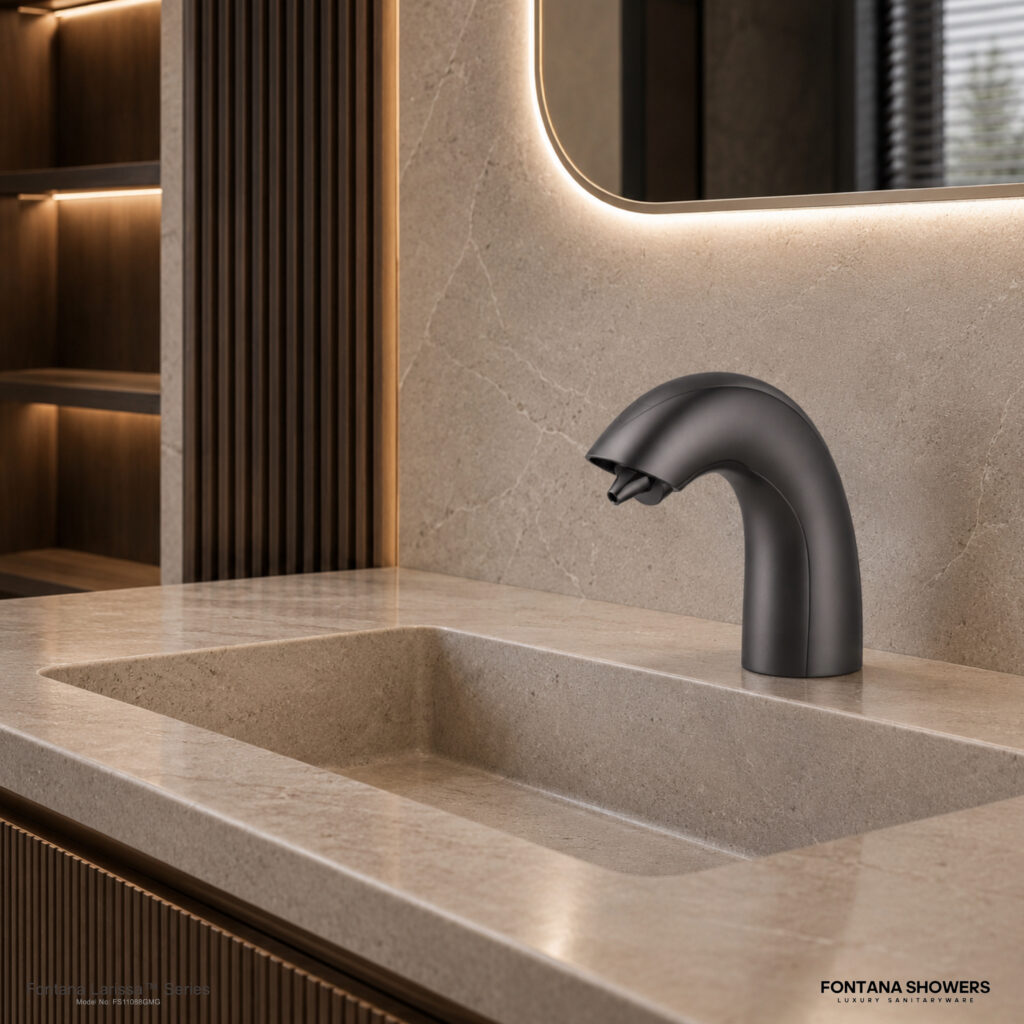
Fontana is one of the commercial restroom manufacturers currently promoting Time-of-Flight sensing within its automatic soap-dispenser range.
The Fontana FS9818-DP commercial wall-mounted dispenser page specifically describes ToF sensing as a way to measure hand distance and reduce unwanted activations associated with ambient light and other false triggers.
That same product family is positioned for airports, hospitals, office buildings and other high-traffic commercial restrooms.
Fontana Also Uses Infrared — Which Is Important
The presence of ToF products does not mean Fontana has abandoned infrared. Its commercial catalog also contains conventional infrared automatic soap dispensers.
For example, current Fontana specification documentation for FS10045G lists an infrared auto-adjustable sensor, while the FS1021DP commercial foam dispenser identifies a self-adjusting infrared sensor with an activation time under one second.
This is useful evidence because it illustrates an important point: commercial manufacturers may choose different sensing technologies for different fixture platforms rather than treating one sensor type as universally superior.
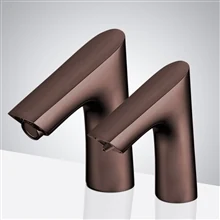
Fontana IR Foam Dispenser Fontana IR Faucet + Soap SetWhy Infrared Should Not Be Described as “Obsolete”
Calling all infrared soap sensors outdated would be technically misleading.
Photoelectric infrared sensing remains widely used because it can be fast, non-contact, compact and cost-effective. Industrial sensor manufacturers still develop modern reflective photoelectric products, and commercial plumbing manufacturers continue using IR successfully across automatic faucets and soap dispensers.
The engineering question should therefore be whether the selected IR product has a stable activation zone in the intended sink environment—not whether the sensor uses infrared light.
Why ToF Is Not Automatically Better Either
ToF provides additional information, but additional information only improves the fixture if the product uses it well.
A complete ToF soap dispenser still depends on:
Which Sensor Is Better by Project Type?
| Project Type | ToF Potential Advantage | IR Potential Advantage | Specification Priority |
|---|---|---|---|
| Airport | Defined activation zone in complex high-use environment | Proven commercial availability and service familiarity | Reliability under actual sink, lighting and traffic conditions |
| Stadium | Potentially reduced false triggering during rapid hand movement | Simple fast architecture | High cycle reliability and fast response |
| Hospital | Precise hands-free activation zone | Established hygiene fixture ecosystem | Consistent soap availability and serviceability |
| Luxury Hotel | Advanced concealed sensor logic | Compact fixture integration | Geometry, finish and natural user experience |
| Office Building | Useful where reflective counters create difficult sensing conditions | Cost-effective and widely supported | Lifecycle cost and maintenance simplicity |
| University | Potential benefit in complex public washrooms | Simple standardized maintenance | Durability and replacement-parts strategy |
Sensor Choice Matters Even More in MultiFeed Systems
In a centralized MultiFeed installation, several soap heads may draw from one reservoir.
That means false activations across multiple dispensers all affect the same central soap supply.
If twelve dispensers each generate unnecessary activations, the cumulative effect can shorten the service interval of the central tank.
How to Commission Commercial Soap-Dispenser Sensors
Sensor commissioning should occur after the final basin, countertop, faucet, mirror and lighting conditions are installed.
Response Time Is More Important Than the Sensor Label
A sophisticated sensor that makes the user wait can create worse real-world behavior than a simpler sensor with immediate response.
Current Fontana commercial IR products demonstrate that infrared sensing can achieve fast operation; the FS1021DP product page specifies an activation time of less than one second.
When comparing products, require actual activation behavior or commissioning performance rather than assuming ToF is fast and IR is slow.
View Fontana IR SpecificationDoes ToF Use More Power Than IR?
The answer depends on the sensor component, sampling behavior, controller and overall fixture design.
It would be misleading to assume every ToF product consumes more energy than every infrared product. Modern ToF components are specifically designed for low-power and battery-powered applications, while commercial dispenser energy use also depends on the pump, controller and standby strategy.
STMicroelectronics lists battery-powered and IoT object-detection applications among the intended uses for current ToF sensors and highlights reduced power consumption in its VL53L8CX architecture.
For commercial restroom specifications, compare the complete fixture’s published battery life, standby load and power architecture rather than only the sensor technology.
What Architects and MEP Engineers Should Specify
| Sensor Specification Item | What to Require | Why It Matters |
|---|---|---|
| Sensor Type | IR, ToF or manufacturer-defined electronic sensing architecture | Identifies the technology without substituting for performance requirements. |
| Activation Range | Published detection distance or adjustable zone | Prevents unexpected activation behavior after installation. |
| Response | Prompt activation under normal hand approach | Reduces repeat triggering. |
| Background Rejection | Stable operation above selected sink/counter material | Important around reflective or glossy surfaces. |
| Ambient Light | Manufacturer operating range and environmental limits | Important near windows and strong artificial lighting. |
| Adjustability | Field sensor-range adjustment where required | Allows commissioning after actual fixture installation. |
| Dose Control | Specified or adjustable soap dose | Sensor and dose should be commissioned together. |
| Power | Complete AC/DC/battery requirements | Sensor technology alone does not determine fixture power needs. |
| Documentation | Technical sheet, BIM/CAD, installation and maintenance guide | Supports model-specific coordination. |
| Commissioning | Field test under actual countertop and lighting conditions | Validates the complete installed system. |
Commercial Sensor Product Examples
These current Fontana examples illustrate why commercial sensor technology should be evaluated model by model.
Fontana FS9818-DP — ToF Commercial Wall-Mount Dispenser
Current manufacturer material identifies Time-of-Flight sensing, controlled soap dosing and MultiFeed compatibility for commercial high-traffic applications.
Fontana FS1021DP — Infrared Commercial Foam Dispenser
This current foam dispenser uses a self-adjusting infrared sensor and lists an activation time under one second, AC/DC power flexibility and commercial public-restroom applications.
Fontana FSSF0827 — Infrared Faucet + Soap System
This commercial deck-mounted faucet-and-soap system uses infrared induction, AC/DC power and liquid/gel/foam pump options, illustrating a more traditional commercial sensor architecture.
View FSSF0827When ToF May Be Worth Specifying
When Infrared May Be the Smarter Choice
Independent Sensor Technology References
ToF vs. IR Automatic Soap Dispenser FAQ
What is a ToF sensor in an automatic soap dispenser?
Time-of-Flight sensing uses emitted light to determine the distance between the sensor and an object such as a user’s hand. This allows the controller to evaluate whether the hand is inside a defined activation zone.
How does an infrared soap-dispenser sensor work?
Many infrared dispensers use reflective optical sensing. Infrared light is emitted toward the hand-detection area and reflected light returning to the receiver triggers the dispenser.
Is ToF more accurate than IR?
ToF can provide more direct distance information and may support tighter activation-zone control. However, actual dispenser accuracy depends on the complete sensor, optics, software, calibration and fixture design.
Does infrared sensing fail in bright light?
Not necessarily. Modern IR sensors use optical filtering, modulation and other methods to improve reliability. Ambient-light performance should be verified from the actual manufacturer’s specification.
Can glossy sinks interfere with automatic soap sensors?
Reflective optical sensing can be influenced by surface characteristics and installation geometry. Industrial sensor guidance identifies gloss, inclination, background, color and material as relevant factors for reflective sensors.
Is ToF better for airport and stadium restrooms?
It can be advantageous where precise activation-zone control and false-trigger reduction are priorities. However, a proven commercial IR dispenser may also perform very well when properly installed and commissioned.
Does ToF save soap?
ToF does not inherently reduce soap use. Better activation-zone control may help reduce unwanted dispensing, but actual soap consumption depends on dose, user behavior and system configuration.
Does ToF use more battery power?
Not necessarily. Power consumption varies by sensor and product design. Modern ToF components are available for low-power and battery-powered applications.
Should architects specify ToF by name?
Only when the project has a clear technical reason. Performance requirements such as activation distance, response, background rejection, adjustability and field commissioning are usually more important than the technology label alone.
Can one manufacturer use both ToF and IR sensors?
Yes. FontanaShowers, for example, currently offers commercial automatic soap-dispenser products using both ToF and infrared sensing architectures.
Final Verdict: Is ToF Better Than IR for Commercial Soap Dispensers?
ToF is technically more informative because it provides distance measurement rather than relying only on reflected-light intensity. That can provide meaningful advantages when a commercial dispenser needs a tightly controlled activation zone or must operate around challenging background geometry.
However, infrared remains a highly credible commercial sensing technology. Modern IR systems can be fast, compact, reliable and economical, and they remain widely used throughout commercial washrooms.
For high-traffic restrooms, the practical priority should be: stable activation, minimal false dispensing, fast response, appropriate sensing distance, adjustability and reliable field performance.
Fontana’s current product portfolio demonstrates both approaches. Its FS9818-DP platform promotes Time-of-Flight sensing for high-traffic commercial soap dispensing, while other Fontana commercial models continue to use self-adjusting infrared sensors with fast response and AC/DC operation.
The best specification therefore does not say “ToF is always better” or “IR is good enough.” It defines the desired sensor behavior and verifies that the selected model delivers that performance in the actual restroom environment.
Related Commercial Automatic Soap Dispenser Research
Once the companion WordPress URLs are published, add their exact verified internal links here rather than assuming URL slugs.
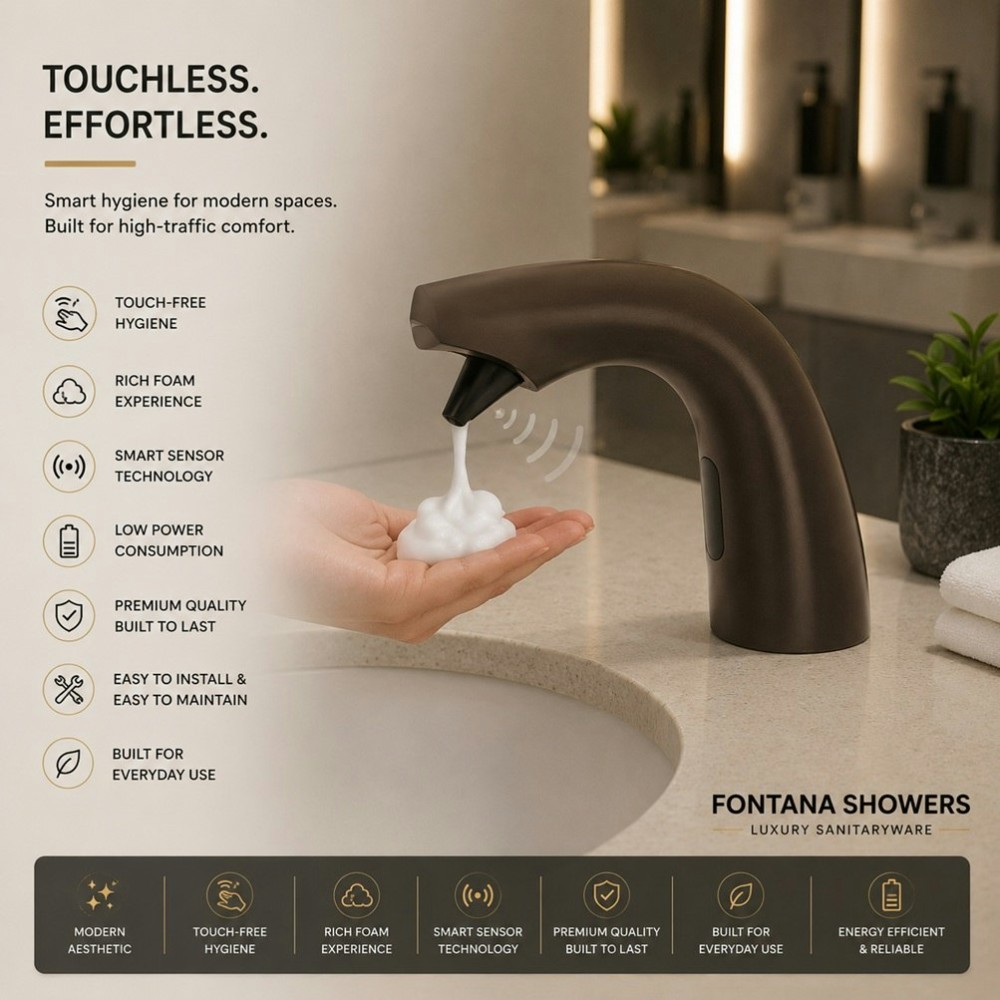
IR Sensors: Proven Touchless Detection for Commercial Dispensers
Traditional infrared sensors activate by detecting reflected IR energy from a user’s hand. IR remains a practical, cost-effective technology for many commercial automatic soap dispensers, particularly where lighting and surrounding surfaces are predictable. However, reflective finishes, changing ambient light, sensor positioning, and nearby objects can influence detection consistency, making correct installation and calibration important.
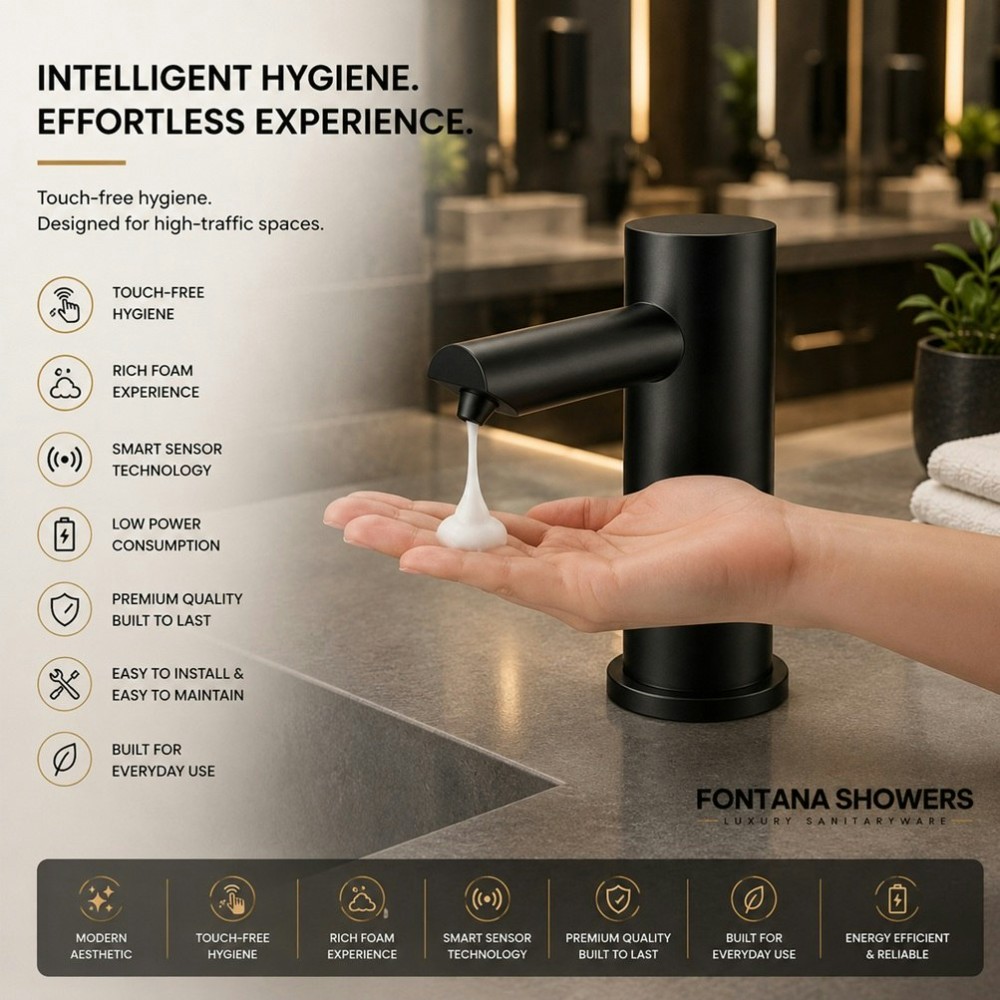
ToF Sensors: Precision Distance Detection for High-Traffic Restrooms
Time-of-Flight sensing measures distance using the travel time of emitted light rather than relying primarily on reflected intensity. This provides a more controlled activation zone and can reduce nuisance triggering around reflective counters or variable lighting. For airports, healthcare facilities, office towers, and other high-traffic restrooms, ToF offers an advanced option where sensing precision and repeatable activation are specification priorities.